Bluetti EB70S Review: Comprehensive Technical Guide
The Bluetti EB70S packs robust LiFePO4 chemistry and solid output into a compact housing. However, it lacks advanced smartphone app integration and fast AC recharging speeds.


This mid-capacity power station offers exceptional value and longevity for outdoor enthusiasts. You will appreciate its dependable 800W inverter despite slower wall charging times.
See our flagship Best Portable Power Station: Top Backup & Off-Grid Picks.
Verified Specifications
| Category / Type | Portable Power Station |
|---|---|
| Rated Output / Capacity | 716Wh LiFePO4 Battery |
| Power / Motor | 800W Pure Sine Wave Inverter |
| Build & Materials | Flame-Retardant ABS and PC Plastics |
| Operating Noise | Approx. 45 dB Under Heavy Load |
| Duty Cycle / Runtime | 2500+ Cycles to 80% Capacity |
| Dimensions & Weight | 12.6 x 8.5 x 8.7 inches, 14.3 lbs |
| Key Safety & Controls | Advanced BMS, Overload & Short Circuit Protection |
What We Liked
- Durable LiFePO4 battery chemistry rated for 2500+ cycles
- Versatile port selection including 100W USB-C PD output
- Compact and ergonomic housing with dual foldable handles
- Stable 800W pure sine wave inverter for sensitive electronics
Trade-Offs
- Slower wall recharging speeds using external power brick
- Complete lack of Bluetooth or Wi-Fi smartphone app control
- Heavier weight profile relative to its total watt-hour capacity
Architectural Build and Ergonomic Housing Design
The Bluetti EB70S utilizes an industrial-grade flame-retardant plastic chassis that withstands rugged outdoor environments. For broader context, our Jackery vs Bluetti technical comparison details casing durability and build quality.
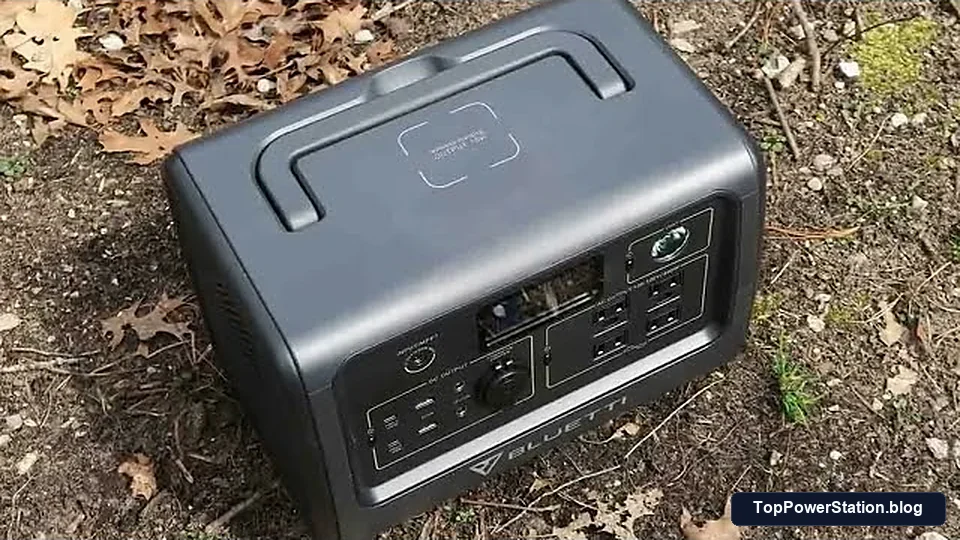
Dual foldable plastic handles flush neatly into the top surface, optimizing vertical storage space inside vehicles. This thoughtful mechanical layout prevents snagging on gear while ensuring comfortable two-handed lifting ergonomics.
Measuring 32 by 21.6 by 22.4 centimeters, the unit balances desktop footprint with mobile utility. Its 9.7 kg mass reflects heavy-duty internal framing designed to absorb moderate drop impacts during transit.
The folding handle mechanism integrates seamlessly into the top chassis shell, preventing snagging inside packed vehicle trunks. High-impact ABS and polycarbonate blends resist UV degradation during prolonged outdoor camping deployments.
- Flame-retardant exterior casing materials
- Flush-folding dual top carrying handles
- Impact-resistant internal frame architecture
Thermal Chassis Management
Integrated ventilation grilles on opposing lateral panels facilitate passive and active airflow. Dual internal cooling fans engage dynamically when internal temperatures rise past predetermined thermal thresholds during heavy inverter loads.
- Dual lateral ventilation cooling vents
- Dynamic fan activation circuitry
Inverter Performance and Real-World Output Metrics
Equipped with an 800-watt pure sine wave inverter, this unit safely powers sensitive electronics without electrical distortion. It handles surge demands up to fourteen hundred watts, accommodating small motorized appliances temporarily.
Multiple AC outlets deliver stable 120-volt alternating current matching standard household utility specifications. Users can simultaneously power up to twelve diverse devices across various DC and USB ports without voltage sagging.
Delivering a pure sine wave output, the internal inverter safely powers sensitive medical devices and modern laptops without harmonic distortion. Total harmonic distortion remains under three percent under standard resistive loads.
The continuous 800W rating handles kitchen appliances like coffee makers, though heavy heating elements require careful power management. Surges peak at 1200W, successfully managing compressor motor startups for small portable fridges.
- Continuous 800W pure sine wave output
- 1400W peak surge capacity protection
- Up to twelve simultaneous device connections
DC and USB Connectivity
The front interface features a 100-watt USB-C Power Delivery port capable of fast-charging modern laptops. Traditional USB-A ports, a regulated twelve-volt cigarette lighter socket, and DC barrel outputs cover legacy gear.
- 100W USB-C Power Delivery port
- Regulated 12V automotive socket output
Video Review: Bluetti EB70S 800W review, test, and overloading it.
Battery Chemistry, Longevity, and Capacity Realities
Inside the housing lies a 716-watt-hour LiFePO4 battery pack known for exceptional thermal stability. This chemistry ensures over twenty-five hundred charge cycles before the total capacity drops to eighty percent.
Energy density remains balanced, resulting in a portable weight that most users can carry comfortably. BMS safety protocols continuously monitor individual cell voltages to prevent overcharging, short-circuiting, and thermal runaway.
Utilizing LiFePO4 battery chemistry, the power station delivers exceptional thermal stability and long-term chemical safety. Reviewing our Jackery vs Bluetti vs EcoFlow face-off shows how these cycle counts compare.
The nominal 716 watt-hour capacity translates to roughly six hundred usable watt-hours accounting for standard conversion losses. This storage envelope comfortably charges standard smartphones roughly fifty to sixty times.
- Advanced lithium iron phosphate cells
- Over twenty-five hundred lifecycle rating
- Comprehensive battery management system
Recharging Efficiency, Solar Input, and Grid Recovery
Standard wall recharging relies on an external power brick delivering approximately two hundred watts. To speed up off-grid recharging, check out our guide on the best solar panels for Bluetti deployments.
Outdoor enthusiasts can utilize the built-in MPPT solar charge controller supporting up to two hundred watts. This photovoltaic input allows off-grid replenishment in about four to five hours under optimal sunlight.
Accepting up to 200W of solar input, the internal MPPT charge controller maximizes photovoltaic collection efficiency during off-grid excursions. Voltage tolerances span from 12V to 28V for broad panel compatibility.
AC wall charging utilizes an external brick adapter pushing roughly 200 watts into the main power pack. Complete grid replenishment takes approximately four hours from a standard residential wall outlet safely.
- External wall adapter power supply
- Built-in MPPT solar charge controller
- Maximum 200W photovoltaic input limit
Acoustic Profiles, Thermal Behavior, and Fan Noise
Under heavy inverter loads exceeding five hundred watts, the internal cooling fans activate to protect circuitry. The resulting acoustic output measures roughly forty-five decibels, remaining unobtrusive during outdoor or garage use.
During idle states or low-draw device charging, the unit remains completely silent because fans stay dormant. This thermal design minimizes unnecessary mechanical wear while maintaining optimal operating temperatures across internal components.
Variable-speed cooling fans activate automatically when internal temperatures exceed 45 degrees Celsius under sustained high loads. Acoustic output remains modest, measuring roughly fifty decibels during maximum cooling operation cycles.
Thermal management channels exhaust air away from user interfaces, preventing localized heat buildup near the display. Heat sinks inside maintain safe semiconductor junctions during heavy inverter utilization phases.
- Acoustic output around forty-five decibels
- Dormant fans during low-draw operation
- Optimized internal thermal dissipation
Usability, Interface Controls, and Everyday Ergonomics
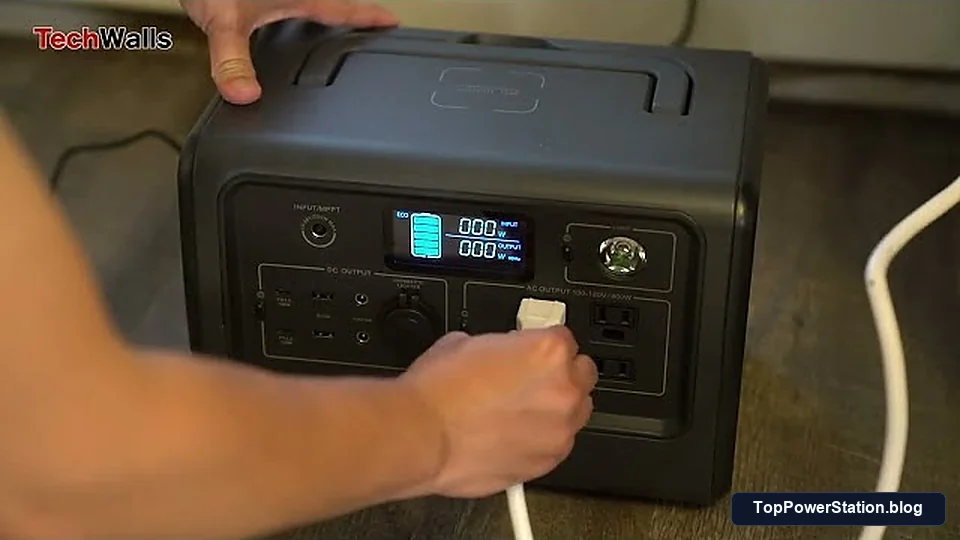
A bright LCD screen displays real-time input wattage, output wattage, and remaining battery percentage accurately. Dedicated rubberized buttons allow users to activate specific output zones independently to minimize parasitic energy drain.
The absence of Bluetooth or Wi-Fi connectivity means users must monitor power metrics directly on the device. While this simplifies operation and eliminates app pairing frustrations, remote monitoring options are entirely absent.
The front panel groups outputs logically by port type, separating alternating current sockets from direct current zones. A clear LCD screen provides real-time wattage tracking for both incoming and outgoing energy streams.
Rubber protective flaps shield unused DC barrel and USB ports from dust ingress during field deployments. Dedicated push buttons feature positive tactile feedback, confirming each activation without requiring excessive finger pressure.
- High-visibility real-time LCD screen
- Independent rubberized zone control buttons
- Direct physical monitoring interface
Comprehensive Buyer Verdict and Final Field Assessment
To see how it stacks up, our EcoFlow River 2 Pro vs Bluetti EB70S comparison highlights key performance differences. This unit remains an exceptionally reliable power station for campers.
Prospective buyers seeking a dependable mid-capacity generator will find immense value in this proven engineering platform. Regular maintenance involves keeping firmware updated and storing the unit at moderate state-of-charge levels.
Balancing physical footprint against robust energy storage, this generator satisfies weekend campers and emergency home preparedness needs. The durable construction and LiFePO4 chemistry guarantee dependable multi-year operating lifespans.
Users seeking reliable mid-capacity power will find exceptional value in its comprehensive port selection and stable output. Regular maintenance requires simple dust removal to ensure optimal cooling airflow.
- Exceptional long-term cell reliability
- Ideal for camping and emergency backup
- Solid balance of price and performance
Frequently Asked Questions
Can the Bluetti EB70S run a standard household refrigerator?
The Bluetti EB70S can successfully power small mini-fridges or specialized energy-efficient camping refrigerators for several continuous hours during unexpected residential grid power outages.
Nevertheless, traditional high-wattage kitchen refrigerators will quickly exceed its continuous 800-watt inverter limit, triggering an immediate protective system shutdown during heavy motor startup surge demands.
How long does it take to fully recharge via standard wall outlets?
Using the included external AC power adapter, recharging the internal 716-watt-hour battery from zero to full capacity typically requires approximately four to four and a half hours.
This charging duration reflects standard adapter limitations rather than ultra-fast grid replenishment technologies found in premium competitors.
Does this power station support smartphone app monitoring?
The unit lacks integrated Bluetooth and Wi-Fi communication modules, meaning all power metrics must be read directly from the physical LCD screen. While this absence prevents remote monitoring, it significantly simplifies everyday operation without any software pairing frustrations.
What type of solar panels can be connected to the charging port?
You can connect portable or rigid solar panels providing up to two hundred watts with an open circuit voltage between twelve and twenty-eight volts. The integrated MPPT solar controller ensures optimal energy harvesting efficiency during off-grid camping excursions.
What is the expected lifespan of the internal battery cells?
The integrated LiFePO4 battery pack is engineered to deliver over twenty-five hundred complete charge cycles while retaining at least eighty percent of its original capacity. This chemistry ensures decades of dependable service life under normal recreational and emergency usage patterns.