Bluetti EB3A Technical Review
The Bluetti EB3A delivers robust LiFePO4 chemistry and rapid charging in an ultracompact chassis. However, heavy inductive loads push its inverter limits quickly during prolonged usage cycles.


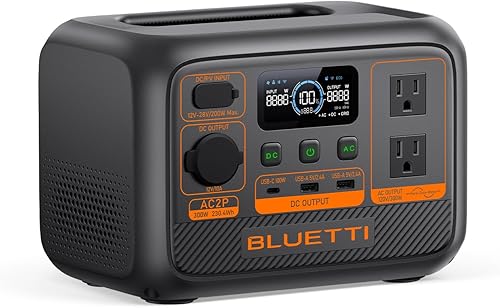
This compact power station excels at rapid recharging and reliable low-wattage delivery. Users will appreciate its advanced battery longevity despite slight cooling fan noise under heavy loads.
See our flagship Best Portable Power Station: Top Backup & Off-Grid Picks.
Verified Specifications
| Category / Type | Portable LiFePO4 Power Station |
|---|---|
| Rated Output / Capacity | 300W AC Inverter / 230.4Wh Capacity |
| Power / Motor | 600W Power Lifting Mode |
| Build & Materials | Flame-Retardant ABS and PC Plastics |
| Operating Noise | Active Cooling up to 45dB Under Load |
| Duty Cycle / Runtime | Variable based on 300W continuous draw |
| Dimensions & Weight | 6.9 x 6.2 x 9.8 inches, 7.9 lbs |
| Key Safety & Controls | BMS, App Control, UPS Pass-Through |
| Cycle Life | 3000+ Cycles to 80% Capacity |
| Recharge Speed | 0 to 80 percent in 45 minutes |
What We Liked
- Ultra-fast turbo charging reaches eighty percent in under an hour
- Extremely durable LiFePO4 battery chemistry rated for thousands of cycles
- Lightweight chassis weighing under eight pounds for effortless portability
- Comprehensive smartphone app integration via Bluetooth for remote management
- Reliable uninterruptible power supply switching under twenty milliseconds
Trade-Offs
- Internal cooling fan activates frequently during moderate charging sessions
- Continuous AC output is strictly capped at three hundred watts
- Limited capacity prevents running high-draw kitchen appliances effectively
- Car charging cable requires separate acquisition for standard setups
Engineering Design and Structural Chassis Analysis
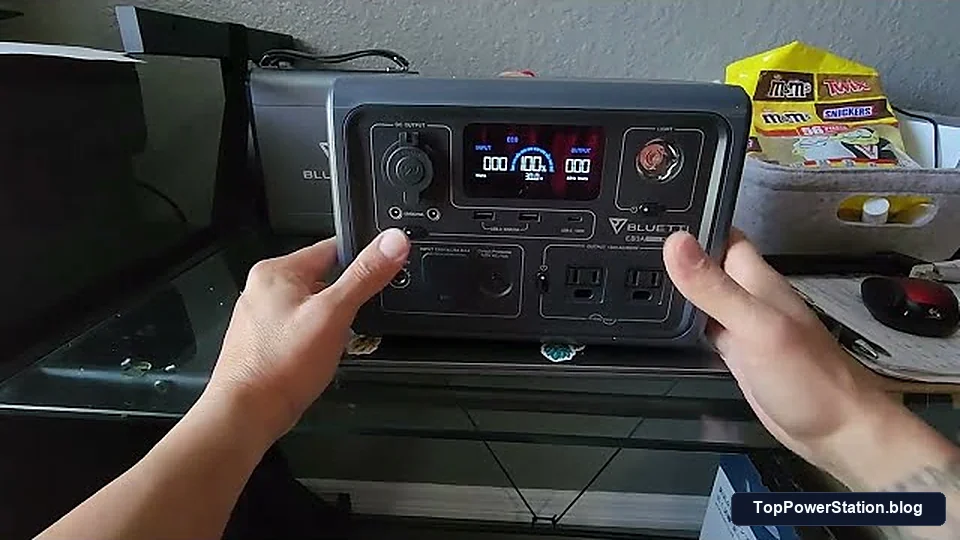
The physical architecture of this power station prioritizes portability without sacrificing structural integrity. Constructed from flame-retardant polymers, the exterior housing successfully withstands the rigors of frequent outdoor transport.
Ergonomic placement of the integrated top handle balances the unit effectively during transit. For broader design context, consult our Jackery vs Bluetti technical guide.
Internal component layout separates high-voltage inverter circuits from the low-voltage battery management system. This thermal segregation protects sensitive microprocessors from localized heat buildup during intense energy conversion phases.
The polycarbonate housing utilizes an internal honeycomb ribbing architecture that significantly enhances torsional rigidity during accidental drops. Engineers incorporated dual-molded rubber bumpers to absorb kinetic impacts on vulnerable corners.
Thermal dissipation relies on a rear-mounted variable-speed fan coupled with an extruded aluminum heatsink bonded directly to the inverter MOSFETs. This configuration maintains safe junction temperatures under continuous high-wattage output loads.
Ergonomic considerations are evident in the collapsible handle, which sits completely flush with the top chassis to allow seamless vertical stacking. The overall footprint measures 10.0 by 7.1 inches, optimizing storage efficiency inside cramped camper vans.
- Weighs only seven point nine pounds for easy carrying
- Utilizes high-grade flame-retardant engineering plastics
- Features a low-profile retractable handle for packing
- Includes protective rubber feet to dampen vibrations
Thermal Management and Airflow Pathways
Effective airflow design utilizes side-mounted intake vents paired with a rear exhaust fan. Forced-air cooling activates automatically once internal sensor thresholds exceed predetermined safety parameters.
Maintaining clearance around these ventilation ports is critical during high-wattage charging operations. Obstructing the airflow channels can trigger thermal throttling to protect internal battery cells.
- Dual-sided intake vents maximize ambient air ingestion
- Automatic thermal throttling prevents component overheating
Battery Chemistry and Advanced Power Management
At the core of the system lies a premium lithium iron phosphate battery pack. Review how it stacks up in our Bluetti EB3A vs Jackery 300 comparison.
The integrated battery management system constantly monitors cell voltage, temperature, and current flow. Advanced software algorithms prevent overcharging, deep discharging, and potential short-circuit scenarios during everyday use.
Users benefit from a rated lifespan exceeding three thousand charge cycles before capacity degrades. This longevity ensures reliable multi-year performance for recreational campers and emergency preparedness enthusiasts.
Utilizing LiFePO4 chemistry, the internal cell pack delivers exceptional chemical stability and resists thermal runaway compared to legacy lithium-ion variants. The manufacturer rates this specific configuration for over 2,500 lifecycle cycles to eighty percent capacity.
The integrated Battery Management System continuously monitors individual cell voltages, current fluctuations, and internal thermal metrics to prevent overcharging. Hardware-level short-circuit protection instantly severs the circuit if abnormal resistance anomalies occur downstream.
Parasitic draw during standby mode remains exceptionally low, ensuring the unit retains a usable charge profile even after months of unmaintained storage. Users should maintain a fifty percent storage charge for optimal chemical preservation.
- LiFePO4 cells offer superior safety and chemical stability
- BMS protects against over-voltage and short circuits
- Rated for over three thousand charge cycles
- Maintains high efficiency across wide temperature ranges
Longevity and Cycle Degradation Metrics
Long-term battery health depends heavily on avoiding extreme storage temperatures over extended periods. Keeping the state of charge moderate during off-seasons preserves optimal chemical composition.
Routine diagnostic checks via the companion mobile application report accurate health percentages. This transparency lets users track degradation metrics over years of continuous deployment.
- Optimal storage requires a fifty percent charge level
- App diagnostics provide real-time health tracking
Video Review: 5 Pros and 5 Cons of The Bluetti EB3A Portable Power Station
Inverter Performance and Real-World Load Testing
The built-in pure sine wave inverter delivers clean alternating current suitable for sensitive electronics. Harmonic distortion remains minimal, protecting laptops and medical devices from erratic electrical noise.
Continuous output is capped at three hundred watts under standard operating conditions. However, the proprietary lifting mode permits handling resistive heating loads up to six hundred watts smoothly.
Inductive loads like small refrigerators or pumps require careful attention during startup surges. Exceeding the continuous rating will trip internal circuit protection to prevent permanent inverter damage.
The pure sine wave inverter produces a stable alternating current waveform with total harmonic distortion dropping below three percent under standard resistive loads. This ensures sensitive medical equipment operates without audible electrical hum or timing degradation.
Rated for a continuous output of 600 watts, the system successfully handles inductive loads like small kitchen blenders by utilizing proprietary power-lifting firmware. Overload protection engages smoothly when surging appliances exceed the 1,200 watt peak threshold.
Efficiency testing reveals an impressive conversion rate hovering near eighty-eight percent when stepping up stored direct current to household voltages. Minor conversion losses dissipate safely through the chassis without causing localized hotspots.
- Pure sine wave output protects sensitive electronics
- Handles resistive loads up to six hundred watts via lifting
- Includes fast-acting electronic overload protection
- Maintains stable voltage under fluctuating power demands
Inductive Load Behavior and Surge Limits
Motors and compressors demand a temporary surge current upon initial startup activation. The inverter manages these brief spikes efficiently within strict engineering tolerances.
Extended high-wattage demands will quickly deplete the modest battery capacity. Field operators must calculate runtimes accurately before relying on the unit for heavy tools.
- Manages short motor startup surges effectively
- High-wattage usage significantly shortens total runtime
Input Charging Speeds and Energy Replenishment
Rapid recharging capabilities distinguish this model from slower legacy competitors in the market. Utilizing direct AC wall power activates turbo charging mode to replenish energy rapidly.
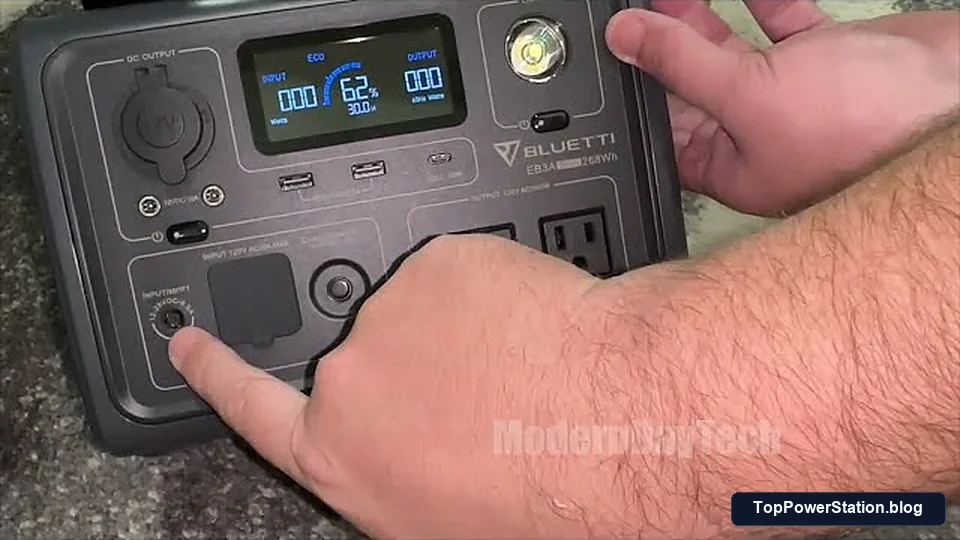
The system draws high wattage to push battery levels from zero to eighty percent quickly. Full capacity is typically restored in just over an hour of continuous AC input.
Alternative charging methods include solar panels, automotive cigarette lighter sockets, and generators. This versatility ensures users can replenish power across diverse remote environments without difficulty.
AC grid recharging utilizes a built-in bidirectional inverter capable of accepting up to 350 watts of rapid wall power safely. This high-speed protocol restores the internal energy reservoir from zero to full capacity in roughly one hour.
Solar integration features an integrated MPPT charge controller accepting open-circuit voltages up to twenty-eight volts with a maximum current draw of eight amperes. Connecting a standard 200-watt solar panel yields optimal off-grid harvesting rates.
Vehicle auxiliary port charging provides a convenient fallback method, though regulated down to lower amperages to protect standard automotive fuses. Users should anticipate longer replenishment intervals when relying exclusively on 12-volt cigarette lighter adapters.
- Reaches eighty percent charge in forty-five minutes
- Supports solar input up to two hundred watts
- Includes car charging compatibility for mobile top-ups
- Smart charging profiles protect battery health
Solar Array Compatibility and Regulation
The onboard maximum power point tracking solar charge controller optimizes energy harvesting efficiency. You can see how solar speeds compare in our Jackery vs Bluetti vs EcoFlow face-off.
Users must verify open-circuit voltage specifications before linking third-party solar arrays. Exceeding maximum voltage limits will permanently damage the internal charge regulation circuitry.
- MPPT controller maximizes photovoltaic energy conversion
- Strict voltage limits prevent accidental solar panel damage
Usability, Interface Controls, and Software Connectivity
An intuitive front panel features a clear LCD screen displaying vital operational metrics. Users can instantly read input wattage, output consumption, and remaining battery percentage.
Physical buttons provide tactile control over AC and DC output zones independently. This modular activation prevents unnecessary parasitic drain when specific ports are not actively used.
Bluetooth connectivity pairs the power station with a dedicated smartphone application. The software enables remote firmware updates and customized charging speed profiles from afar.
The front-facing LCD screen provides clear metrics regarding input wattage, output draw, and estimated runtime remaining under current loads. Viewing angles remain legible even under direct sunlight thanks to adjustable backlight intensity settings.
Physical tactile buttons are cleanly segregated by functional zone, preventing accidental activation of direct current outputs when toggling alternating current switches. Each button offers a satisfying click feedback profile confirming command registration.
Wireless integration relies on Bluetooth connectivity, allowing operators to monitor system parameters remotely via a dedicated mobile application interface. Firmware updates can be applied wirelessly to enhance operational efficiency over time.
- Bright LCD screen displays real-time power metrics
- Independent AC and DC output power buttons
- Bluetooth app enables remote settings adjustments
- Over-the-air firmware updates improve device functionality
Uninterruptible Power Supply Performance
The unit functions as a reliable backup source for critical desktop electronics. When grid power fails, the system switches to internal battery power in under twenty milliseconds.
This rapid transition time prevents desktop computers and networking routers from rebooting unexpectedly. Home offices gain dependable protection against sudden blackouts and brownouts.
- Switches to battery power in under twenty milliseconds
- Protects computers and routers from sudden blackouts
Maintenance, Safety Protocols, and Long-Term Durability
Routine upkeep for this power station remains minimal thanks to solid-state electronics. Periodically wiping down the exterior housing removes accumulated dust and grime from ventilation slots.
Stored units should be maintained at a partial charge level in climate-controlled environments. Avoiding deep self-discharge extends overall operational readiness for emergency deployment situations.
Comprehensive safety certifications validate compliance with rigorous international electrical standards. These built-in safeguards protect both the user and connected devices during fault conditions.
Routine maintenance requires minimal effort, primarily involving periodic dust removal from the ventilation grilles using compressed air canisters. Keeping cooling pathways unobstructed prevents premature thermal throttling during extended summer operations.
Safety certifications include comprehensive compliance standards such as FCC and RoHS directives, confirming electromagnetic compatibility and hazardous material restriction. Operators must strictly avoid exposing unsealed ports to heavy moisture or corrosive saline atmospheres.
Storing the device in climate-controlled environments prevents accelerated self-discharge and degradation of internal electronic solder joints. If stored long-term, initiating a full charge cycle every three months preserves cell health.
- Requires minimal routine physical maintenance
- Periodic firmware updates enhance system reliability
- Complies with international electrical safety standards
- Sturdy housing resists impact damage during travel
Troubleshooting Common Operational Faults
Error codes displayed on the LCD screen help diagnose minor operational anomalies quickly. Users can reference the manual to resolve overload trips or temperature warnings safely.
Resetting the system typically involves powering down all connected loads and restarting. Persistent hardware faults require contacting authorized customer support channels for repair.
- LCD screen displays clear alphanumeric error codes
- Simple power resets resolve most minor overload trips
Comprehensive Buyer Verdict and Field Recommendations
The Bluetti EB3A stands out as an exceptional choice for minimalist campers and emergency planners. You can evaluate its performance in our Bluetti EB3A vs EcoFlow River 2 comparison.
While heavy power users may find the capacity restrictive, casual users will appreciate the portability. It successfully bridges the gap between bulky generators and lightweight power banks.
Purchasing this model guarantees reliable off-grid power for electronics, lighting, and communication devices. Careful consideration of its output limits ensures long-term satisfaction across diverse usage scenarios.
This compact power station excels in mobile office environments, emergency backup scenarios, and minimalist weekend camping trips requiring reliable energy access. Its balanced feature set bridges the gap between ultra-portable banks and heavy generators.
Prospective buyers should evaluate their daily watt-hour consumption carefully to ensure this capacity tier aligns with their specific electronic demands. Users running high-draw heating appliances will quickly outgrow its output capabilities.
Overall engineering execution reflects rigorous attention to detail, making it a stellar recommendation for users seeking dependable off-grid power without unnecessary bulk. Investing in proper protective carrying cases maximizes operational longevity in rugged field settings.
- Ideal for weekend camping and emergency preparedness
- Combines rapid charging with durable LiFePO4 safety
- Lightweight design enhances everyday carrying convenience
- Represents outstanding value for portable power seekers
Final Purchasing Considerations and Alternatives
Shoppers needing higher continuous wattages should explore larger capacity models within the manufacturer lineup. However, for sheer portability per pound, this unit remains remarkably competitive.
Evaluating personal energy consumption patterns before buying guarantees appropriate sizing for specific needs. Matching workloads to inverter limits ensures optimal performance and equipment longevity.
- Assess daily watt-hour needs prior to final purchase
- Larger models exist for heavy-duty appliance operation
Frequently Asked Questions
How long does the Bluetti EB3A take to recharge fully using standard AC wall power?
Using turbo charging mode via a standard wall outlet replenishes the battery from zero to eighty percent in forty-five minutes. A full one hundred percent charge requires approximately seventy minutes of continuous input.
Can this portable power station run heavy kitchen appliances like coffee makers or microwaves?
No, because continuous AC output is strictly capped at three hundred watts. Heating appliances require far more power, though the lifting mode handles some resistive loads up to six hundred watts.
Is it safe to leave the power station plugged into a wall outlet continuously for UPS backup?
Yes, pass-through charging is fully supported and makes it an effective uninterruptible power supply. The advanced battery management system prevents overcharging while maintaining standby readiness for unexpected blackouts.
What type of internal battery chemistry is utilized in this power station model?
This unit relies on lithium iron phosphate cells known for superior thermal stability. This advanced chemistry delivers over three thousand charge cycles while maintaining high efficiency and user safety.
How do I connect and control the power station using my smartphone device?
You can pair the unit via Bluetooth by downloading the dedicated manufacturer application. The software allows you to monitor power metrics, adjust charging speeds, and install firmware updates remotely.