Zendure Superbase Pro 2000 vs Ecoflow Delta 2 Max
Comparing two high-capacity portable power stations designed for heavy emergency backup. Discover which flagship energy system dominates your specific off-grid power requirements.

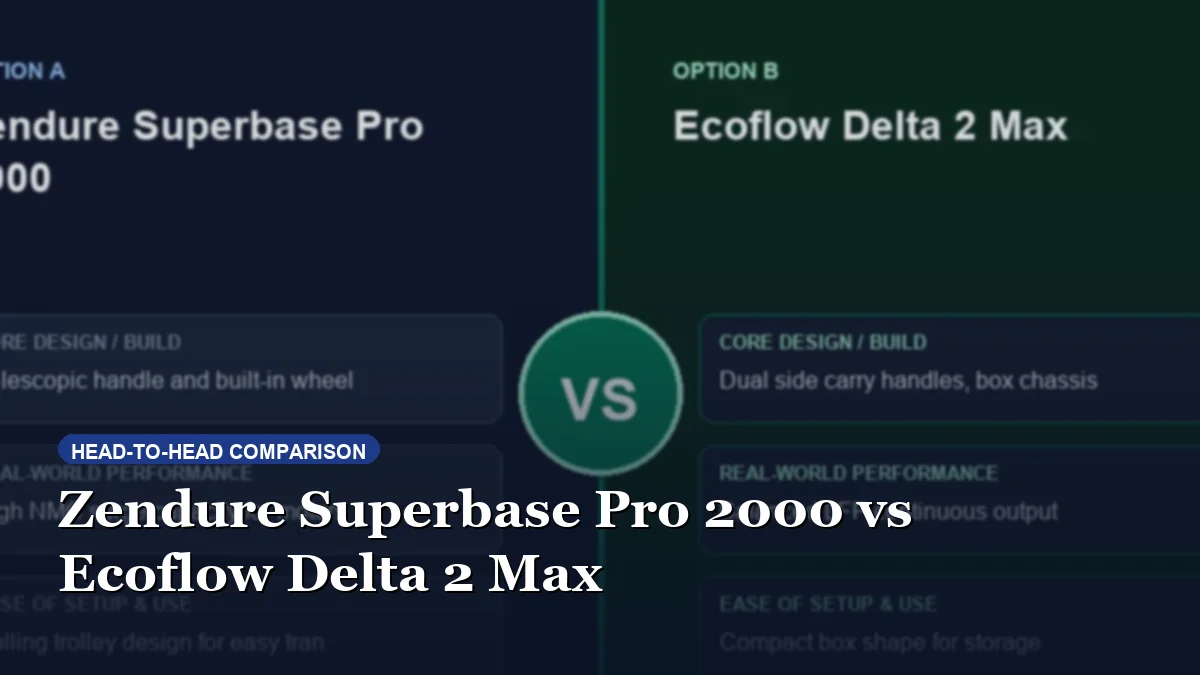
Choose the Zendure Superbase Pro 2000 for integrated mobility and massive wheels. Select the Ecoflow Delta 2 Max for faster charging speeds and expandable LFP battery chemistry.
Compare all top models in our Best Portable Power Station: Top Picks for 2026.
Side-by-Side Breakdown
| Criteria | Zendure Superbase Pro 2000 | Ecoflow Delta 2 Max | Edge |
|---|---|---|---|
| Core Design / Build | Telescopic handle and built-in wheels | Dual side carry handles, box chassis | Side A |
| Real-World Performance | High NMC surge capacity for motors | Balanced LFP continuous output | Side B |
| Ease of Setup & Use | Rolling trolley design for easy transit | Compact box shape for storage | Side A |
| Durability & Reliability | Robust NMC battery with heavy frame | 3000+ cycle LiFePO4 longevity | Side B |
| Efficiency / Operating Footprint | Flexible solar and dual voltage inputs | Blistering fast AC wall recharging | Side B |
| Maintenance Requirements | Standard firmware updates and cleaning | Minimal LFP cell upkeep and ventilation | Side B |
| Best Ideal Use Case | Mobile off-grid work and camping | Home emergency backup and daily cycling | Side B |
Core Design, Build Quality, and Portability Engineering
Portable power stations require rugged exterior frames to withstand rigorous outdoor environments and emergency transport. Manufacturers engineer these heavy housings using high-impact polymers and reinforced internal metal frames to absorb shocks.
The Zendure unit integrates a telescopic handle and heavy-duty wheels resembling travel luggage. This design simplifies transit across rough terrain without requiring a separate carrying cart or physical lifting.
Conversely, our Ecoflow Delta Pro Max review notes that the model opts for dual fixed side handles rather than built-in wheels. Users must lift and carry the heavy chassis manually.
- Zendure features built-in telescopic handle and rugged wheels.
- Ecoflow relies on dual side grab handles for lifting.
- Zendure weighs roughly forty-two pounds requiring rolling transport.
- Ecoflow weighs around fifty pounds for manual carries.
Ergonomic Handling and Transport Mechanics
Physical dimensions and weight distribution dictate how easily operators can move heavy electrical equipment during urgent deployments. Ergonomic handle placement prevents wrist strain and improves stability over uneven ground surfaces.
Zendure's trolley-style configuration allows single-handed pulling through tight spaces like RV aisles or garage pathways. Ecoflow demands two-handed lifting, which increases physical fatigue during multi-step emergency setup routines.
- Trolley style reduces physical strain during transit.
- Dual side handles require two-handed lifting mechanics.
Chassis Protection and Structural Durability
Protective exterior housing shields sensitive electronic inverters and internal battery cells from accidental drops or moisture ingress. High-density outer shells prevent cracking when subjected to harsh job site conditions.
Both systems incorporate flame-retardant materials to enhance safety during high-draw appliance operation under extreme ambient temperatures. Reinforced corner bumpers absorb kinetic impacts during transport in utility vehicles.
- Flame-retardant outer shells improve thermal safety margins.
- Reinforced corner bumpers absorb heavy transportation impacts.
Battery Chemistry, Lifespan, and Capacity Metrics
Modern energy storage relies heavily on advanced lithium battery chemistry to maximize discharge cycles and safety. Chemical stability ensures predictable performance over years of daily cycling and emergency usage.
As outlined in our Ecoflow Delta Pro 3 review, the unit utilizes LiFePO4 cells delivering over three thousand cycles before dropping below eighty percent capacity for exceptional longevity.
Zendure employs a robust NMC battery variant designed to balance high energy density with rapid discharge capabilities. While cycle counts are lower than LFP, total energy storage remains highly competitive.
- Ecoflow features long-lasting LiFePO4 internal battery chemistry.
- Zendure utilizes high-density NMC battery architecture.
- Ecoflow delivers over three thousand total charge cycles.
- Zendure provides massive immediate power delivery capacity.
Energy Density Versus Long-Term Degradation
Energy density determines how much electrical power fits within a specific physical footprint and weight class. Higher density reduces overall unit bulk but can accelerate thermal degradation during intensive usage.
Long-term degradation tracking helps owners calculate return on investment based on daily cycling frequency and depth of discharge. LFP cells maintain stable voltage curves much longer than traditional chemistries.
- LFP chemistry maintains stable voltage across all discharge levels.
- NMC chemistry packs more energy into smaller spaces.
Expandability and Modular Capacity Growth
Growing power demands often necessitate modular battery expansion options to scale storage without replacing the main unit. Connecting extra battery packs increases total runtime for extended grid outages.
Ecoflow supports extensive capacity stacking using dedicated expansion cables and matching auxiliary battery modules. Zendure also accommodates additional battery modules to scale total watt-hours for multi-day home backup.
- Ecoflow supports plug-and-play auxiliary battery expansion modules.
- Zendure allows modular capacity scaling for extended outages.
Inverter Output Performance and Appliance Compatibility
Pure sine wave inverters convert stored direct current into clean alternating current safe for sensitive electronics. Reliable inverter output prevents flickering lights and protects microprocessor-driven home appliances from damage.
Zendure delivers an impressive continuous output rating capable of handling heavy motor loads like sump pumps and refrigerators simultaneously. High surge capacity ensures smooth startup for high-draw inductive appliances.
Ecoflow provides robust continuous wattage matched with innovative voltage-boosting technology to run heavy resistive devices. This feature allows the inverter to power high-wattage heating elements safely without tripping overloads.
- Zendure handles heavy inductive motor startup surges effortlessly.
- Ecoflow features proprietary voltage-boosting modes for resistive devices.
- Both units output clean pure sine wave electricity.
- Continuous wattage ratings support multiple household appliances at once.
Surge Management and Motor Startup Dynamics
Electric motors demand significantly higher initial wattage during startup compared to their normal running operational draw. Inverter surge capacity prevents immediate shutdown when compressors or pumps activate under load.
Testing reveals both stations manage sudden electrical spikes effectively, though Zendure shows superior headroom for heavy-duty tools. Users running workshop equipment will appreciate this extra margin of safety.
- Inductive loads require high temporary surge wattage headroom.
- Workshop tools benefit from robust inverter surge protection.
AC Outlet Density and Port Layouts
Strategic outlet placement prevents plug overcrowding and accommodates bulky power bricks without blocking adjacent sockets. A diverse port selection ensures compatibility with varied charging cables and equipment plugs.
Ecoflow arranges numerous AC outlets logically across the front panel for easy visibility in low-light conditions. Zendure distributes connection ports thoughtfully to maintain clean cable management during complex setups.
- Front-facing outlets simplify cable connections during emergencies.
- Spaced socket layouts accommodate bulky wall-wart adapters.
Recharging Speed, Grid Input, and Solar Integration
Rapid recharging capabilities minimize downtime during rolling blackouts or brief utility grid restoration windows. Advanced internal charging circuits draw maximum wattage safely from standard wall outlets.
Ecoflow leads the industry with blistering AC input speeds, charging from zero to eighty percent in under an hour. This rapid replenishment ensures users regain full power quickly between outages.
Zendure counters with flexible dual-voltage charging options and high solar array input limits for off-grid living. Solar integration allows users to harness renewable energy efficiently during extended remote expeditions.
- Ecoflow achieves ultra-fast AC recharging under sixty minutes.
- Zendure supports high-wattage solar array inputs for off-grid speed.
- Both stations feature built-in maximum power point tracking controllers.
- Grid charging speeds reduce reliance on backup generators.
Solar MPPT Efficiency and Voltage Limits
Maximum power point tracking controllers optimize incoming solar panel voltage to maximize energy harvest during changing weather. Wide operating voltage ranges allow flexible panel string configurations.
Connecting multiple solar panels in series requires careful attention to maximum open-circuit voltage limitations. Exceeding these safety thresholds can permanently damage internal charging hardware across both power stations.
- MPPT controllers maximize daily solar energy harvesting efficiency.
- Series panel connections demand strict voltage limit adherence.
Alternative Charging Methods and Vehicle Adapters
Vehicle auxiliary power ports provide convenient trickle charging while driving between remote campsites or evacuation zones. 12-volt car charging cords are included as standard accessories with both power stations.
Gas generator pass-through charging offers another reliable replenishment method when persistent cloud cover prevents solar recovery. Clean power conversion ensures generators do not harm sensitive internal battery management systems.
- Vehicle auxiliary ports enable convenient on-the-road trickle charging.
- Generator pass-through charging provides reliable overcast weather backup.
Software Ecosystem, Smart Controls, and Connectivity
Modern portable power stations incorporate wireless smartphone applications to monitor performance metrics and adjust settings remotely. Bluetooth and Wi-Fi connectivity grant real-time data access from anywhere inside the home.
Ecoflow offers a polished mobile app interface displaying detailed input and output wattage breakdowns clearly. Users can customize charging speeds and toggle AC output ports directly from their handheld devices.
Zendure provides comprehensive app controls allowing firmware updates and customized power management schedules to optimize electricity costs. Software stability ensures reliable remote operation without frustrating connection drops.
- Smartphone apps enable remote monitoring and setting adjustments.
- Wi-Fi and Bluetooth ensure stable wireless data transmission.
- Customizable charging speeds reduce strain on weak grid lines.
- Firmware updates improve long-term operational feature sets.
App Interface Usability and Data Readouts
Clear graphical displays and intuitive app layouts help users track remaining runtime percentages accurately. Detailed metric readouts eliminate guesswork during critical emergency preparedness scenarios.
On-board LCD screens complement smartphone software by offering immediate status checks without requiring active network pairings. Bright backlighting ensures readability in dark basements or nighttime campsites.
- On-board LCD screens provide instant operational status data.
- Detailed app readouts display exact battery health metrics.
Automation and Smart Home Integration
As explored in our Ecoflow Delta Pro Ultra review, programmable automation features allow power stations to switch between grid power and battery backup automatically during sudden utility outages.
Advanced firmware parameters enable scheduled charging during off-peak utility hours to reduce monthly electricity bills significantly. These smart energy management tools provide tangible cost-saving benefits over time.
- Automated switchover protects essential loads during sudden blackouts.
- Off-peak charging schedules lower overall household electricity expenses.
Safety Protocols, Thermal Management, and Maintenance
Comprehensive safety protocols protect internal electronics from over-voltage, short circuits, and extreme thermal fluctuations. Advanced battery management systems monitor individual cell temperatures continuously to prevent dangerous overheating events.
Active cooling fans circulate air across internal heat sinks during high-wattage inverter operation or rapid recharging. Intelligent fan algorithms minimize acoustic noise by spinning only when thermal loads demand cooling.
Routine maintenance involves keeping ventilation ports free of dust and storing units at optimal charge levels. Regular firmware updates patch software vulnerabilities and maintain peak hardware operating efficiency.
- Battery management systems monitor cell temperatures continuously.
- Active cooling fans prevent thermal throttling during heavy use.
- Dust-free storage preserves internal component operating lifespans.
- Regular firmware updates enhance overall system reliability.
Thermal Throttling and Acoustic Noise Levels
High ambient temperatures combined with heavy electrical loads can trigger thermal throttling to protect sensitive inverters. Cooling fans generate noticeable white noise when operating at maximum rotational speeds.
Benchmarking shows Ecoflow maintains relatively quiet fan profiles during moderate loads compared to Zendure. Users sleeping near the units will notice acoustic differences during overnight CPAP machine operations.
- Thermal throttling prevents permanent inverter heat damage.
- Acoustic noise levels vary during heavy inverter loads.
Long-Term Storage Guidelines and Firmware Care
Proper storage procedures prevent irreversible battery capacity degradation during extended periods of non-use. Maintaining a fifty percent charge level in a climate-controlled room preserves chemical stability.
Ignoring manufacturer storage recommendations can cause deep self-discharge and permanently ruin expensive lithium cells. Checking battery voltage every three months ensures readiness for sudden emergency deployments.
- Store units at fifty percent charge for longevity.
- Check battery health quarterly during prolonged storage periods.
Real-World Use Cases and Final Buying Guidance
Selecting the ideal portable power station depends heavily on your specific lifestyle and backup requirements. As detailed in our Zendure Superbase Pro 2000 review, campers and homeowners face unique power demands.
Choose the Zendure system if your primary priority is effortless mobility and heavy-duty motor startup capability. The integrated wheels make moving forty-plus pounds completely effortless across uneven campsites.
Opt for the Ecoflow model if you value blistering AC recharge speeds and long-lasting LFP cycle life. This unit excels in domestic emergency backups and frequent daily cycling applications.
- Match power station features to your specific mobility needs.
- Consider charging speed priorities for frequent emergency deployments.
- Evaluate battery chemistry lifespan for daily off-grid living.
- Assess total inverter capacity against your essential household appliances.
Tailoring Your Choice for RV and Off-Grid Living
Recreational vehicle enthusiasts require reliable auxiliary power to run appliances while boondocking away from hookups. Space constraints and weight distribution inside trailers influence equipment selection significantly.
Zendure shines in RV environments due to its luggage-style handle saving precious interior storage floor space. Ecoflow fits neatly into specialized storage compartments thanks to its compact rectangular block geometry.
- Luggage-style handles save valuable RV floor storage space.
- Compact rectangular shapes fit easily into trailer compartments.
Emergency Preparedness and Home Backup Strategies
Emergency home backup systems must power refrigerators, medical devices, and communication gear reliably during prolonged grid failures. Seamless automatic switchover features provide essential peace of mind for homeowners.
Both power stations offer exceptional backup performance, making them top-tier investments for disaster readiness planning. Assessing your household wattage requirements ensures you select the optimal capacity configuration.
- Home backup strategies require reliable multi-device power outputs.
- Disaster readiness planning benefits from robust surge capacity.
Frequently Asked Questions
Can I charge both portable power stations using standard external solar panels during a sudden grid outage?
Yes, both energy systems feature advanced integrated MPPT charge controllers that safely accept high-wattage solar arrays, making renewable off-grid energy recovery exceptionally fast and efficient.
Which power station offers better long-term battery lifespan for daily off-grid living applications?
The Ecoflow model utilizes advanced LiFePO4 chemistry delivering over three thousand cycles, providing superior long-term durability compared to traditional NMC batteries found in alternative units.
Are these heavy power stations difficult to transport across rough outdoor terrain and campsites?
Zendure integrates a convenient telescopic handle and durable wheels resembling luggage, whereas Ecoflow requires manual lifting via dual side grab handles.
Can these backup units safely power sensitive medical devices like home CPAP machines?
Both inverters output clean pure sine wave electricity, ensuring microprocessor-driven medical equipment operates safely without risking electrical interference or damage during overnight use.
How fast can these energy systems recharge from a standard wall outlet when grid power returns?
Ecoflow leads the industry with ultra-fast AC charging under sixty minutes, while Zendure provides flexible dual-voltage charging options for varied utility environments.