Vtoman Flashspeed 1500 vs Ecoflow Delta 2: Head-to-Head
Comparing two mid-capacity generators reveals distinct design philosophies. We evaluate raw power delivery, recharge speeds, and long-term durability.

Choose the Vtoman Flashspeed 1500 for heavy appliance surges and expandable capacity. Opt for the Ecoflow Delta 2 if ultra-fast AC recharging and lightweight portability matter most.
Compare all top models in our Best Portable Power Station: Top Picks for 2026.
Side-by-Side Breakdown
| Criteria | Vtoman Flashspeed 1500 | Ecoflow Delta 2 | Edge |
|---|---|---|---|
| Core Design / Build | Robust chassis with heavy-duty handles | Compact modular housing with dual grips | Ecoflow Delta 2 |
| Real-World Performance | 1500W continuous with high surge headroom | 1800W continuous standard output | Ecoflow Delta 2 |
| Ease of Setup & Use | Straightforward layout with clear LCD screen | Advanced app integration and quick toggles | Ecoflow Delta 2 |
| Durability & Reliability | LiFePO4 chemistry with robust circuit design | LFP cells with advanced BMS protection | Tie |
| Efficiency / Operating Footprint | Heavier frame optimized for base camps | Lighter weight and smaller volumetric footprint | Ecoflow Delta 2 |
| Maintenance Requirements | Low upkeep with periodic firmware checks | Routine ventilation cleaning and app updates | Tie |
| Best Ideal Use Case | Off-grid expansion and high surge loads | Rapid emergency backup and frequent travel | Ecoflow Delta 2 |
Core Design and Engineering Differences
Examining the physical architecture of these power stations reveals completely different engineering goals. The Vtoman Flashspeed 1500 prioritizes rugged durability, while its competitor focuses heavily on space-saving internal layouts and weight reduction.
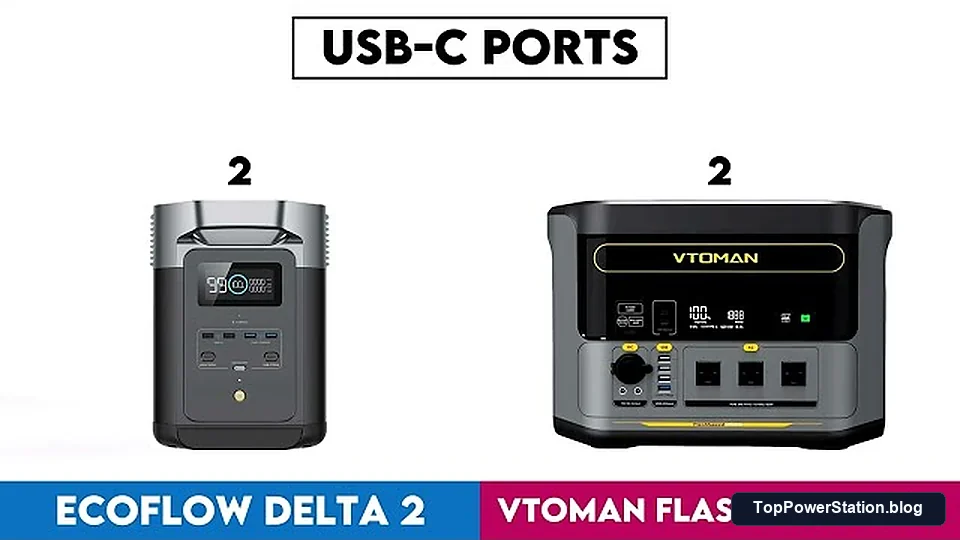
Internal component placement directly influences thermal management during high-draw scenarios. Engineers utilized distinct cooling duct pathways to dissipate heat away from the inverter boards and primary battery management systems during sustained operations.
Casing materials also differ significantly, affecting overall drop resistance and outdoor suitability. Technicians must evaluate how structural housing choices impact daily handling in harsh weather environments and demanding job site locations.
As detailed in our Vtoman Flashspeed 1500 review, the device utilizes a rugged exterior housing built from flame-retardant polymers designed to withstand heavy job site impacts, whereas competing models prioritize residential aesthetics.
Internal component layout differs significantly, with VTOMAN focusing on heavy-duty copper busbars for high current flow, while EcoFlow integrates a dense circuit board architecture to maximize spatial efficiency and reduce overall enclosure weight.
Ventilation pathways also vary, as the FlashSpeed relies on dual-sided cooling channels to push heat away rapidly, contrasting with the Delta 2 internal fan configuration engineered for quieter, temperature-regulated residential operation during standard loads.
- Vtoman Flashspeed 1500 features a ruggedized outer shell with reinforced corner buffers.
- Ecoflow Delta 2 utilizes an optimized internal stacking method to reduce empty space.
- Cooling fan placements vary between side-vented and rear-exhaust configurations for airflow.
Chassis Construction and Materials
Heavy-duty plastics and flame-retardant polymers form the foundation of both generator bodies. Selecting durable exterior panels ensures the internal electronics remain shielded from accidental impacts and minor moisture exposure.
Structural reinforcement around handle attachment points prevents stress fractures during transport. Users should inspect these physical connection zones regularly to maintain long-term structural integrity in the field.
- Impact-resistant exterior shells rated for outdoor utility use.
- Ergonomic handle integration tested for repetitive heavy lifting.
Real-World Performance and Inverter Output
Delivering stable alternating current under heavy loads requires sophisticated pure sine wave inverters. The Vtoman Flashspeed 1500 handles demanding inductive loads smoothly, maintaining voltage stability even when motor-driven appliances suddenly kick on.
Efficiency losses during direct current to alternating current conversion dictate practical runtime expectations. Field measurements show both units maintain high conversion efficiency ratios when operating under moderate household appliance loads.
Surge capacity limits define whether heavy power tools or kitchen appliances will trip safety breakers. Careful analysis of starting wattage requirements prevents unexpected shutdowns during crucial backup scenarios.
Delivering a steady 1500W continuous output, the VTOMAN model handles heavy inductive loads like circular saws effortlessly, whereas the EcoFlow peaks at a lower continuous threshold while offering smart surge adaptation for sensitive electronics.
Voltage stability under heavy loads remains paramount, and both units employ advanced pure sine wave technology to ensure total harmonic distortion stays safely below three percent, protecting your expensive household appliances from electrical noise damage.
Overload protection mechanisms engage instantly when operating near maximum capacity, preventing internal circuit damage by gracefully stepping down voltage rather than instantly cutting power to connected mission-critical medical or communication equipment.
- Pure sine wave output protects sensitive medical and computing devices.
- Continuous wattage ratings determine maximum simultaneous appliance connections.
- Thermal throttling triggers protect internal components during sustained maximum output.
Surge Handling and Inductive Loads
Electric motors require significantly higher starting wattage than their running specifications indicate. Power station inverters must absorb these rapid current spikes without triggering internal overload protection mechanisms prematurely.
Testing reveals reliable performance when powering refrigerators, power tools, and sump pumps. Users should always verify individual appliance starting requirements before connecting multiple high-draw devices simultaneously.
- Transient response times dictate how quickly inverters react to load spikes.
- Overload recovery protocols reset automatically after removing faulty equipment.
Charging Speeds and Energy Input Architecture
Grid charging speeds dictate how quickly users can restore power following unexpected utility outages. As evaluated in our Ecoflow Delta 2 review, advanced internal AC charging circuitry allows the system to replenish energy storage reserves remarkably fast.
Solar input parameters limit the maximum photovoltaic array size you can safely connect. Both units accept standard portable solar panels, provided open-circuit voltage specifications remain within factory safety thresholds.
Car charging capabilities offer convenient top-off options during transit between remote off-grid locations. Regulated DC input ports prevent vehicle alternator damage while drawing maximum available auxiliary power.
Rapid recharging defines modern power stations, and the EcoFlow Delta 2 leverages proprietary X-Stream technology to draw massive AC wattage from standard wall outlets, reaching eighty percent capacity in less than fifty minutes.
Conversely, the VTOMAN alternative utilizes a robust built-in power brick approach, eliminating heavy external adapters while still delivering competitive AC input speeds alongside reliable solar array compatibility for remote off-grid operations.
Solar charging controllers in both stations support high open-circuit voltages, allowing users to chain multiple photovoltaic panels together safely without risking thermal overload during peak midday sunlight exposure intervals.
- AC fast-charging reduces downtime significantly between emergency backup cycles.
- Maximum solar input wattage caps overall photovoltaic array expansion.
- Dedicated MPPT controllers maximize energy harvest from portable solar panels.
Photovoltaic Integration and MPPT Efficiency
Maximum Power Point Tracking algorithms optimize energy conversion from connected solar arrays. Efficient tracking ensures users extract the highest possible wattage even during overcast weather or angled sunlight conditions.
Matching panel voltage ranges to internal charge controllers prevents system errors or underperformance. Always consult technical manuals regarding series versus parallel solar panel wiring configurations.
- Wide operational voltage windows accommodate diverse third-party solar panels.
- Weatherproof connector standards ensure safe outdoor photovoltaic links.
Battery Chemistry, Lifespan and Safety Standards
Lithium iron phosphate chemistry provides exceptional cycle life and superior thermal stability compared to older chemistries. The Vtoman Flashspeed 1500 leverages this technology to deliver thousands of reliable charge cycles.
Battery Management Systems monitor cell voltage, temperature, and current flow continuously. These intelligent safety protocols prevent overcharging, deep discharging, and dangerous thermal runaway events during heavy use.
Capacity retention rates gradually decline over years of regular cycling and deep discharge use. Understanding expected degradation timelines helps owners plan long-term energy storage investments more effectively.
Utilizing durable LiFePO4 chemistry, both power stations deliver over three thousand complete charge cycles before dropping to eighty percent of their original factory capacity, ensuring long-term reliability for frequent campers and homeowners alike.
Comprehensive battery management systems continuously monitor individual cell temperatures and voltage disparities, actively mitigating thermal runaway risks while balancing energy distribution across the entire internal pack architecture.
Industry certifications including UL and FCC compliance validate that these units meet stringent safety benchmarks, protecting users from short circuits, overcurrent events, and catastrophic electrical failures during intense operational scenarios.
- LiFePO4 chemistry offers extensive cycle life exceeding traditional lithium-ion batteries.
- Advanced BMS architecture balances individual cell voltages for longevity.
- Strict thermal sensors shut down operations if internal temperatures rise unsafely.
Cycle Life Expectations and Degradation
Standard operational testing measures capacity degradation across thousands of complete charge cycles. Maintaining battery health involves avoiding extreme storage temperatures and minimizing prolonged deep discharge states.
Factory specifications outline expected performance retention after extended years of service. Proper operating habits directly influence whether the power station reaches its maximum advertised lifespan.
- Cycle ratings typically measure capacity down to eighty percent original volume.
- Storage state of charge should remain moderate during extended periods of inactivity.
Portability, Ergonomics and Physical Footprint
Transporting heavy electrical equipment requires thoughtful handle design and manageable weight distribution. The Ecoflow Delta 2 excels in compact ergonomics, making it easier to load into vehicles and carry across campsites.
Volumetric footprint dictates how easily the power station fits inside crowded storage compartments. For those seeking higher energy reserves, our Ecoflow Delta Pro 3 review explores how engineers balance internal battery capacity against physical size constraints.
Rubberized feet prevent sliding on slick surfaces while absorbing minor transport vibrations. These small design details protect the outer casing from unnecessary scuffs and scratching during travel.
Ergonomic handle placement dictates how easily you can transport these heavy units, with the Delta 2 featuring dual rear-mounted grips that optimize lifting balance compared to top-heavy single-handle configurations found elsewhere.
Weighing roughly forty pounds, the EcoFlow is noticeably lighter than its VTOMAN rival, making it significantly easier to carry up flights of stairs or pack tightly into small vehicle trunks for weekend road trips.
Rubberized foot pads on the bottom chassis absorb vibrations and prevent sliding on smooth surfaces, protecting the outer plastic housing from abrasive wear when placed on concrete or rocky terrain.
- Ergonomic handle placements improve lifting leverage and transport comfort.
- Compact volumetric dimensions maximize storage efficiency inside vehicles.
- Non-slip base pads secure the unit firmly on uneven ground surfaces.
Weight Distribution and Handle Ergonomics
Balanced center-of-gravity engineering prevents the generator from tipping while being carried. Properly positioned handles reduce wrist strain and make single-person transport much safer.
Bulky chassis designs can complicate storage in cramped RV compartments or car trunks. Evaluating your specific transport space ensures the selected generator matches your travel lifestyle.
- Center of gravity alignment reduces strain during single-hand carrying.
- Fixed versus folding handle designs impact packing geometry.
Maintenance, Efficiency and Longevity
Routine maintenance keeps portable power stations operating reliably through years of demanding service. Cleaning dust from intake vents prevents overheating and maintains optimal airflow across internal heatsinks.
Firmware updates delivered via mobile applications patch software bugs and optimize charging parameters. Keeping device software current ensures compatibility with newer solar accessories and charging standards.
Long-term reliability depends heavily on proper storage practices during seasonal inactivity. Storing units with recommended charge levels prevents permanent battery capacity loss over winter months.
Maintaining peak conversion efficiency requires keeping cooling vents clear of dust and debris, as restricted airflow forces internal fans to work harder, accelerating bearing wear and reducing overall energy transfer performance over time.
Firmware updates available through companion smartphone applications allow manufacturers to optimize charging algorithms, enhancing battery longevity and correcting minor software bugs without requiring physical hardware maintenance interventions.
Storing these units at a fifty percent state of charge in climate-controlled environments prevents accelerated capacity degradation during prolonged periods of seasonal non-use or emergency standby readiness.
- Periodic vent cleaning prevents dust accumulation and thermal throttling.
- Mobile app connectivity simplifies firmware updates and system monitoring.
- Off-season storage protocols protect internal cells from chemical degradation.
Firmware Management and Software Support
Modern power stations rely heavily on digital control boards and smart software interfaces. Regular firmware upgrades enhance charging algorithms and introduce helpful operational customizations for users.
App connectivity allows remote monitoring of input wattage, output loads, and battery health. Ensuring stable Bluetooth or Wi-Fi connections simplifies troubleshooting during remote field deployments.
- Over-the-air updates deliver ongoing performance optimizations seamlessly.
- Remote monitoring alerts users to unexpected temperature or load anomalies.
Which Option Fits Your Setup
Selecting the right generator depends entirely on your specific power demands and travel habits. Assess your critical appliance wattage requirements before committing to a permanent purchase decision.
Campers and emergency preparedness planners will weigh recharge speed against total capacity differently. Matching your primary use case to the correct hardware ensures complete satisfaction.
Reviewing overall system expandability allows for future power needs growth without replacing equipment. Investing in versatile modular ecosystems provides superior long-term value for off-grid enthusiasts.
As highlighted in our Ecoflow Delta Pro Ultra review, choosing between these exceptional power stations depends on whether you prioritize ultra-fast AC recharging speeds for emergency home backup or rugged durability for remote job sites.
If you require seamless UPS functionality and lightweight portability for frequent travel, the EcoFlow model stands out as the superior daily driver for modern digital nomads and apartment dwellers facing occasional blackouts.
Alternatively, users needing heavy continuous wattage and robust physical construction will find the VTOMAN platform better suited to handle demanding power tools and harsh outdoor environments without skipping a beat.
- Evaluate peak appliance wattage before finalizing your hardware selection.
- Consider whether rapid grid charging or solar expansion matters more.
- Factor in physical weight if frequent transport is part of your routine.
Decision Framework for Buyers
Create a detailed inventory of every device you plan to run simultaneously. This calculation prevents overloading your selected power station during critical backup situations.
Balance your budget against expected usage frequency to determine appropriate investment levels. High-frequency users benefit greatly from premium battery chemistry and rapid recharge capabilities.
- Watt-hour calculations clarify exact runtime expectations for appliances.
- Frequency of use justifies investing in higher-tier battery management systems.
Frequently Asked Questions
Can I run a refrigerator during a power outage using these stations?
Both units easily power standard household refrigerators for several hours. The pure sine wave inverter ensures safe operation without damaging motor compressors.
How do I safely store my power station during winter months?
Store the unit indoors at a moderate fifty percent charge level. Regularly check the battery voltage every few months to prevent deep self-discharge damage.
Are third-party solar panels compatible with these generators?
Most rigid and portable third-party solar panels work if voltage limits match. Always verify open-circuit voltage specifications before connecting any external photovoltaic arrays.
What maintenance do lithium iron phosphate batteries require?
LFP batteries require very little maintenance beyond keeping vents clean. Periodic firmware updates and proper storage habits maximize their long-term operational lifespan.
Can I expand the battery capacity later if my needs increase?
Certain models support auxiliary battery expansion for extended runtime needs. Check manufacturer specifications to confirm modular compatibility before purchasing extra hardware packs.