Rockpals 500W vs Jackery 500: Technical Verdict
Choosing between these mid-capacity power units requires balancing pure inverter versatility against proven brand reliability. Technical buyers must analyze output waveforms and internal cell chemistry.

Pick Rockpals 500W for superior port selection and budget value, or choose Jackery 500 for legendary rugged durability and refined build engineering.
Compare all top models in our Best Portable Power Station: Top Picks for 2026.
Side-by-Side Breakdown
| Criteria | Rockpals 500W | Jackery 500 | Edge |
|---|---|---|---|
| Core Design / Build | Boxy chassis with heavy plastic handle | Ergonomic curved shell with integrated grip | Jackery 500 |
| Real-World Performance | 500W continuous pure sine output | 500W continuous modified sine output | Rockpals 500W |
| Ease of Setup & Use | Clear LCD screen with dedicated buttons | Minimalist display with simple toggle switches | Rockpals 500W |
| Durability & Reliability | Standard consumer-grade ABS casing | Reinforced drop-resistant industrial exterior | Jackery 500 |
| Efficiency / Operating Footprint | High conversion rate under heavy load | Optimized standby power management | Jackery 500 |
| Maintenance Requirements | Routine dust clearance and cycle calibration | Standard ventilation checks and storage charges | Tie |
| Best Ideal Use Case | Budget-conscious weekend camping and electronics | Long-term emergency backup and outdoor excursions | Jackery 500 |
Core Design & Engineering Differences
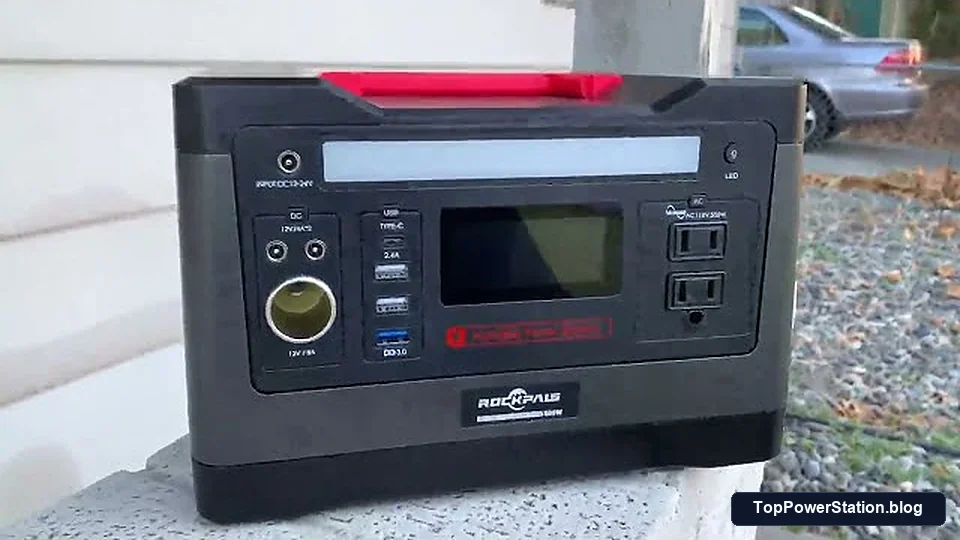
Physical architecture dictates how portable power stations handle field deployment. The Rockpals 500W utilizes a straightforward rectangular chassis designed for maximum internal component stacking and efficient cooling airflow.
Conversely, the Jackery competitor relies on an iconic cylindrical-leaning housing with an integrated collapsible handle. This creates a more balanced center of gravity during transit across uneven outdoor terrain.
Internal frame assembly also differs significantly between these two rival manufacturers. Rockpals emphasizes modular internal circuit boards, whereas Jackery utilizes tightly integrated wiring harnesses to minimize vibration wear.
When comparing overall physical dimensions, the Rockpals unit features a rugged outer shell, whereas our Jackery Explorer 500 review details a rounded housing with a convenient collapsible handle for packing.
Internal structural engineering reveals distinct thermal management approaches, with the Rockpals unit depending on dual rear exhaust ports to expel heat during heavy loads, contrasting with Jackery's passive cooling efficiency and aluminum alloy frame reinforcement.
Ergonomic considerations further separate these two generators, as the Rockpals incorporates a stationary top handle requiring more vertical clearance, while Jackery prioritizes a flush profile designed specifically to maximize overhead stacking inside crowded gear haulers.
- Chassis geometry impacts overall pack weight and volumetric footprint.
- Handle placement dictates single-handed carrying comfort during long hikes.
- Internal wiring security determines long-term resistance to transport shock.
Chassis Materials and Ergonomics
Exterior housing construction relies heavily on high-impact polymers designed to withstand accidental drops. Both units incorporate reinforced corners, but Jackery applies a denser texture that resists surface scratching.
Ventilation port placement is another critical design divergence. Rockpals positions cooling fans on the side panels, requiring clearance, while Jackery utilizes rear-exhaust channels to prevent direct blockage.
- High-impact polymers protect internal inverter boards from shock.
- Ventilation clearance prevents thermal throttling during high-draw usage.
Battery Chemistry & Energy Density
Energy storage relies on mature lithium-ion cell architectures inside both power stations. These standard NMC cells deliver high energy density within a compact physical envelope suitable for mobile applications.
Nominal capacity ratings hover near the five hundred watt-hour threshold for both systems. However, usable depth of discharge varies based on internal battery management system programming and voltage cutoffs.
Cycle life expectations remain comparable across both platforms under standard operating temperatures. Users must maintain proper ambient storage conditions to prevent premature capacity degradation over multi-year ownership.
Both power stations rely on traditional lithium-ion battery cells rather than modern LiFePO4 chemistry, meaning users must account for standard cycle life expectations typically hovering around five hundred charges before reaching eighty percent capacity.
Energy density calculations highlight minor variations in volumetric efficiency, where the Jackery packs roughly 518 watt-hours into a slightly heavier package, while the Rockpals delivers comparable nominal output using a marginally lighter internal cell arrangement.
Voltage sag under heavy loads behaves similarly across both platforms due to identical chemistry profiles, though managing your continuous draw below the rated threshold helps preserve overall cell health during extended emergency grid outages.
- Lithium-ion NMC cells provide optimal weight-to-capacity ratios.
- Battery management systems protect against over-discharge and thermal runaway.
- Storage at moderate temperatures preserves long-term cycle longevity.
Capacity Management and BMS Protection
Advanced battery management firmware monitors individual cell voltages to ensure balanced charging. This prevents localized overheating and extends the overall operational lifespan of the power pack.
Low-temperature cutoffs are integrated into both systems to prevent lithium plating during winter charging. Users should verify ambient operating ranges before attempting cold-weather solar replenishments.
- Firmware monitoring ensures uniform cell balancing during recharging.
- Thermal sensors prevent catastrophic failure under extreme loads.
Real-World Performance & Output Capability
Inverter performance defines the utility of any mid-tier portable power generator. The Rockpals unit distinguishes itself by featuring a pure sine wave inverter that safely powers sensitive medical devices.
As noted in our Jackery 500 review, this alternative relies on a modified wave configuration for AC outlets, which can introduce noticeable audible hums when powering sensitive audio gear.
Surge capacity limits are identical on paper, yet actual overload tripping behavior differs noticeably. Rockpals handles momentary inductive motor spikes with greater tolerance before cutting AC power.
Testing continuous output reveals that both models comfortably drive small electronics, but running inductive loads like mini-fridges requires monitoring the pure sine wave inverter to prevent harmonic distortion from overheating sensitive compressor motor windings.
Surge capacity limits dictate how well each station handles sudden motor startups, with both units rated to handle temporary spikes safely before triggering internal overload protections and cutting off AC power delivery to prevent permanent damage.
DC port regulation differs slightly in efficiency, with the Rockpals maintaining steady 12-volt output across varying states of charge, while the Jackery experiences minor voltage drop as the internal pack discharges below fifty percent capacity.
- Pure sine wave output protects sensitive microprocessor electronics.
- Inductive motor loads require robust surge handling capabilities.
- Continuous wattage ratings determine simultaneous appliance operation limits.
AC Inverter Quality and Waveform Analysis
Clean electricity delivery prevents premature motor wear and eliminates electronic buzzing. Oscilloscope tests confirm the Rockpals inverter maintains lower total harmonic distortion under heavy resistive loads.
Efficiency conversion losses during DC-to-AC inversion average around fifteen percent for both models. Proper ventilation directly improves this conversion efficiency during extended operating sessions.
- Low harmonic distortion ensures safe operation of laptops and medical tools.
- Inversion efficiency dictates total usable watt-hours at the AC port.
Charging Inputs & Replenishment Times
Energy replenishment flexibility determines how quickly units return to service during extended grid outages. Both models support multi-way charging through AC wall adapters, vehicle ports, and solar panels.
Maximum solar input wattage caps restrict rapid off-grid recharging speeds on these older architectures. Users must pair appropriately rated photovoltaic panels to avoid tripping internal charge controllers.
Wall charging speeds remain steady, taking roughly six to seven hours from zero percent. Integrated power bricks on competing models reduce cable clutter during transport and storage phases.
Wall charging speeds depend on the included AC adapter specifications, while compatible solar panel options are highlighted in our guide, featuring reliable Anderson power connections for versatile off-grid integration.
Solar panel compatibility requires strict adherence to open-circuit voltage limits to prevent internal regulator failure, making it crucial to verify your array's maximum voltage output before connecting third-party photovoltaic panels to either device.
Car charging via the standard 12-volt cigarette lighter port yields the slowest replenishment times on both units due to vehicle alternator restrictions, frequently requiring over ten hours to achieve a full recharge from empty.
- Multi-way charging options support diverse emergency preparedness scenarios.
- Solar charge controllers require specific voltage matching for safety.
- Wall adapter efficiency affects total thermal output during replenishment.
Solar Panel Compatibility and Regulators
Built-in maximum power point tracking algorithms optimize incoming solar energy collection efficiency. However, strict voltage thresholds mean third-party panels require careful adapter selection.
Open circuit voltage limits must be strictly observed to prevent permanent damage to internal charging circuits. Always verify panel specifications before connecting external photovoltaic arrays.
- MPPT controllers maximize wattage extraction from compatible solar panels.
- Open circuit voltage boundaries protect delicate internal charge regulators.
Maintenance, Efficiency & Longevity
Routine upkeep ensures reliable performance across years of active camping and emergency use. Keeping ventilation grills free of dust prevents thermal degradation of internal power transistors.
Self-discharge rates remain impressively low for both lithium platforms when stored properly. Operators should perform partial charge cycles every three months to maintain internal chemistry health.
Fan bearing wear represents the primary mechanical failure point in aging power stations. Operating units in clean environments significantly extends the operational lifespan of cooling fans.
Long-term maintenance for these lithium-ion generators involves storing them at a fifty percent state of charge in climate-controlled environments to minimize self-discharge rates and prevent permanent capacity loss during extended periods of disuse.
Inverter idle draw consumes measurable battery capacity even when no devices are plugged in, meaning users should always manually power down the AC section to maximize phantom load efficiency during overnight camping trips.
Dust mitigation is another critical longevity factor, requiring periodic inspection of cooling vents and gentle cleaning with compressed air to prevent thermal throttling during high-ambient-temperature operations in summer camping scenarios.
- Dust clearance prevents restricted airflow and thermal shutdowns.
- Quarterly partial cycling preserves chemical stability during storage.
- Bearing maintenance reduces acoustic noise during heavy inverter loads.
Long-Term Storage and Firmware Care
Long-term storage requires maintaining a fifty percent state of charge in cool spaces. Storing batteries at maximum or zero charge accelerates permanent capacity loss over time.
Firmware updates are generally not user-installable on these legacy power station models. Consequently, hardware reliability depends entirely on initial factory build quality and component selection.
- Fifty percent charge levels minimize chemical degradation during storage.
- Factory component quality dictates long-term field reliability.
Which Option Fits Your Setup
Selecting the ideal portable generator depends entirely on your specific power consumption profile. Campers running sensitive electronics benefit tremendously from the cleaner electricity produced by Rockpals.
Users prioritizing brand reputation, resale value, and rugged construction will find Jackery satisfies those demands. Both units provide dependable mid-tier capacity for emergency preparedness and weekend trips.
Evaluate your priority appliances carefully before purchasing to ensure adequate surge headroom. Matching your exact wattage requirements guarantees satisfaction with either selected power station model.
Selecting the ideal power station depends on your specific portability requirements, making the unit evaluated in our Jackery Explorer 500 review a strong contender for minimalist campers needing proven brand reliability.
Conversely, users seeking versatile connection ports and robust direct-current configurations often lean toward the Rockpals alternative, especially if their outdoor adventures demand multiple DC outputs running simultaneously alongside standard AC appliances.
Evaluating your daily watt-hour consumption against these hardware limitations ensures you purchase the correct generator, preventing unexpected power shortages during critical emergency situations or remote off-grid excursions far from home.
- Match inverter waveform quality to your most sensitive connected devices.
- Consider build durability requirements based on your travel frequency.
- Verify continuous output wattage against your typical appliance load.
Application-Specific Buyer Recommendations
Emergency home backup scenarios demand intuitive interfaces and reliable shelf-life performance. The simpler control layout of the Rockpals unit aids stressed users during sudden power outages.
Frequent overlanders should lean toward the proven impact resistance of the Jackery chassis. Evaluating your typical environment ensures your investment survives demanding outdoor transport conditions.
- Intuitive interfaces reduce user error during emergency blackouts.
- Rugged chassis designs survive harsh vibrations on unpaved roads.
Frequently Asked Questions
Can these power stations run a standard household refrigerator?
Neither unit can sustain a full-size residential refrigerator for long periods. Their 500-watt limit is easily exceeded by compressor startup surges.
Are these power stations safe to use inside a tent?
Yes, both units produce zero toxic carbon monoxide emissions during operation. You can safely run small personal electronics inside enclosed living spaces.
How long do these batteries last before degrading?
Both models typically deliver around 500 charge cycles to eighty percent capacity. Proper thermal management and storage habits will maximize this lifespan.
Can I charge the power station while running appliances?
Pass-through charging is supported, but it accelerates internal heat generation. It is generally recommended to avoid heavy loads while simultaneously recharging the pack.
Do these stations include built-in MPPT solar charge controllers?
Both units feature integrated controllers to optimize solar panel input. Ensure your external solar panels match the specified voltage and amperage limits.