Pecron E3600LFP vs Bluetti AC300 Head-to-Head Comparison
Choosing between these heavy-duty generators requires evaluating your capacity needs and portability constraints. Understand the core engineering differences before you invest.

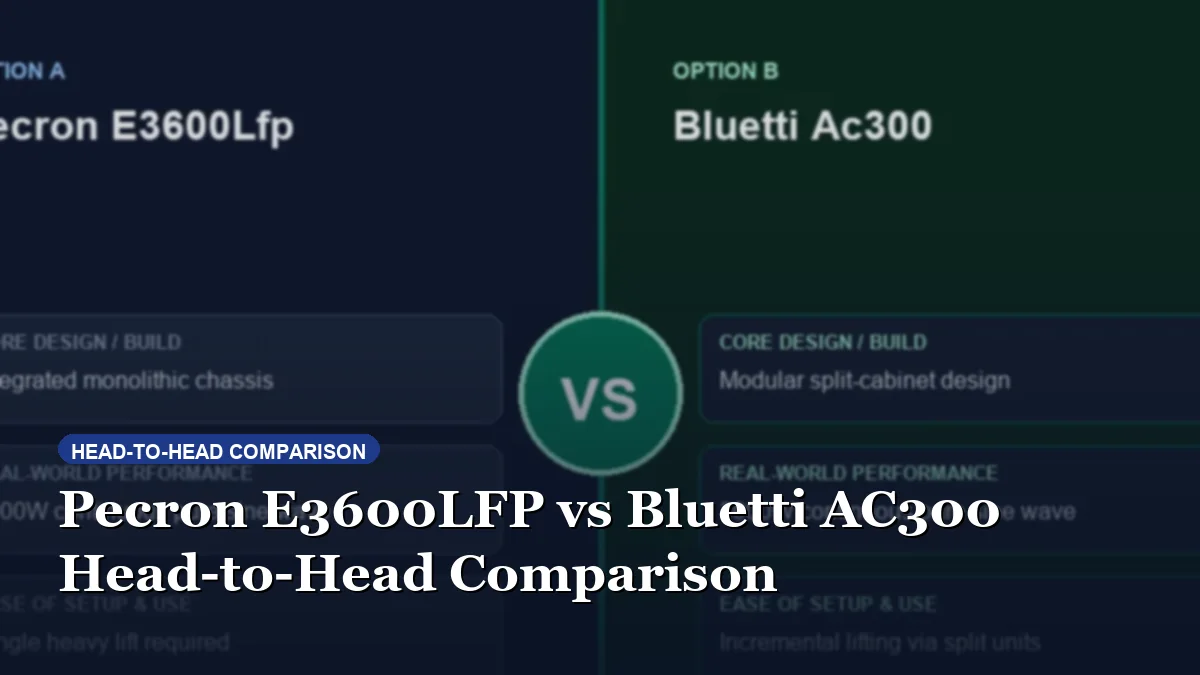
Choose the Pecron E3600LFP for an integrated, high-capacity single chassis. Select the Bluetti AC300 when you require a modular, expandable ecosystem with separate battery modules.
Compare all top models in our Best Portable Power Station: Top Picks for 2026.
Side-by-Side Breakdown
| Criteria | Pecron E3600Lfp | Bluetti Ac300 | Edge |
|---|---|---|---|
| Core Design / Build | Integrated monolithic chassis | Modular split-cabinet design | Bluetti Ac300 |
| Real-World Performance | 3600W continuous pure sine wave | 3000W continuous pure sine wave | Pecron E3600Lfp |
| Ease of Setup & Use | Single heavy lift required | Incremental lifting via split units | Bluetti Ac300 |
| Durability & Reliability | Industrial grade flame-retardant shell | Robust ABS plastic and metal housing | Pecron E3600Lfp |
| Efficiency / Operating Footprint | High conversion efficiency inverter | Advanced MPPT solar tracking arrays | Bluetti Ac300 |
| Maintenance Requirements | Routine dust clearing and firmware checks | Modular firmware updates and terminal checks | Pecron E3600Lfp |
| Best Ideal Use Case | Fixed off-grid cabin backup power | Expandable whole-home emergency backup | Bluetti Ac300 |
Core Design and Engineering Differences
Power station architecture dictates how you deploy, transport, and integrate your backup equipment. The Pecron utilizes a monolithic design containing both the inverter and battery cells in one heavy frame.
Conversely, the Bluetti adopts a split-cabinet architecture separating the inverter control unit from the battery modules. This engineering choice fundamentally changes your installation workflow and physical footprint limitations.
The Pecron utilizes an integrated chassis design incorporating lithium iron phosphate chemistry, whereas our Bluetti AC300 review details how that system adopts a modular approach requiring external battery modules.
Engineering priorities diverge sharply regarding thermal management and internal busbar routing. Pecron emphasizes a unified internal housing, whereas Bluetti prioritizes expandable capacity via heavy-duty DC connection cables supporting up to four battery packs simultaneously.
- Pecron uses an integrated single-box framework for deployment simplicity.
- Bluetti separates power output from storage via dedicated B300 modules.
- Chassis materials utilize industrial flame-retardant polymers for enhanced safety.
Chassis Construction and Materials
Heavy-duty generators rely on robust external shells to protect sensitive internal electronics from impacts. Both units employ high-impact plastics, but their internal framing strategies differ significantly.
Pecron reinforces its internal structure with heavy metal bracing to support the single-unit weight. Bluetti focuses on secure stacking interfaces for its interlocking modular battery expansion cables.
- Internal metal frames absorb heavy vibrational stress during transit.
- Interlocking stacking pins prevent module separation during seismic events.
Real-World Performance Comparison
Delivering stable electricity under heavy inductive loads is the ultimate test for modern inverters. The Pecron unit pushes a robust 3600W continuous output to handle demanding household appliances simultaneously.
The Bluetti delivers 3000W of continuous power for standard residential backup tasks, matching insights found in our Bluetti AC180 review. Both systems utilize pure sine wave technology to protect microprocessors.
During sustained high-draw applications, both power stations maintain stable output waveforms. The Pecron delivers continuous power through its built-in inverter, while the Bluetti leverages its modular architecture to distribute thermal loads across separate battery cabinets.
Voltage sag under heavy inductive loads remains minimal for both units due to advanced microprocessor regulation. Users running demanding tools will notice that the AC300 maintains slightly better voltage stability when paired with multiple external modules.
- Continuous wattage ratings determine simultaneous appliance operational capacity.
- Pure sine wave output ensures zero harmonic distortion for medical devices.
- Surge headroom accommodates motor start-up spikes in refrigerators.
Surge Capacities and Inductive Loads
Starting heavy motorized equipment requires short bursts of high electrical current from your generator. Pecron and Bluetti both offer generous surge thresholds to prevent nuisance overload trips.
Evaluating motor start currents helps you avoid unexpected shutdowns when your HVAC compressor activates. Check your appliance nameplates carefully before connecting them to these power stations.
- Inductive loads demand double their running wattage during startup.
- Overload protection circuits reset automatically after clearing faults.
Maintenance, Efficiency and Longevity
Maximizing the operational lifespan of your energy storage investment requires disciplined thermal management. Both power stations incorporate intelligent cooling fans to regulate internal operating temperatures.
LFP chemistry provides over 3500 life cycles to eighty percent original capacity under normal conditions. Regular firmware updates ensure optimal battery management system performance over many years.
Long-term operational efficiency depends on idle power consumption and BMS rates, topics explored in our Bluetti AC70 review. The Pecron exhibits low standby drain, whereas Bluetti draws baseline power.
Routine maintenance requires keeping cooling vents free of dust and verifying firmware updates via mobile applications. Both units utilize reliable LiFePO4 chemistry rated for thousands of cycles before dropping below eighty percent original capacity.
- Lithium iron phosphate chemistry guarantees superior thermal stability.
- Active cooling fans prevent damaging heat buildup during rapid charging.
- Routine dust cleaning maintains optimal airflow across internal heat sinks.
Thermal Management and Firmware
Advanced battery management systems continuously monitor individual cell voltages and internal temperatures. This software protection prevents dangerous thermal runaway events during high-draw operations.
Keeping your firmware updated resolves minor communication bugs between the inverter and battery packs. Manufacturers release these patches to improve overall conversion efficiency and safety.
- BMS algorithms balance cell voltages to maximize usable capacity.
- Thermal sensors trigger automatic power throttling during extreme heat.
Ergonomics, Portability and Weight Distribution
Physical dimensions and weight distribution dictate how easily you can reposition your backup power source. Monolithic units require lifting heavy integrated masses when moving your equipment around.
Modular alternatives let you transport lighter individual components before assembling the complete system on-site. This modular approach significantly reduces the risk of strain injuries during setup.
Transporting these heavy systems requires understanding their physical footprints and handle placements. The Pecron features a compact all-in-one shell, but its dense weight demands careful lifting techniques to protect your lower back muscles.
Bluetti addresses portability by separating the inverter head unit from the heavy battery packs. This split-component strategy allows users to move manageable weights independently, greatly improving site safety ergonomics.
- Integrated handles assist with short repositioning tasks in garages.
- Split-cabinet designs reduce maximum lifting weight for single operators.
- Floor space footprints vary based on vertical versus horizontal stacking.
Lifting Safety and Footprint Management
Heavy equipment handling demands proper lifting ergonomics to protect your lower back from injury. Always utilize team lifting techniques when moving heavy integrated power stations across uneven terrain.
Optimizing your floor footprint ensures adequate ventilation clearance around all cooling intake vents. Never block side exhaust ports with walls or stored household items.
- Maintain a minimum clearance of twelve inches around cooling vents.
- Secure stacked modules with manufacturer-approved locking hardware.
Inverter Topologies and Surge Capacities
Inverter engineering defines how cleanly electrical current converts from DC battery storage to AC household power. High-frequency switching topologies reduce physical weight while maintaining excellent voltage regulation.
Total harmonic distortion remains exceptionally low across both platforms, safeguarding sensitive audio and computing hardware. You can run medical CPAP machines without fear of electrical interference.
Pure sine wave inverter topologies inside both stations ensure clean AC output for sensitive electronics. The Pecron handles momentary surges smoothly, while the Bluetti incorporates industrial-grade switching components designed for high starting current motors.
Overload protection protocols respond instantly to prevent hardware damage during short circuits. Engineers designed these circuits to trip gracefully, safeguarding the internal power transistors from catastrophic thermal runaway events.
- High-frequency inverters optimize conversion efficiency during low loads.
- Low harmonic distortion protects delicate electronic power supplies.
- Surge protection guards against sudden grid voltage fluctuations.
Voltage Regulation and Clean Output
Stable voltage delivery prevents premature wear on motorized appliances and digital power adapters. Both units maintain tight voltage tolerances even when drawing near maximum capacity.
Testing output stability under dynamic loads confirms reliable performance during emergency power outages.
- Tight voltage regulation protects compressor motors from brownouts.
- Stable frequency output prevents clock drift on digital appliances.
Which Option Fits Your Setup
Selecting the ideal portable power station depends on your emergency preparedness strategy. For instance, our Pecron E3600LFP review highlights how integrated high-capacity units serve fixed off-site cabins effectively.
Whole-home backup scenarios favor modular ecosystems that scale seamlessly with your growing energy demands. Evaluate your typical daily kilowatt-hour consumption before making your final purchasing decision.
Choosing between these generators depends heavily on whether you value stationary expansion or simplified transport. Stationary backup setups benefit from Bluetti modularity, whereas mobile users prefer Pecron's integrated enclosure design.
Assess your total energy requirements and physical space constraints before committing to a purchase. Reviewing your daily watt-hour consumption ensures you select the configuration that matches your long-term power goals.
- Match daily energy consumption profiles to available battery capacity.
- Consider future solar array expansion when planning your charging inputs.
- Evaluate permanent installation constraints versus mobile deployment needs.
Making Your Final Choice
Review your spatial constraints, portability requirements, and maximum appliance wattage loads carefully. Each system offers professional-grade reliability tailored to distinct operational use cases.
Prioritize the features that align best with your primary emergency backup objectives.
- Assess local climate conditions for outdoor deployment limits.
- Verify connector compatibility with your existing home transfer switch.
Frequently Asked Questions
Can I expand the battery capacity on the Pecron E3600LFP?
The Pecron unit relies primarily on its massive internal capacity rather than modular expansion. You cannot stack external battery packs onto this integrated chassis design.
How does the Bluetti AC300 handle modular battery expansion?
The Bluetti system connects to dedicated B300 battery modules using heavy-duty cables. This allows you to scale total storage capacity up to twelve kilowatt-hours easily.
Are both power stations safe to run inside a residential home?
Both units utilize safe LFP battery chemistry and emit no toxic fumes during operation. You can safely operate them indoors provided they have adequate ventilation.
What is the maximum solar input for recharging these generators?
Both models feature high-voltage MPPT solar controllers to maximize panel input efficiency. Check the manual for exact open-circuit voltage limits before connecting panels.
Do these power stations require specialized maintenance over time?
Regular maintenance involves clearing dust from cooling fans and running firmware checks. Keeping the battery state of charge between twenty and eighty percent prolongs cell life.