Lithium Ion vs LiFePO4 Portable Power Station: Technical Breakdown
Choosing the right battery chemistry impacts equipment weight and longevity. Understand the core technical differences before buying.

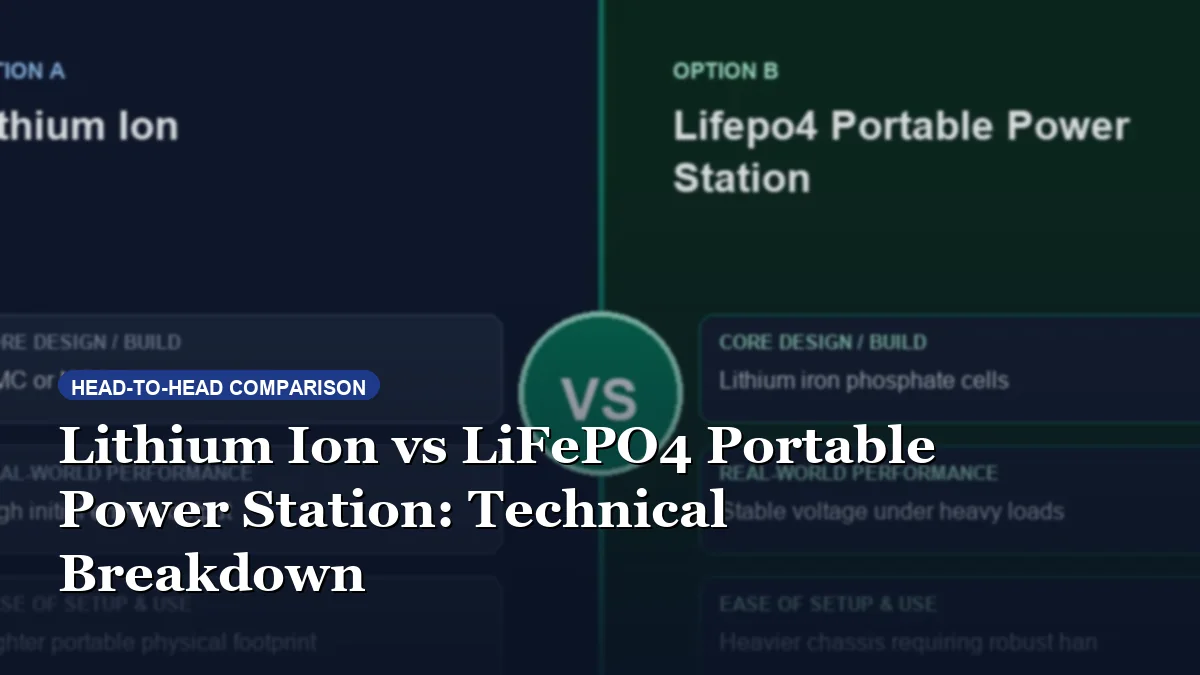
Pick Lithium Ion for ultra-lightweight backpacking, or choose LiFePO4 for heavy-duty daily cycling and long-term safety standards.
Compare all top models in our Best Portable Power Station: Top Picks for 2026.
Side-by-Side Breakdown
| Criteria | Lithium Ion | Lifepo4 Portable Power Station | Edge |
|---|---|---|---|
| Core Design / Build | NMC or NCA chemistry cells | Lithium iron phosphate cells | LiFePO4 |
| Real-World Performance | High initial energy output | Stable voltage under heavy loads | LiFePO4 |
| Ease of Setup & Use | Lighter portable physical footprint | Heavier chassis requiring robust handles | Lithium Ion |
| Durability & Reliability | 500 to 800 charge cycles | 3000+ deep discharge cycles | LiFePO4 |
| Efficiency / Operating Footprint | Compact volumetric density | Slightly larger physical volume | Lithium Ion |
| Maintenance Requirements | Strict storage voltage monitoring | Minimal active maintenance needed | LiFePO4 |
| Best Ideal Use Case | Emergency grab-and-go kits | Off-grid daily solar generators | LiFePO4 |
Core Design & Chemical Architecture
Traditional portable units utilize standard lithium-ion formulations like nickel manganese cobalt. These internal cells deliver impressive energy density packed into very tight physical dimensions.
Conversely, modern units incorporate iron phosphate chemistry to radically alter longevity profiles. This fundamental shift prioritizes molecular stability over absolute miniaturization during assembly.
Engineering teams design these contrasting internal architectures to target completely different user demands across the power station marketplace.
Traditional lithium-ion batteries typically utilize nickel manganese cobalt or nickel cobalt aluminum chemistries. These formulations maximize volumetric efficiency but require rigorous management to prevent internal short circuits during high-drain operations.
Conversely, LiFePO4 batteries replace cobalt with safer phosphate cathodes. This olivine crystal structure provides exceptional structural stability, resisting oxygen release even when subjected to severe thermal or mechanical puncture testing.
Understanding these fundamental internal structures explains why older chemistries achieve higher initial energy capacities while newer variants prioritize absolute structural safety during sustained high-wattage residential or mobile power delivery applications.
- NMC cells offer higher volumetric efficiency.
- LiFePO4 structures resist thermal runaway effectively.
- Internal BMS firmware manages cell balancing differently.
Molecular Structure Realities
The microscopic crystal lattice of iron phosphate provides superior structural integrity during rapid charging phases. Traditional nickel-based alternatives experience faster mechanical degradation under identical thermal stress.
Understanding these microscopic properties helps engineers design safer enclosures and better passive cooling systems for demanding outdoor environments.
- Crystal bonds remain stable under high current draws.
- Thermal thresholds vary significantly between chemical families.
Real-World Energy Density & Weight
Weight remains a primary metric when packing gear for remote wilderness excursions or mobile worksites. Standard chemistry units traditionally offer a clear physical advantage regarding overall ounces.
By squeezing more watt-hours into smaller casings, legacy designs reduce cargo space requirements inside crowded vehicle trunks. This optimization suits backpackers who count every single ounce carefully.
Iron phosphate alternatives trade away some of that lightweight convenience in exchange for significantly higher operational safety margins.
Standard lithium-ion cells offer superior gravimetric energy density, frequently exceeding 200 Wh/kg. This compact physical footprint makes them ideal for lightweight emergency kits where every single ounce impacts portability and transport ergonomics.
Meanwhile, LiFePO4 chemistry typically yields around 100 to 140 Wh/kg. Consequently, power stations utilizing these iron-phosphate cells demand significantly larger physical enclosures and carry a noticeably heavier deadweight during manual field deployments.
Equipment buyers must weigh this physical weight penalty against long-term operational longevity, balancing the convenience of lighter gear with the robust durability demanded by frequent off-grid camping or professional jobsite environments.
- Traditional chemistry weighs considerably less per watt-hour.
- Phosphate units require sturdier housing materials for protection.
- Portability metrics heavily favor legacy lithium-ion builds.
Transportability Trade-Offs
Backpacking enthusiasts often struggle with the added heft of modern iron phosphate generators. However, vehicle-based campers gladly accept the extra weight for increased cycle endurance.
Evaluating your specific transit methods clarifies whether absolute lightness outweighs long-term chemical durability during transport.
- Backpackers favor lightweight legacy cells.
- Vehicle campers prioritize capacity and longevity.
Cycle Life & Long-Term Durability
Lifespan represents a major financial and practical factor when investing in portable electrical infrastructure. Modern iron phosphate chemistry easily outperforms legacy options in raw cycle endurance counts.
Standard units typically degrade noticeably after reaching several hundred total discharge cycles. Iron phosphate alternatives often exceed three thousand cycles before dropping below acceptable capacity thresholds.
This dramatic longevity gap redefines how users approach daily off-grid living and emergency backup preparedness scenarios.
Standard lithium-ion portable stations usually deliver roughly 500 to 800 cycles before dropping to eighty percent capacity. This lifespan suits casual weekend users who deploy their backup generators only during rare emergency blackouts.
In stark contrast, modern LiFePO4 power stations routinely achieve 3000 to 4000 cycles to the same threshold. This massive durability leap stems from the robust molecular bonds inherent in the iron-phosphate cathode material.
Calculating long-term value reveals that phosphate units withstand daily cycling for over a decade, making them vastly superior investments for remote homesteads, van lifers, and heavy daily utility backup systems requiring extreme reliability.
- Legacy cells average five hundred operational cycles.
- Phosphate variants deliver thousands of reliable charges.
- Long-term value metrics favor advanced chemical structures.
Degradation Curves Over Time
Monitoring capacity retention reveals how quickly internal resistance increases during years of regular usage. Legacy cells degrade faster under heavy daily cycling routines.
Phosphate variants maintain flat voltage profiles throughout their extended operational lifespans, ensuring consistent device performance year after year.
- Internal resistance builds up gradually in phosphate cells.
- Voltage sag appears sooner in older chemical designs.
Thermal Stability & Safety Measures
Safety during high-draw appliance usage is non-negotiable for responsible equipment operators. Chemical stability dictates how well a power station handles accidental short circuits or punctures.
Iron phosphate bonds possess extreme resistance to thermal runaway events, even when subjected to extreme physical damage. This inherent safety trait prevents catastrophic fires in tight spaces.
Traditional configurations require sophisticated software interventions and active cooling fans to mitigate inherent risks associated with volatile cathode materials.
Chemical volatility remains a primary concern for traditional lithium-ion packs. Their lower thermal runaway threshold demands sophisticated cooling arrays and aggressive firmware interventions to prevent catastrophic failure during heavy ambient heat waves.
Alternatively, LiFePO4 cells exhibit remarkable thermal stability, resisting runaway temperatures up to two hundred seventy degrees Celsius. This inherent safety reduces reliance on heavy forced-air cooling fans during peak inverter output stages.
Selecting the right chemistry ultimately depends on operational environments, ensuring users working in hot climates or confined spaces prioritize the exceptional fire resistance provided by modern phosphate-based energy storage solutions.
- Phosphate chemistry resists accidental thermal runaway.
- Legacy units rely heavily on complex BMS safeguards.
- Physical puncture tolerance varies drastically by chemistry.
BMS Oversight and Protection
Advanced battery management systems monitor voltage, current, and temperature continuously across every internal cell group. These digital safeguards protect vulnerable chemistry from catastrophic failure states.
While both types utilize robust microprocessors, legacy cells demand stricter monitoring parameters to prevent dangerous overheating during rapid solar input phases.
- Microprocessors track real-time cell temperatures.
- Rapid solar inputs require precise voltage regulation.
Charging Efficiency & BMS Integration
Energy conversion efficiency dictates how much solar power actually reaches your internal storage banks. Modern internal circuitry minimizes resistive heat losses during high-amperage charging cycles.
Legacy formulations accept fast charging inputs efficiently but generate higher internal temperatures during peak solar harvesting hours. This heat accumulation requires careful thermal management by the inverter.
Optimized firmware ensures seamless handshakes between wall adapters, solar arrays, and internal storage banks without wasting valuable watts.
Advanced Battery Management Systems monitor cell voltages, balancing individual banks to optimize overall charging efficiency. Both chemistries benefit from these microprocessors, yet firmware calibration varies significantly based on internal chemical resistance profiles.
Standard lithium-ion generators accept rapid DC inputs efficiently, but their sensitive state-of-charge curves require strict voltage cutoffs. Overcharging these older packs can easily trigger irreversible plate degradation or dangerous internal pressure buildups.
Phosphate systems utilize flatter discharge curves, allowing the internal BMS to calculate remaining runtime with greater precision. This stability ensures safer solar recharging routines across fluctuating outdoor weather conditions and variable panel outputs.
- Conversion rates remain high across modern inverter designs.
- Resistive heat losses impact overall system efficiency.
- Firmware updates improve daily charging performance metrics.
Solar Panel Compatibility
Matching your portable station with unregulated third-party solar panels requires robust internal voltage step-down regulators. Both chemical types handle variable DC inputs well when paired with quality controllers.
Ensuring proper open-circuit voltage limits prevents internal damage during peak sunlight hours in remote off-grid locations.
- Voltage regulators protect sensitive internal components.
- Off-grid solar setups demand careful panel matching.
Environmental Footprint & Maintenance
Ongoing upkeep requirements differ noticeably between these two dominant portable energy storage technologies. Legacy batteries demand careful storage voltage protocols during extended periods of seasonal inactivity.
Phosphate models require virtually zero active maintenance beyond keeping exterior chassis clean and firmware updated. This hands-off reliability appeals to casual users and emergency responders alike.
Eco-conscious consumers also appreciate the elimination of scarce cobalt minerals within modern iron-based chemical formulations.
Manufacturing traditional lithium-ion batteries involves mining sensitive metals like cobalt and nickel. These extraction processes often raise severe ecological concerns, requiring strict regulatory oversight to minimize localized groundwater contamination and habitat destruction.
Conversely, LiFePO4 chemistry avoids scarce cobalt entirely, relying on abundant iron and phosphate minerals. This compositional shift significantly reduces supply chain environmental toxicity and simplifies large-scale recycling protocols at end-of-life stages.
Routine maintenance for both types remains minimal, requiring only periodic firmware updates and storage at fifty percent charge. However, phosphate units demand fewer replacement cycles, lowering total lifetime resource consumption for eco-conscious consumers.
- Seasonal storage requires specific charge percentages.
- Cobalt reduction improves ethical sourcing standards.
- Minimal maintenance saves time during emergency deployments.
Storage Best Practices
Storing units at moderate state-of-charge levels prevents accelerated chemical degradation in all battery types. Keeping equipment in temperature-controlled garages preserves maximum capacity over long winters.
Routine inspection of connection ports prevents dust accumulation and ensures reliable power delivery during unexpected grid outages.
- Maintain moderate charge levels during off-seasons.
- Keep storage environments cool and dry.
Best Ideal Use Case Scenarios
Matching your intended application profile with the correct internal chemistry guarantees long-term user satisfaction and optimal value. Weekend campers have vastly different technical needs than full-time digital nomads.
Emergency preparedness kits stored in closets benefit greatly from ultra-stable chemistry that retains charge for many months without active monitoring or frequent plug-in cycles.
Selecting the right generator ensures your critical medical devices, communication gear, and refrigeration appliances stay powered reliably.
Lightweight lithium-ion units excel in scenarios requiring maximum portability, such as ultralight backpacking, mobile photography shoots, or emergency bug-out bags where minimizing total carried weight overrides long-term cycle count considerations.
Meanwhile, heavy-duty LiFePO4 power stations dominate stationary backup roles. They serve off-grid cabins, medical equipment backups, and daily solar storage systems where massive cycle longevity and absolute safety justify the extra physical weight.
Matching your specific application profile to the correct battery chemistry prevents premature equipment degradation, ensuring reliable off-grid power delivery tailored specifically to your unique mobility and runtime operational requirements.
- Weekend travelers value lightweight legacy gear.
- Off-grid homesteaders require durable daily cycling.
- Emergency kits demand reliable long-term storage.
Making Your Final Choice
Review your typical power consumption patterns, transit methods, and budget constraints before making a final purchasing decision. Prioritizing weight differs fundamentally from prioritizing multi-year durability.
Consulting comprehensive technical specifications guarantees your chosen power station matches your exact lifestyle demands out in the field.
- Analyze daily wattage requirements before buying.
- Weigh physical portability against cycle longevity.
Frequently Asked Questions
What is the primary difference between lithium ion and LiFePO4 power stations?
Traditional lithium-ion units offer lighter weights, while LiFePO4 models provide superior cycle life and enhanced thermal stability for everyday off-grid use.
Can I leave a LiFePO4 power station plugged into solar panels continuously?
Yes, modern battery management systems prevent overcharging by regulating incoming solar currents safely. This allows for seamless, hands-free daily solar harvesting without constant user supervision.
Which battery chemistry lasts longer over years of regular use?
LiFePO4 chemistry easily outperforms legacy options, often exceeding three thousand charge cycles before significant degradation. This remarkable longevity delivers exceptional long-term value for frequent users.
Are traditional lithium-ion units safer for emergency storage kits?
Both types are safe when managed by quality internal circuitry, but LiFePO4 resists thermal runaway better. This makes iron phosphate the preferred choice for reliable emergency preparedness.
Why do some portable power stations weigh significantly more than others?
Weight differences stem directly from the chosen cathode materials and internal casing requirements. Choosing a heavier LiFePO4 model trades away portability for maximum durability and safety.