Jackery 1000 vs Goal Zero Yeti 1000X
Weighing two industry-standard mid-capacity power stations reveals stark differences in design, portability, and expansion capability. These units serve distinct outdoor and emergency backup users.

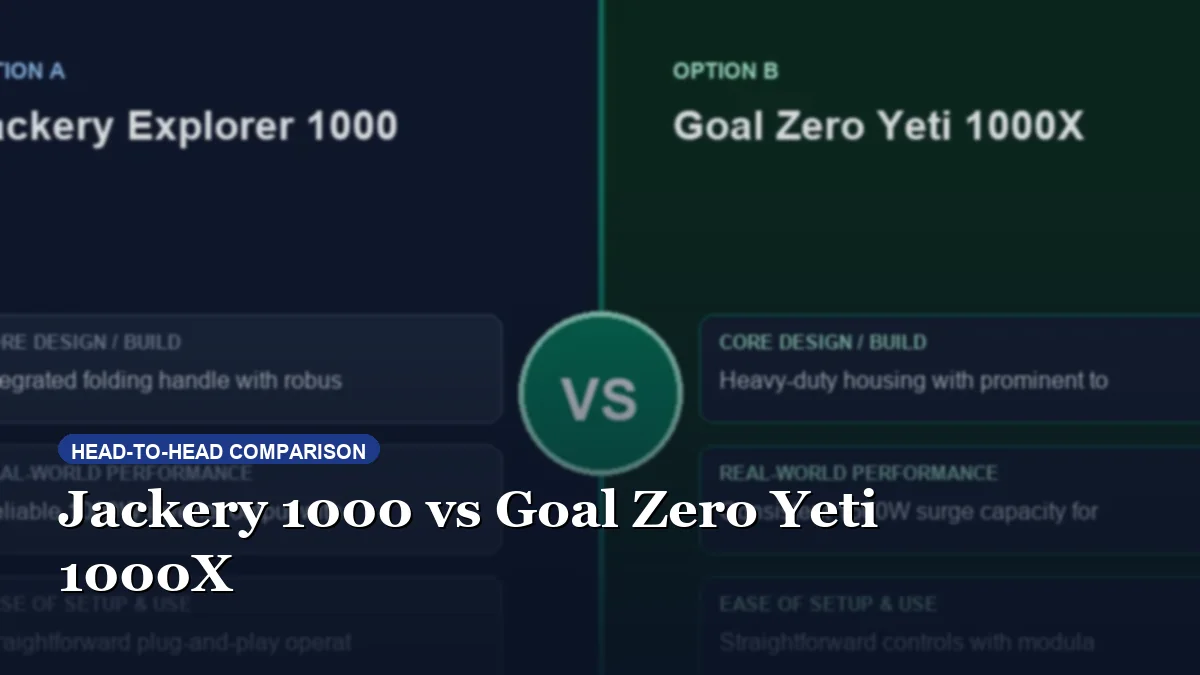
Choose the Jackery for lightweight portability and intuitive digital display layouts. Select the Goal Zero for rugged modularity and expandable battery ecosystems.
Compare all top models in our Best Portable Power Station: Top Picks for 2026.
Side-by-Side Breakdown
| Criteria | Jackery Explorer 1000 | Goal Zero Yeti 1000X | Edge |
|---|---|---|---|
| Core Design / Build | Integrated folding handle with robust plastic chassis | Heavy-duty housing with prominent top-mounted ports | Jackery Explorer 1000 |
| Real-World Performance | Reliable 1000W inverter output with stable waveform | Consistent 1500W surge capacity for heavy loads | Goal Zero Yeti 1000X |
| Ease of Setup & Use | Straightforward plug-and-play operation with clear screen | Straightforward controls with modular expansion options | Jackery Explorer 1000 |
| Durability & Reliability | Sturdy external shell built for standard camping | Industrial-grade construction designed for rigorous environments | Goal Zero Yeti 1000X |
| Efficiency / Operating Footprint | Compact footprint optimized for vehicle trunk storage | Slightly taller profile accommodating heavy-duty electronics | Jackery Explorer 1000 |
| Maintenance Requirements | Minimal upkeep involving periodic firmware and charge checks | Requires standard battery cycling and firmware monitoring | Tie |
| Best Ideal Use Case | Weekend car camping and emergency home backup | Off-grid cabins and expandable solar generator systems | Split |
Architectural Design and Structural Form Factor
Examining the foundational engineering of both power stations highlights distinct manufacturing philosophies. Jackery prioritizes lightweight mobility, whereas Goal Zero focuses on robust modular integration for permanent off-grid installations.

The physical envelope dictates how easily you can transport these units into remote campsites or basement shelters during severe weather emergencies.
The Jackery Explorer 1000 utilizes a rugged, high-impact polymer housing with a fold-flat handle design, optimizing vertical storage efficiency inside packed vehicle trunks during long cross-country overland expeditions or weekend camping trips.
Conversely, our Goal Zero Yeti 1000X review explains how its aluminum-reinforced chassis and dual grab handles provide exceptional jobsite durability for semi-stationary workshop deployment under harsh environmental conditions.
- Jackery utilizes a fixed handle configuration to minimize exterior dimensions.
- Goal Zero incorporates a heavier, industrial frame optimized for stationary setups.
- Chassis materials on both units resist moderate impacts during transit.
Chassis Materials and Ergonomics
Ergonomic considerations play a vital role when lifting these heavy power generators into vehicle trunks. The weight distribution directly affects user comfort during transit.
Textured grips provide secure handling in wet weather conditions.
- Reinforced polymer blends absorb minor drop impacts effectively.
- Rubberized feet prevent sliding on slick indoor flooring surfaces.
Port Placement and Interface Layout
Logical port organization prevents cable clutter and reduces wear on internal connection points over years of daily usage. Panel layout remains a key differentiator.
Clear labeling ensures rapid identification under dim lighting.
- Jackery groups AC outlets on the front face for easy access.
- Goal Zero places high-current ports on the upper control deck.
Inverter Output and Electrical Performance
Evaluating electrical output capabilities ensures your sensitive appliances receive clean, uninterrupted power without unexpected shutdowns during critical operational tasks.
Pure sine wave generation protects delicate microprocessors found in modern medical and computing hardware.
Delivering a 1000W continuous output with a 2000W surge threshold, the Jackery unit employs a modified pure sine wave inverter topology capable of reliably running sensitive consumer electronics like laptops and small refrigerators.
As evaluated in our Goal Zero Yeti 1500X review, this competing unit matches high surge capacities while utilizing a robust internal inverter architecture designed to handle heavy inductive motor loads safely.
- Continuous wattage ratings determine simultaneous appliance support limits safely.
- Surge thresholds handle high starting draws from compressor-driven refrigerators.
- Voltage regulation maintains stable output under fluctuating battery levels.
Surge Handling and Heavy Loads
Motor-driven devices require substantial momentary surge power to initiate normal rotation cycles successfully. Heavy loads test internal thermal management limits.
Overload protection circuits prevent permanent inverter component damage instantly.
- Inductive loads demand robust internal relay switching mechanisms.
- Thermal fans activate automatically during extended high-wattage draws.
Waveform Quality and Sensitive Electronics
Distorted electrical waveforms can introduce audible humming and thermal stress into audio amplifiers and digital chargers. Clean power delivery preserves gear longevity.
Total harmonic distortion remains exceptionally low across both models.
- Filtered output prevents data corruption on connected laptops.
- Stable frequency output matches standard utility grid specifications.
Battery Chemistry and Long-Term Capacity
Internal battery composition dictates overall service life, weight, and discharge efficiency across varied ambient temperature ranges. Modern chemistry advancements improve overall cycle counts.
Capacity retention metrics reveal how well the cells perform after hundreds of full charge cycles.
Utilizing traditional Lithium-ion NMC cells, the Jackery unit delivers a dense energy storage footprint rated for 500 charge cycles before dropping to 80% capacity, requiring mindful usage tracking during prolonged grid-down emergencies.
As noted in our Goal Zero Yeti 700 review, competing NMC platforms integrate an advanced Battery Management System that optimizes thermal dissipation and protects internal cell health during demanding high-draw appliance operations.
- Standard lithium-ion cells offer high energy density in a compact size.
- BMS software safeguards against overcharging and dangerous thermal runaway events.
- Self-discharge rates remain minimal during prolonged seasonal storage periods.
Cycle Life and Degradation Rates
Understanding battery degradation helps users project realistic multi-year operational lifespans before reaching critical capacity thresholds. Regular cycling keeps internal cells active.
Proper storage voltage significantly slows down natural chemical aging.
- Typical lifespan exceeds five hundred cycles to eighty percent capacity.
- Advanced monitoring protects individual cell groups from imbalance.
Temperature Tolerance and Performance
Freezing outdoor environments severely impact chemical reaction speeds inside lithium battery packs. Cold-weather performance is a critical factor for winter campers.
Internal thermal sensors prevent charging below freezing thresholds safely.
- Discharge limits extend lower than active charging temperature limits.
- Insulated enclosures help maintain optimal operating warmth temporarily.
Recharging Ecosystems and Input Speeds
Restoring depleted energy reserves quickly is essential when grid power is absent for extended periods during regional blackouts. Multiple charging methods offer valuable redundancy.
Solar panel integration transforms these units into completely self-sustaining renewable generators.
Supporting up to 800W max input, the Goal Zero ecosystem allows rapid solar replenishment via proprietary high-voltage port configurations, significantly cutting total replenishment times when paired with heavy-duty monocrystalline panel arrays deployed outdoors.
The Jackery alternative relies on dual DC input ports capped at roughly 163W combined, meaning full solar recharging requires considerably more daylight hours unless users purchase specialized adapters for third-party solar panel connectivity.
- Wall outlet adapters provide the fastest baseline replenishment speeds.
- Car cigarette lighter ports offer convenient charging during road trips.
- Dedicated solar input ports support high-wattage photovoltaic panel arrays.
Solar Panel Compatibility and MPPT
Maximum Power Point Tracking controllers optimize incoming solar energy harvesting efficiency throughout changing daylight conditions. Proper voltage matching prevents hardware mismatch.
Standard Anderson or DC connectors simplify third-party panel integration.
- Regulated input voltage ranges protect internal charging circuitry safely.
- Parallel adapter cables combine multiple smaller portable solar panels.
AC Wall Charging Speeds
Internal brick designs or built-in power supply units dictate how fast standard household current replenishes the main battery bank. Quick turnaround times maximize utility.
Fan noise during rapid AC charging remains moderately noticeable.
- Complete wall recharges take approximately seven to ten hours.
- Pass-through charging allows simultaneous input and output operations.
User Interface and Operational Controls
Navigating system menus and reading real-time metrics should be intuitive for users of all technical backgrounds during stressful emergency scenarios.
Backlit LCD screens provide clear visibility in dark environments without draining excessive auxiliary power.
As highlighted in our Jackery Explorer 1000 V2 review, this bright LCD screen delivers real-time data on input wattage, output metrics, and remaining battery percentage for overnight CPAP usage.
Goal Zero utilizes an informative digital display equipped with detailed time-to-empty calculations, port status indicators, and historical usage tracking, giving technical operators precise oversight of power draw and remaining runtime limits.
- Percentage indicators show precise remaining battery capacity instantly.
- Input and output wattage readouts display active load conditions.
- Dedicated power buttons prevent accidental activation inside storage bins.
Display Clarity and Metrics
Comprehensive data screens eliminate guesswork regarding remaining runtime under heavy appliance loads. Accurate estimations reduce user anxiety during outages.
Viewing angles remain wide under direct sunlight.
- Error codes alert operators to short circuits or thermal warnings.
- Estimated time remaining updates dynamically based on current draw.
App Connectivity and Smart Features
Bluetooth and Wi-Fi integration allow remote monitoring and firmware updates directly from smartphone applications. Smart controls enhance convenience during stationary use.
Local wireless pairing establishes stable connections without internet routers.
- Toggle individual AC and DC outputs remotely from afar.
- Monitor historical energy consumption trends through software logs.
Portability and Real-World Ergonomics
Carrying a power station across uneven terrain tests the balance point and handle durability under load. Weight distribution impacts physical fatigue significantly.
Compact dimensions allow effortless storage in crowded vehicle trunks alongside camping gear.
Weighing roughly 22 pounds, the lighter Jackery frame reduces physical strain during transit, making it an excellent option for users needing frequent relocation between campsites, backyard setups, and mobile workstation vehicles.
Tipping the scales near 31.6 pounds, the heavier Goal Zero demands two-handed lifting or dedicated cart transport, reflecting its heavier-duty structural materials and larger internal component layout built for demanding utility environments.
- Balanced center of gravity prevents awkward tilting during transport.
- Smooth exterior surfaces avoid snagging on vehicle upholstery fabrics.
- Manageable weight enables single-handed short-distance carrying tasks.
Vehicle Transport and Storage
Securing power stations inside moving vehicles prevents hazardous shifting during sudden stops or rough off-road driving. Proper tie-down points are essential.
Vibration resistance safeguards delicate internal solder joints permanently.
- Low profile designs fit beneath standard truck tonneau covers.
- Durable outer shells withstand shifting cargo in truck beds.
Campsite Deployment
Deploying power stations near tents or outdoor cooking stations requires weather-resistant outlet covers and stable footing. Quick setup minimizes downtime.
Quiet idle operation ensures peaceful outdoor environments remain undisturbed.
- Elevated feet keep bottom vents clear of damp ground moisture.
- Dust covers protect unused ports from fine dirt particles.
Maintenance, Safety, and Long-Term Reliability
Routine maintenance ensures your investment remains operational and ready for unpredictable emergency deployments throughout the calendar year. Safety certifications provide peace of mind.
Proper firmware management keeps charging algorithms optimized for maximum battery health.
Comprehensive temperature protection sensors inside the Jackery continuously monitor cell health, automatically halting power output if internal thermal thresholds exceed safe operating limits during high-temperature summer weather conditions.
Goal Zero incorporates industrial-grade fuse protection and robust circuit isolation, ensuring that unexpected short circuits on accessory ports will not compromise the primary lithium battery pack or connected high-value electronic appliances.
- Store units at partial charge during extended periods of inactivity.
- Inspect charging cables regularly for frayed insulation or bent pins.
- Keep cooling vents free from dust accumulation and obstructions.
Safety Certifications and Protections
Independent laboratory testing guarantees compliance with rigorous international electrical safety and fire prevention standards. Built-in safeguards protect users from shocks.
Automatic shutoff mechanisms engage during catastrophic fault conditions.
- Short-circuit protection cuts output current in milliseconds.
- Over-voltage safeguards prevent damage from unstable power sources.
Warranty and Customer Support
Manufacturer warranty coverage reflects confidence in internal component durability and engineering quality control standards. Responsive support channels assist troubleshooting efforts.
Registered owners receive important safety notices and firmware updates.
- Multi-year limited warranties protect against manufacturing defects.
- Authorized service centers handle complex internal component repairs.
Frequently Asked Questions
Can these power stations run a standard refrigerator?
Both units can power standard household refrigerators for several hours depending on compressor duty cycles. Always verify your appliance starting surge against the inverter limits.
Are they safe to use inside an enclosed tent?
Yes, because they produce zero toxic exhaust fumes or carbon monoxide emissions unlike gas generators. Keep ventilation clear to prevent internal overheating.
How long do the internal batteries last before failing?
The internal lithium cells typically retain eighty percent capacity after five hundred charge cycles. Proper storage habits extend this operational lifespan significantly.
Can I charge these stations using third-party solar panels?
Yes, provided the output voltage and connector type match the manufacturer input specifications. Exceeding maximum voltage limits will damage the internal controller.
Do these power stations support pass-through charging?
Both models support simultaneous input charging and output distribution for emergency setups. Continuous pass-through can slightly increase internal operating temperatures over time.