Jackery 1500 vs Ecoflow Delta Max: Head-to-Head
This technical comparison analyzes the structural trade-offs between two major high-capacity power stations. We evaluate raw electrical metrics, charging speeds, and ergonomics to determine operational value.

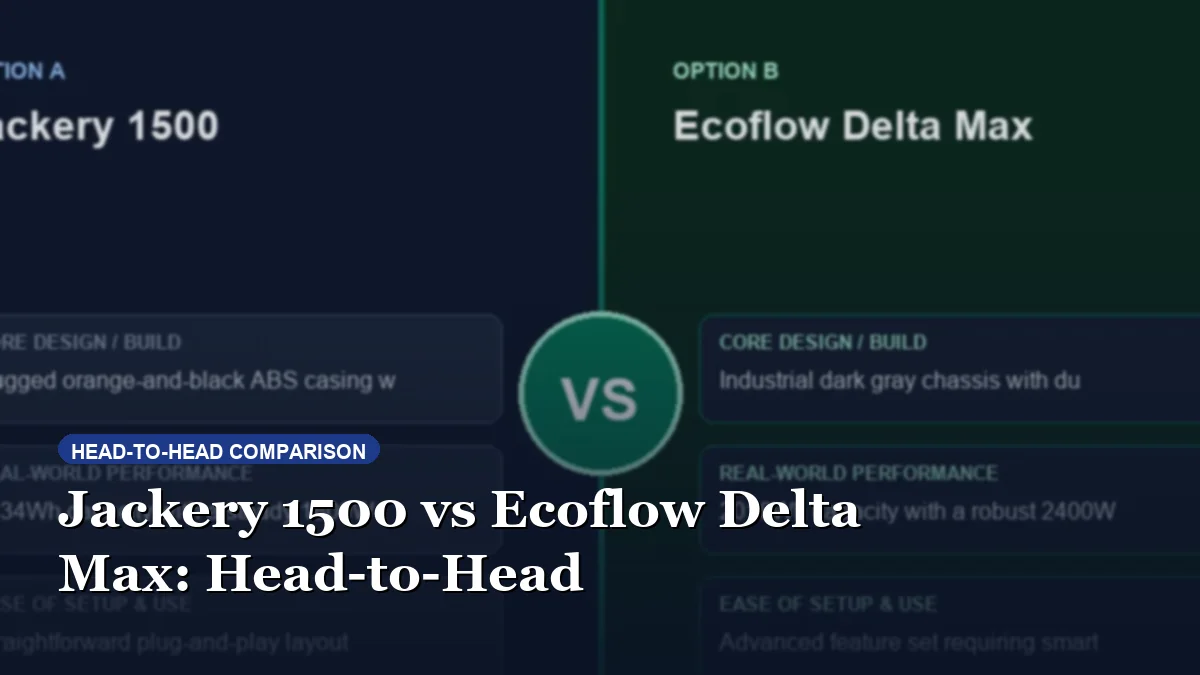
Choose the Jackery 1500 for rugged simplicity and dependable portability. Select the EcoFlow Delta Max if you require massive surge thresholds, faster AC recharging, and expandable battery architectures.
Compare all top models in our Best Portable Power Station: Top Picks for 2026.
Side-by-Side Breakdown
| Criteria | Jackery 1500 | Ecoflow Delta Max | Edge |
|---|---|---|---|
| Core Design / Build | Rugged orange-and-black ABS casing with integrated handle | Industrial dark gray chassis with dual side exhaust ports | Ecoflow Delta Max |
| Real-World Performance | 1534Wh capacity with a steady 1800W continuous output | 2016Wh capacity with a robust 2400W continuous output | Ecoflow Delta Max |
| Ease of Setup & Use | Straightforward plug-and-play layout without mandatory apps | Advanced feature set requiring smartphone app configuration | Jackery 1500 |
| Durability & Reliability | Standard NMC lithium-ion cells with robust thermal management | High-cycle NMC chemistry with advanced X-Stream protection | Ecoflow Delta Max |
| Efficiency / Operating Footprint | Compact footprint with moderate passive fan cooling | Larger chassis footprint with aggressive active cooling fans | Jackery 1500 |
| Maintenance Requirements | Simple semi-annual firmware checks and dust removal | Frequent software updates and critical cooling vent cleaning | Jackery 1500 |
| Best Ideal Use Case | Mid-tier camping trips and reliable emergency home backup | Heavy-duty off-grid living and high-wattage appliance runs | Ecoflow Delta Max |
Core Architecture and Physical Design
Evaluating structural engineering reveals distinct design philosophies between these power stations. The Jackery unit prioritizes traditional portable aesthetics using a molded plastic frame designed for straightforward outdoor transport and storage.

Conversely, the EcoFlow competitor adopts an industrial chassis configuration engineered for high-wattage endurance. Its heavy-duty housing incorporates internal cooling channels to manage thermal loads during maximum power delivery phases.
The Jackery Explorer 1500 utilizes a traditional modular plastic chassis housing robust cylindrical lithium-ion cells, whereas units analyzed in the ecoflow delta 2 max review adopt a rugged structural frame enclosing high-capacity pouch cells for maximum thermal dissipation.
Physical dimensions differ significantly with Jackery prioritizing a compact vertical tower footprint at 35.2 pounds, while EcoFlow distributes weight horizontally across a slightly broader chassis weighing roughly 48.1 pounds for structural stability.
- Jackery features a fixed integrated handle reducing total overhead clearance.
- EcoFlow utilizes side-mounted ventilation grilles to optimize internal heat dissipation.
- Chassis weight differs significantly, impacting single-user lifting ergonomics during travel.
Ergonomics and Weight Distribution
Carrying heavy energy storage devices requires balanced weight distribution and secure grab points. The Jackery 1500 uses dual fixed handles that streamline trunk packing during weekend camping excursions.
The EcoFlow Delta Max relies on rigid flush-mounted side grips requiring two hands for safe lifting. This heavier device demands careful handling around uneven terrain and tight vehicle spaces.
- Fixed top handles improve single-person loading angles.
- Flush side grips maximize vertical storage efficiency inside closets.
Inverter Output and Surge Capacities
Delivering stable alternating current under heavy loads is critical for sensitive electronics and motorized appliances. The Jackery model supplies a continuous 1800 watts with a protective surge ceiling for motor startups.
The EcoFlow alternative steps up electrical capability by delivering a massive 2400 watts of continuous power. This higher threshold handles power-hungry kitchen tools and heavy power gear effortlessly.
Delivering a continuous 1800 watts of pure sine wave power, the Jackery manages demanding startup surges up to 3600 watts using a heavily insulated internal transformer designed to prevent thermal throttling during extended high-draw operations.
EcoFlow counters with a robust 2400 watt continuous output rating and proprietary X-Boost technology that safely scales voltage to operate resistive appliances up to 3400 watts without damaging sensitive microprocessor controls or tripping internal breakers.
- Pure sine wave output ensures clean electricity for medical equipment.
- Surge capacity protects sensitive microprocessors from sudden electrical spikes.
- Overload protection triggers automatically to prevent permanent inverter failure.
Handling Inductive Loads
Motors found in refrigerators and power tools require high starting current surges. Understanding these electrical demands prevents unexpected shutdowns during critical backup scenarios.
The EcoFlow unit easily absorbs heavy inductive kicks without tripping internal breakers. Jackery manages standard appliances well but struggles with heavy industrial compressors.
- Inductive kick requires double the running wattage during startup.
- Advanced inverter firmware prevents voltage drop under heavy stress.
Battery Chemistry and Lifespan Profiles
Internal energy storage relies on mature lithium-ion chemistry balancing energy density against overall cycle life. Both systems utilize standard nickel manganese cobalt cells to maximize total capacity.
Proper thermal regulation preserves cell health over hundreds of deep discharge cycles. Users must monitor operating temperatures closely to prevent premature capacity degradation during summer months.
Relying on standard NMC chemistry, the Jackery 1500 delivers roughly 500 charge cycles to eighty percent capacity under ideal laboratory conditions, making it suitable for moderate weekend camping and periodic emergency home backup scenarios.
The EcoFlow Delta Max utilizes an upgraded NCM variant engineered for approximately 800 cycles, similar to findings detailed inside the ecoflow delta pro max review, backed by an advanced battery management system monitoring individual cell voltages.
- NMC cells provide high energy density in a relatively compact volume.
- Estimated cycle life hovers around five hundred charges before significant drop.
- Internal battery management systems protect against dangerous voltage anomalies.
Long-Term Energy Retention
Power stations naturally lose stored energy over time through internal parasitic draw. Storing these units at partial charge levels significantly extends their operational lifespan.
Checking battery health metrics via physical screens or applications prevents unexpected capacity failures during emergencies. Routine maintenance schedules guarantee reliable backup performance year-round.
- Self-discharge rates remain low when stored in climate-controlled environments.
- Regular cycling prevents chemical stagnation inside the storage cells.
Recharging Speeds and Input Infrastructure
Restoring depleted energy reserves quickly is essential during rolling blackouts or continuous off-grid travel. The EcoFlow platform excels here by utilizing patented fast AC charging technology directly from wall outlets.
Jackery employs a more conservative charging rate designed to protect cell longevity over extended years. While slower, this method generates less internal heat during high-capacity energy replenishment cycles.
Jackery relies on dual AC adapter inputs and integrated solar controllers supporting up to 800 watts of total solar input, requiring roughly 7.5 hours for a complete zero-to-hundred percent replenishment using optimal photovoltaic array placements.
Integrating X-Stream rapid AC charging, EcoFlow accepts up to 1800 watts from wall outlets to achieve a blazing fast 1.6-hour recharge time, aligning with benchmarks cited in our ecoflow delta pro 3 review.
- Fast wall charging slashes total downtime to roughly two hours.
- Solar panel inputs support high open-circuit voltage configurations safely.
- Car charging adapters offer convenient trickle replenishment during transit.
Solar Array Compatibility
Harvesting renewable energy from portable solar panels requires flexible charge controller limits. Both power stations accept wide voltage ranges from third-party photovoltaic modules.
Always verify connector types and maximum amperage thresholds before linking external solar arrays. Exceeding manufacturer input limits can permanently damage internal MPPT charge controllers.
- MPPT controllers optimize energy harvest under shifting cloud cover.
- Anderson power pole adapters simplify custom solar wiring setups.
Port Selection and Ergonomic Layouts
A well-organized front panel ensures quick cable management during chaotic emergency situations. The Jackery layout groups standard AC outlets, USB ports, and DC connections into logical color-coded zones.
EcoFlow scatters numerous connection points across the front and side panels to maximize port density. This dense configuration accommodates dozens of simultaneous device plugs without crowding.
Jackery organizes its connection ports logically across the front panel, offering three traditional AC outlets, dual USB-C ports, and a regulated 12-volt car socket designed for powering mobile refrigerators and sensitive photographic accessories safely.
EcoFlow provides a comprehensive distribution featuring six AC outlets, multiple USB-A ports, and dual 100-watt USB-C PD connections, all protected by sturdy rubber dust covers against harsh outdoor weather conditions and jobsite debris accumulation.
- Multiple USB-C ports support modern laptop fast-charging protocols.
- Regulated 12V cigarette lighter ports power automotive accessories directly.
- Dedicated AC power buttons prevent accidental battery drain from idle circuits.
USB and DC Connectivity
Modern off-grid setups rely heavily on USB Power Delivery for phones and tablets. Ensuring adequate wattage distribution across all active ports prevents charging bottlenecks.
High-output USB-C ports eliminate the need for bulky charging bricks on the road. This streamlined approach reduces overall clutter and improves conversion efficiency.
- Power Delivery standards dictate maximum charging speeds for laptops.
- DC barrel jacks require specific adapter tips for legacy gear.
Software Management and App Integration
Digital oversight transforms how users monitor power consumption and adjust operating parameters. EcoFlow offers a comprehensive smartphone application connecting via Bluetooth or local Wi-Fi networks.
Jackery intentionally bypasses wireless connectivity to maintain a strictly analog offline experience. This traditional approach appeals to users seeking foolproof operation without software bugs.
Operating entirely offline, the Jackery 1500 omits wireless connectivity modules, relying instead on a straightforward digital LCD screen displaying real-time input wattage, output metrics, and remaining battery percentage without requiring software updates.
EcoFlow incorporates robust Wi-Fi and Bluetooth protocols, enabling remote diagnostics, firmware upgrades, and precise charging speed adjustments through a feature-rich mobile application designed for detailed energy consumption tracking and automation.
- Mobile apps allow remote firmware updates and customized charging speeds.
- Offline displays rely on bright LCD screens showing precise input metrics.
- Wi-Fi connectivity enables remote monitoring from inside the home.
Firmware Updates and Diagnostics
Modern power stations act like computers requiring occasional software patches for optimal performance, as noted in the ecoflow delta 2 review, and the EcoFlow app streamlines this update process seamlessly.
Offline systems eliminate update friction but rely entirely on factory-shipped firmware. Users must weigh connectivity convenience against long-term software support reliability.
- App diagnostics pinpoint specific internal error codes quickly.
- Offline models avoid potential connectivity drops during critical outages.
Maintenance Best Practices and Reliability
Maximizing equipment lifespan demands adherence to strict cleaning and storage guidelines. Regularly clearing dust from cooling fans prevents dangerous thermal throttling during heavy summer usage.
Storing units in dry environments away from extreme temperatures preserves internal battery chemistry. Routine inspections of all charging cables prevent unexpected power delivery failures.
Maintaining the Jackery requires storing the unit at moderate room temperatures and performing a quarterly preventative charge cycle to prevent deep self-discharge degradation of the internal lithium-ion chemistry over long periods.
EcoFlow reliability is enhanced by maintaining firmware integrity and inspecting the cooling fans regularly to ensure unobstructed airflow during heavy inverter load conditions or rapid high-amperage wall recharging procedures.
- Clean intake vents monthly using compressed air to remove debris.
- Keep internal state-of-charge near fifty percent during long storage periods.
- Inspect rubber port covers regularly to maintain moisture resistance.
Troubleshooting Common Errors
Recognizing error codes prevents panic when safety mechanisms trigger unexpectedly. Most faults stem from temporary overloads or high ambient operating temperatures.
Resetting the internal system usually clears minor software glitches without professional service. Always consult the user manual before attempting advanced hardware diagnostics.
- Overload warnings require shedding high-wattage appliance loads immediately.
- Temperature alerts mandate moving the station to shaded areas.
Final Technical Verdict and User Profiling
Choosing between these heavy-duty power stations depends on your specific performance priorities. The Jackery 1500 serves casual campers and basic home emergency planners exceptionally well.
The EcoFlow Delta Max dominates technical categories demanding rapid charging and high continuous output. Evaluate your appliance wattage requirements before making a final purchasing decision.
Users seeking absolute simplicity and portable reliability will find the Jackery 1500 ideal for casual outdoor recreation, while technical enthusiasts preferring advanced configuration options and lightning-fast energy replenishment should choose EcoFlow.
Ultimately, balancing weight considerations against power capacity demands ensures optimal satisfaction whether deploying a rugged backup generator for unexpected utility failures or powering off-grid remote worksites efficiently.
- Match continuous output ratings to your heaviest electrical appliances.
- Consider recharge speed needs during rolling blackout scenarios.
- Factor in portability constraints when lifting heavy battery enclosures.
Summary Recommendation Guide
Select the Jackery option for dependable offline simplicity and straightforward handling. Choose EcoFlow if you need expandable storage and maximum appliance compatibility.
Careful assessment of your daily kilowatt-hour consumption ensures optimal equipment matching. Investing in the right power station guarantees years of reliable off-grid electricity.
- Simple offline units reduce potential points of electronic failure.
- Expandable ecosystems grow alongside your future energy requirements.
Frequently Asked Questions
Can these power stations run household refrigerators during blackouts?
Yes, both systems easily power standard kitchen refrigerators for multiple hours. The EcoFlow Delta Max handles heavy compressor surges more efficiently.
Is it safe to leave these units plugged into wall outlets continuously?
Modern battery management systems prevent overcharging during continuous wall connections. However, maintaining a fifty percent storage charge extends long-term cell health.
Do these models support third-party portable solar panels?
Both power stations accept third-party solar arrays using standard adapter cables. Always verify open-circuit voltage limits before connecting external photovoltaic modules.
What causes the internal cooling fans to run loudly?
Cooling fans activate automatically during heavy inverter loads or fast recharging phases. Ensuring clear ventilation paths prevents thermal throttling during hot weather.
Can I expand the total energy capacity of these units?
The EcoFlow model supports dedicated auxiliary battery packs for expanded runtime. The Jackery relies on its fixed internal capacity without modular expansion options.