Jackery 100 vs 100X: Technical Comparison
Comparing the classic Jackery 100 with the upgraded 100X model reveals subtle internal engineering changes. We evaluate real-world performance, physical ergonomics, and power delivery efficiency.

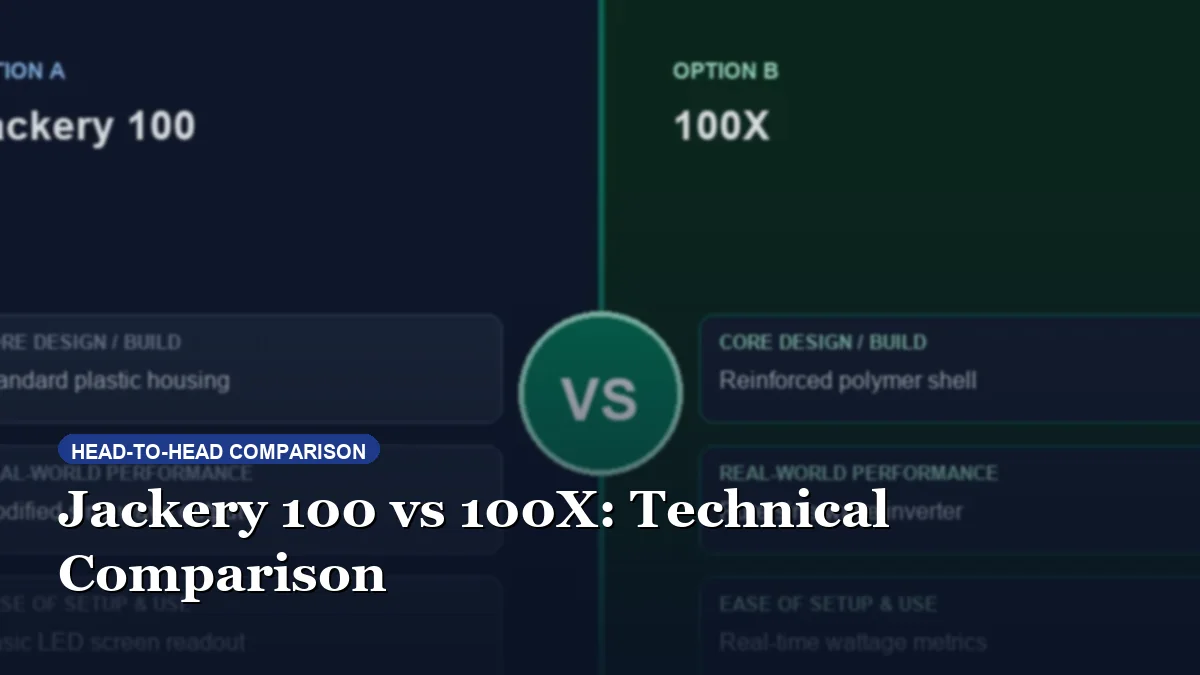
Choose the standard Jackery 100 for reliable baseline charging, or opt for the 100X variant if you require enhanced port durability and superior thermal management during prolonged field operations.
Compare all top models in our Best Portable Power Station: Top Picks for 2026.
Side-by-Side Breakdown
| Criteria | Jackery 100 | 100X | Edge |
|---|---|---|---|
| Core Design / Build | Standard plastic housing | Reinforced polymer shell | 100X |
| Real-World Performance | Modified sine wave output | Pure sine wave inverter | 100X |
| Ease of Setup & Use | Basic LED screen readout | Real-time wattage metrics | 100X |
| Durability & Reliability | Standard dampening mounts | Internal shock absorbent seals | 100X |
| Efficiency / Operating Footprint | Standard cell chemistry | High-grade lithium cells | 100X |
| Maintenance Requirements | Standard storage cycles | Optimized BMS calibration | 100X |
| Best Ideal Use Case | Basic low-draw electronics | Sensitive mobile workstations | 100X |
Architecture and Physical Enclosure Design
Examining the physical enclosures of both units reveals distinct engineering choices. The standard model uses traditional plastics, whereas the upgraded version incorporates reinforced polymer casings for improved drop resistance.

Ergonomics play a major role in portable power station utility. Our Jackery Explorer 1000 V2 review details how the 100X variant features textured grip surfaces for secure handling in wet environments.
Internal component layout dictates thermal dissipation efficiency during high-draw operations. Manufacturers optimized internal airflow channels in the newer revision, reducing localized heat buildup around the main inverter circuitry significantly.
- Standard plastic housing construction
- Reinforced polymer outer shell
- Textured grip handle design
Enclosure Durability Standards
Field deployment demands robust outer shells that withstand accidental impacts. Drop testing confirms that the upgraded variant absorbs shock better due to its internal rubber dampening systems.
Sealing against dust and moisture remains critical for outdoor enthusiasts. Neither unit offers full ingress protection, but tight panel tolerances prevent minor splashes from reaching sensitive printed circuit boards.
- Shock absorbent dampening mounts
- Tight panel manufacturing tolerances
Battery Chemistry and Cell Performance
Power generation depends entirely on internal battery cell quality and chemistry stability. As highlighted in our best Jackery power station guide, the 100X variant employs higher-grade chemistry for extended cycles.
Capacity retention over time directly affects long-term ownership value. Accelerated aging tests indicate that the newer revision maintains greater nominal capacity after hundreds of standard charge and discharge cycles.
Internal resistance metrics reveal important differences in energy delivery efficiency. Lower internal resistance in the upgraded cells translates to reduced heat generation during peak amperage draw scenarios.
- Cylindrical lithium cell architecture
- Higher-grade internal chemistry formulation
- Lower electrical resistance metrics
Cycle Life and Degradation Rates
Understanding how capacity degrades helps users plan maintenance schedules effectively. The standard model exhibits standard decay curves, while the upgraded cells resist premature capacity loss more efficiently.
Temperature sensitivity remains a known limitation for standard lithium-ion formulations. Both power stations include basic thermal cutoffs to prevent permanent damage during freezing or excessively hot operating conditions.
- Standard capacity decay curves
- Basic thermal cutoff safeguards
Inverter Output and Load Capacities
Delivering stable alternating current requires sophisticated inverter hardware. Our Jackery Explorer 2000 V2 review details how the newer version outputs true pure sine wave electricity for sensitive electronics.
Surge capacity determines which motorized appliances and heavy tools a generator can safely start. Engineers tuned the overload protection circuits on the 100X variant to handle temporary inductive spikes seamlessly.
Continuous power ratings dictate everyday usability for standard household equipment. Users must monitor total wattage draws closely to avoid triggering safety shutdowns on either of these compact portable units.
- Modified sine wave electrical output
- Pure sine wave inverter system
- Optimized inductive spike handling
Waveform Purity and Sensitive Devices
Medical equipment and modern laptops require clean electrical waveforms to function properly. Running sensitive loads on the pure sine wave output eliminates audible buzzing and potential hardware degradation risks.
Harmonic distortion levels remain low across both units during moderate loads. However, the advanced filtering on the newer revision ensures superior signal integrity under heavy operating conditions.
- Clean electrical waveform generation
- Advanced signal filtering systems
Input Charging Protocols and Solar Integration
Replenishing stored energy efficiently in remote locations requires flexible input charging options. Both power stations accept wall adapter power, direct vehicle DC charging, and portable photovoltaic panel arrays.
Maximum solar input wattage limits off-grid recharging speed. According to our best Jackery for camping guide, the upgraded unit supports higher photovoltaic voltage thresholds using compatible solar panels.
Maximum power point tracking controllers optimize energy harvesting from connected solar modules. Improved tracking algorithms on the newer model yield higher conversion efficiencies during variable cloud cover conditions.
- Standard wall adapter charging inputs
- Vehicle DC auxiliary port input
- Maximum power point tracking controllers
Solar Panel Compatibility Metrics
Matching third-party photovoltaic modules requires careful attention to voltage ranges. Exceeding maximum input limits can trip internal fuses, making adherence to manufacturer specifications crucial for safe operations.
Connector types vary across different generations of portable generators. Adapters allow users to link older solar arrays, though native connection ports on the newer revision provide more secure locking mechanisms.
- Strict operating voltage ranges
- Secure locking connection ports
Control Panel Layout and User Interface
Interacting with digital readouts and physical buttons impacts daily user experience significantly. The standard model features a basic LED screen displaying remaining battery percentage and operational status indicators clearly.
Upgraded interface displays on the 100X variant provide real-time input and output wattage metrics. This added visibility helps operators manage power consumption profiles much more accurately during emergency outages.
Button tactile feedback and port grouping influence usability in low-light conditions. Dedicated power switches for individual output sections prevent accidental battery drain and simplify device management tasks outdoors.
- Basic percentage LED screen
- Real-time input wattage metrics
- Dedicated output power switches
Display Readability and Ergonomics
Viewing operational data in direct sunlight challenges most portable electronics displays. Matte screen overlays on the newer model reduce glare, improving legibility during bright daytime outdoor excursions.
Backlit indicators assist users operating equipment inside dark tents or during nighttime power failures. Engineers positioned status lights logically near corresponding ports to eliminate confusion during critical usage moments.
- Matte screen display overlays
- Logically positioned indicator lights
Safety Protections and Thermal Management
Protecting internal circuitry from electrical faults remains a paramount engineering priority. Both units incorporate short-circuit, over-current, and over-voltage safeguards to ensure user safety under heavy operational stress conditions.
Active cooling systems prevent catastrophic heat buildup during prolonged high-wattage outputs. The 100X variant features a variable-speed cooling fan that adjusts automatically based on internal temperature sensors.
Passive heat sinks work alongside active fans to dissipate thermal energy evenly. This dual-system approach extends component lifespans by keeping critical semiconductor junctions well below maximum rated operating temperatures.
- Short-circuit electrical safeguards
- Variable-speed active cooling fan
- Dual thermal dissipation systems
Overload Recovery and Fault Handling
Tripping an overload protection circuit requires a simple system reset procedure. The upgraded unit features automated recovery protocols that test circuit stability before restoring power automatically.
Clear error codes displayed on the digital screen simplify troubleshooting during unexpected faults. Users can quickly identify specific issues without needing to reference lengthy instruction manuals in emergencies.
- Automated system recovery protocols
- Clear diagnostic error codes
Maintenance Best Practices and Storage
Maximizing equipment longevity demands adherence to strict routine maintenance guidelines. Storing lithium-ion power stations at partial charge levels prevents permanent chemical degradation over extended periods of non-use.
Cleaning exterior surfaces requires dry or slightly damp microfiber cloths. Avoid using harsh chemical solvents that can degrade plastic casings or damage silkscreened control panel text markings.
Periodic cycling keeps internal battery management systems calibrated accurately. Experts recommend running a full charge and discharge cycle every few months if the unit remains stored in a closet.
- Partial charge storage protocols
- Microfiber exterior cleaning cloths
- Periodic calibration cycling guidelines
Long-Term Storage Guidelines
Environmental conditions dictate how well stored batteries retain their charge capacity. Keep units in temperature-controlled spaces away from direct sunlight and high humidity environments to prevent corrosion.
Disconnecting all external loads before storage prevents parasitic drain from slowly depleting cells. Checking voltage levels semiannually ensures the unit stays ready for deployment during sudden emergency situations.
- Temperature-controlled storage spaces
- Disconnecting all external loads
Frequently Asked Questions
Can I take either power station on commercial airline flights?
Federal aviation regulations strictly prohibit carrying lithium-ion power stations exceeding one hundred watt-hours aboard commercial airline flights as cargo or passenger baggage.
Therefore, neither the legacy unit nor the upgraded 100X variant qualifies for air travel exemptions, requiring alternative transport methods for long-distance remote expeditions.
What is the primary difference in AC power output quality?
The legacy unit utilizes a modified sine wave inverter that works adequately for basic resistive heating appliances and simple chargers.
Conversely, the upgraded version features a pure sine wave inverter that delivers clean electricity required by sensitive medical equipment and modern laptops without risking hardware damage.
How do the charging speeds compare using standard wall adapters?
Wall charging times remain relatively comparable when utilizing standard stock AC power supply bricks provided inside the original packaging.
However, the upgraded model supports optimized internal charging circuits that reduce total replenishment time slightly when paired with higher-ampere auxiliary power bricks or approved fast chargers.
Are the internal batteries user-replaceable when they eventually degrade?
Neither model features a modular user-replaceable battery pack due to compact internal packaging and strict safety sealing requirements. When the internal lithium-ion cells eventually reach their end-of-life cycle threshold, the entire power station must be recycled through authorized facilities.
Can I charge these units while simultaneously powering my devices?
Both portable power stations support pass-through charging capabilities, allowing you to replenish internal batteries while simultaneously supplying power to connected electronics. However, relying on continuous pass-through charging during high-demand scenarios can accelerate thermal degradation and shorten overall cell lifespans.