Goal Zero 1500X vs Jackery 1500: Technical Showdown
Evaluating two heavy-duty mid-capacity generators reveals stark differences in engineering philosophies, port ecosystems, and sustained power delivery profiles. We analyze every critical specification to determine your ideal match.

Choose the Goal Zero 1500X for modular expansion and rugged industrial build quality. Opt for the Jackery 1500 if you prioritize straightforward plug-and-play simplicity and streamlined lightweight portability.
Compare all top models in our Best Portable Power Station: Top Picks for 2026.
Side-by-Side Breakdown
| Criteria | Goal Zero 1500X | Jackery 1500 | Edge |
|---|---|---|---|
| Core Design / Build | Industrial modular chassis with rubber bumpers | Integrated polycarbonate shell with dual handles | Goal Zero 1500X |
| Real-World Performance | 2000W surge capacity with diverse port options | 1800W continuous output with robust surge protection | Jackery 1500 |
| Ease of Setup & Use | Advanced app connectivity and customizable profiles | Simple push-button activation and clear LCD screen | Jackery 1500 |
| Durability & Reliability | Heavy-duty commercial housing for harsh environments | Sturdy consumer-grade casing with reinforced corners | Goal Zero 1500X |
| Efficiency / Operating Footprint | Higher standby power draw due to smart modules | Low idle drain with efficient inverter topology | Jackery 1500 |
| Maintenance Requirements | Requires periodic firmware checks and terminal inspections | Low maintenance cycle with minimal user interventions | Jackery 1500 |
| Best Ideal Use Case | Off-grid cabins, professional work sites, backup power | RV camping, weekend overlanding, home emergency kits | Split |
Core Engineering and Design Architecture
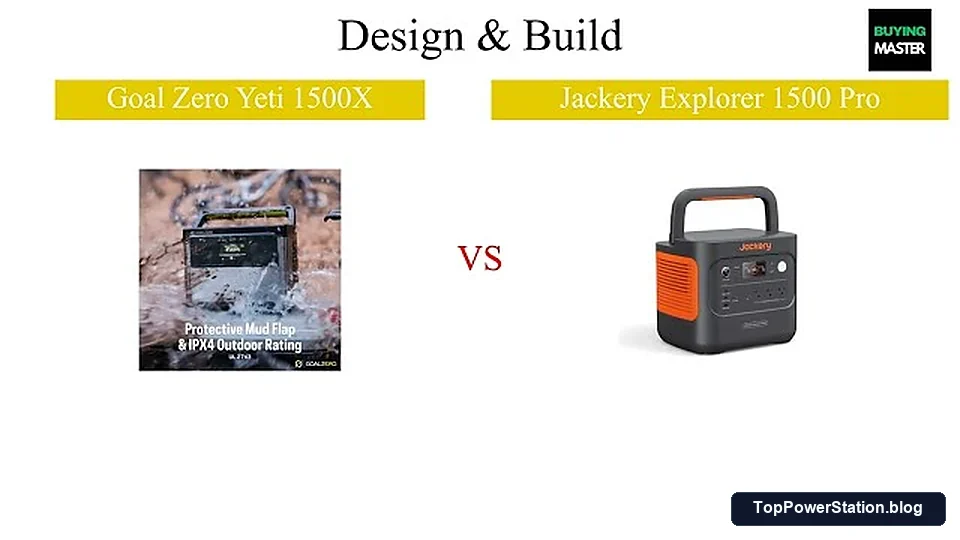
Examining the physical construction of these two power stations highlights fundamentally divergent approaches to portable energy engineering. Goal Zero targets professional durability while Jackery prioritizes accessible consumer ergonomics.
Internal layout configurations directly influence thermal dissipation rates and overall unit longevity under heavy continuous loads.
- Goal Zero utilizes an industrial-grade polymer casing designed for rugged outdoor deployments.
- Jackery incorporates a streamlined ABS shell focused on weight reduction and impact absorption.
- Internal buss bars differ significantly in gauge thickness and copper purity ratios.
Casing and Port Layout Configuration
Goal Zero spreads its extensive port array across the front faceplate, integrating specialized 12V connections alongside standard AC receptacles. You can analyze these capabilities further in our Goal Zero Yeti 1500X review.
Jackery opts for a clean, compartmentalized front panel featuring dedicated sections for AC, DC, and USB connections. Rubber port covers provide moderate dust resistance during outdoor field operations.
- Anderson powerpole ports offer superior high-amp DC connectivity for specialized solar arrays.
- Divided AC outlet spacing accommodates bulky power supply bricks without blocking adjacent ports.
Internal Battery Chemistry and BMS
Both units rely on high-density lithium-ion cells coupled with sophisticated Battery Management Systems to monitor voltage, current, and temperature parameters continuously. Safety thresholds prevent overcharging and deep discharge scenarios.
Thermal sensors positioned near critical hotspots trigger active cooling fans before internal temperatures degrade cell lifespans prematurely.
- Advanced BMS algorithms track overall health metrics to ensure optimal cycle retention.
- Active thermal regulation prevents localized hotspots during rapid charging phases.
Real-World Performance and Output Dynamics
Delivering stable alternating current under fluctuating electrical loads is the primary test for any portable generator. Both units claim large capacity metrics, but their real-world inverter efficiencies vary.
Voltage regulation stability ensures sensitive electronics remain protected from sudden micro-surges or brownout conditions during peak operational demands.
- Inverter conversion efficiency fluctuates based on ambient temperature and connected load types.
- Pure sine wave output prevents electrical humming or damage in inductive motor loads.
AC Inverter Surge Limits
The Goal Zero unit delivers a robust surge threshold capable of handling heavy compressor motor startups. We examine these draw spikes closely within our Goal Zero Yeti 1500X review.
Jackery handles startup surges gracefully within its specified rating, though extreme motor loads may trigger the internal circuit breaker to prevent catastrophic transistor failure.
- High surge capacity prevents nuisance trips when powering inductive household appliances.
- Overload recovery times dictate how quickly normal operation resumes after fault clearing.
Sustained Draw Under Heavy Load
Running high-wattage devices continuously pushes the internal cooling architecture to its absolute limits. Thermal throttling mechanisms engage gradually to protect sensitive electronic components from overheating.
Maintaining consistent voltage output prevents connected computers and medical devices from experiencing unexpected reboots during critical operations.
- Continuous output ratings reflect realistic long-term power delivery capabilities.
- Fan noise escalates proportionally with sustained thermal load intensities.
Charging Speeds and Solar Integration
Restoring energy reserves quickly is essential during extended grid outages or rapid off-grid turnaround scenarios. Both manufacturers provide multiple input pathways including wall outlets and solar panels.
Maximum solar input limits dictate how many photovoltaic panels you can chain together safely without overloading the internal charge controllers.
- Built-in MPPT controllers optimize incoming solar wattage under variable cloud cover.
- Wall charging speeds depend heavily on internal power supply brick capacities.
Wall Charging Versatility
Goal Zero offers modular charging accessories that allow users to scale wall charging speeds significantly. You can find more details in our Goal Zero charger silver review.
Jackery relies on an integrated power block system that plugs directly into standard wall outlets, offering a clean setup without bulky external bricks.
- Direct wall cords simplify transport by eliminating external power adapter bricks.
- Multi-source charging capabilities reduce total downtime between remote excursions.
MPPT Efficiency Metrics
Maximum Power Point Tracking controllers extract the highest possible voltage and amperage from connected solar panels, minimizing energy conversion losses across varying sun angles.
Wide voltage input ranges allow users to string multiple rigid panels together in series configuration for efficient long-distance cable runs.
- High tracking efficiency maximizes daily harvested solar energy yields.
- Broad voltage windows accommodate diverse third-party solar panel brands.
Efficiency, Longevity and Thermal Management
Long-term reliability depends heavily on how efficiently a power station manages idle energy consumption. Thermal performance metrics are thoroughly detailed in our Goal Zero Yeti 1000X review.
Understanding standby drain rates helps users prevent unexpected battery depletion when equipment sits idle in storage for extended periods.
- Idle power draw impacts overall energy retention during multi-week storage periods.
- Thermal management directly influences the calendar life of internal lithium cells.
Standby Drain Rates
Smart display screens and Bluetooth modules consume continuous micro-currents even when the main AC inverter is turned completely off. Monitoring these passive losses prevents sudden surprises.
Users should disconnect auxiliary expansion modules during long-term storage to minimize parasitic battery drain and preserve cell health.
- Passive electronic monitoring systems draw slight continuous background current.
- Physical master power switches completely sever circuit continuity for safe storage.
Active Cooling and Noise Profiles
Variable-speed cooling fans activate automatically when internal temperatures exceed safe operating thresholds during heavy charging or discharging phases.
Acoustic output varies noticeably between models, influencing suitability for quiet environments like tents or small office spaces.
- Fan noise levels dictate placement proximity in enclosed quiet living spaces.
- Optimized airflow channels reduce the frequency of high-RPM fan activations.
Usability, Ergonomics and Portability
Physical dimensions and handle placement dictate how comfortably these heavy power stations can be transported between vehicles and base camps.
Clear interface design ensures users can monitor critical operational metrics at a glance without navigating complex menu systems.
- Ergonomic handle placement reduces strain during two-person or solo lifts.
- Interface clarity improves user confidence during high-stress emergency situations.
Handle Design and Weight Distribution
Goal Zero incorporates heavy-duty folding handles integrated directly into the structural frame, providing secure grip points for awkward loads.
Jackery features dual fixed handles molded into the upper plastic shell, offering a balanced center of gravity for straightforward carrying.
- Fixed handles provide rigid security during frequent vehicle loading tasks.
- Balanced weight distribution minimizes physical fatigue during short carries.
Display and Interface Clarity
Digital LCD screens provide real-time metrics including battery percentage, input wattage, and estimated runtime remaining under current electrical loads.
Backlit screens ensure readability in complete darkness during nighttime emergency setups or remote campsite operations.
- Real-time runtime estimation helps users budget remaining battery reserves.
- Clear iconography prevents user confusion regarding active output ports.
Maintenance Protocols and Safety Standards
Proper upkeep ensures your power station remains ready for deployment during sudden grid failures or planned off-field expeditions.
Adhering to recommended storage and charging protocols maximizes total cycle life across years of regular usage.
- Routine firmware updates enhance operational stability and fix minor software bugs.
- Regular terminal cleaning prevents oxidation and maintains low electrical resistance.
Firmware Updates and Diagnostics
Advanced units feature diagnostic software accessible via smartphone apps, allowing users to monitor health parameters and apply manufacturer patches easily.
Routine self-tests verify internal sensor calibration and ensure safety protection circuits respond instantaneously to faults.
- App connectivity facilitates seamless software updates and remote monitoring.
- Diagnostic logs assist customer support teams in troubleshooting technical issues.
Long-Term Storage Best Practices
Storing lithium power stations at partial charge levels significantly reduces chemical degradation over extended periods of inactivity.
Keeping units in climate-controlled environments prevents extreme temperatures from damaging internal electronic components and battery cells.
- Partial state-of-charge storage preserves internal battery chemistry integrity.
- Temperature-controlled environments prevent premature thermal aging of components.
Final Buyer Fit and Application Verdict
Selecting the correct power station depends entirely on your specific mobile lifestyle, power requirements, and willingness to manage advanced features.
Evaluating your typical peak wattage demands will ensure you purchase a system capable of handling your essential appliances reliably.
- Match your daily watt-hour consumption with the unit's usable capacity.
- Consider your primary charging environment when evaluating solar compatibility.
When to Choose Goal Zero
Opt for the Goal Zero unit if you require a modular, expandable ecosystem that integrates seamlessly with professional work trailers or remote off-grid cabins.
Its rugged construction and heavy-duty port options suit users demanding industrial reliability above lightweight portability.
- Ideal for stationary backup applications and professional job sites.
- Modular expansion supports growing energy storage requirements over time.
When to Choose Jackery
Choose Jackery if your priorities center on straightforward recreational camping, RV trips, and dependable emergency home backup without complex setup procedures.
Its integrated design and user-friendly interface provide hassle-free operation for casual outdoor enthusiasts.
- Perfect for weekend campers and mobile overlanding setups.
- Simple plug-and-play operation eliminates steep learning curves.
Frequently Asked Questions
Can I leave these power stations plugged into a wall outlet continuously for emergency backup?
Yes, both units feature pass-through charging capabilities and advanced battery management systems designed to maintain optimal charge levels safely. Continuous float charging ensures your system remains ready for sudden grid failures without damaging the internal cells.
What is the primary difference in solar panel compatibility between these two models?
While both accept third-party solar panels, their maximum voltage limits and proprietary connector styles differ significantly. Checking adapter requirements beforehand ensures seamless physical and electrical integration with your existing photovoltaic setup.
How long do the internal lithium batteries last before significant capacity degradation occurs?
Both power stations typically deliver hundreds of charge cycles before retaining roughly eighty percent of their original capacity. Proper thermal management and avoiding deep discharges will extend this operational lifespan considerably over years.
Can I use these generators to power sensitive medical devices like CPAP machines?
Yes, both units produce clean pure sine wave alternating current suitable for sensitive electronics and medical equipment. Using DC converters when available can further maximize efficiency by bypassing unnecessary AC inversion stages.
Are these power stations approved for airline travel in checked or carry-on luggage?
No, their total watt-hour capacities far exceed the strict legal limits permitted by commercial airlines for lithium batteries. Ground transport is mandatory for moving these high-capacity energy storage units safely.