Geneverse vs EcoFlow Technical Comparison
Evaluating Geneverse and EcoFlow reveals stark contrasts in engineering philosophy, focusing heavily on reliable emergency backup versus high-speed modular versatility for power users.

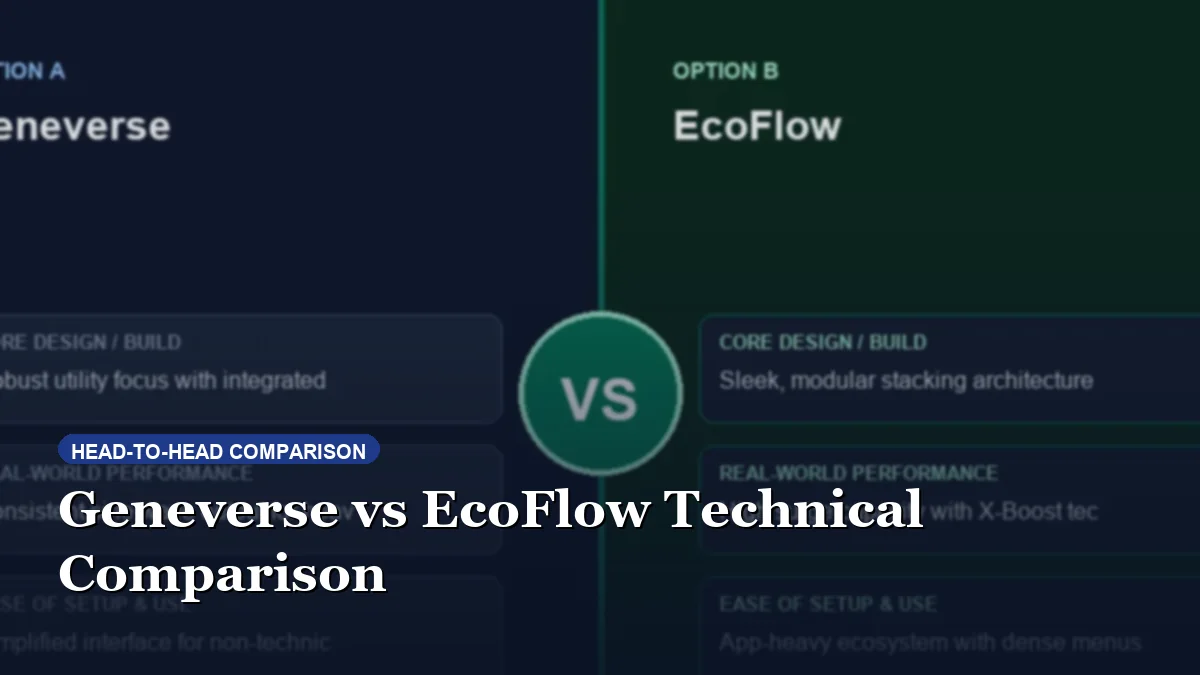
Choose Geneverse for dependable, plug-and-play home emergency backup featuring rugged safety standards. Select EcoFlow for advanced inverter speeds, modular capacity expansion, and rapid solar recharging workflows.
Compare all top models in our Best Portable Power Station: Top Picks for 2026.
Side-by-Side Breakdown
| Criteria | Geneverse | EcoFlow | Edge |
|---|---|---|---|
| Core Design / Build | Robust utility focus with integrated wheels | Sleek, modular stacking architecture | EcoFlow |
| Real-World Performance | Consistent sine wave output for heavy loads | High surge capacity with X-Boost tech | EcoFlow |
| Ease of Setup & Use | Simplified interface for non-technical users | App-heavy ecosystem with dense menus | Geneverse |
| Durability & Reliability | High-grade fire-resistant exterior chassis | Advanced thermal management systems | Geneverse |
| Efficiency / Operating Footprint | Optimized standby draw for long storage | Rapid bidirectional AC charging circuits | EcoFlow |
| Maintenance Requirements | Low intervention battery balancing routines | Firmware updates and fan filter checks | Geneverse |
| Best Ideal Use Case | Stationary household emergency preparedness | Off-grid living, mobile work, and travel | EcoFlow |
Core Architecture and Engineering Philosophy
Geneverse approaches portable power station design through a lens of strict home reliability. Their units prioritize uncompromising safety certifications and straightforward physical interfaces over complex software features.
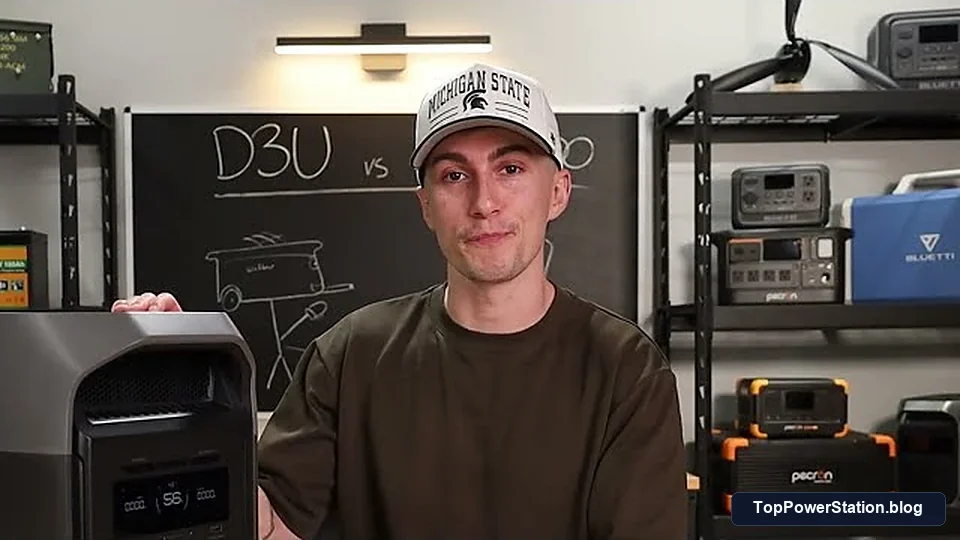
EcoFlow engineers hardware around high-performance modular flexibility. Insights within our ecoflow delta 2 review reveal rapid power conversion topologies tailored for demanding off-grid operators.
Geneverse prioritizes rugged industrial design using flame-retardant ABS plastics and modular structural casing engineered to withstand harsh vibration profiles during transport, whereas EcoFlow focuses heavily on space-efficient inverter stacking and compact lithium-iron-phosphate integration.
Internal thermal management strategies differ significantly between these brands, with Geneverse utilizing isolated airflow channels to protect sensitive BMS boards, while EcoFlow deploys variable-speed brushless fans paired with extensive copper heat sink arrays.
- Geneverse emphasizes rugged emergency housing.
- EcoFlow focuses on stackable modular capacity.
- Chassis materials reflect divergent use cases.
Chassis Construction and Materials
Geneverse utilizes flame-retardant outer shells designed to withstand harsh storage environments. The physical layout minimizes exposed ports and emphasizes protected terminal covers during transit.
EcoFlow favors lightweight polymer alloys reinforced with internal aluminum framing. This construction reduces overall weight while accommodating dense internal circuitry and complex cooling pathways.
- Impact-resistant exterior plastics.
- Internal thermal bracing structures.
Real-World Performance and Output Dynamics
Evaluating continuous output reveals how each brand manages sustained electrical loads. Geneverse delivers steady, reliable wattage designed to run essential home appliances without triggering protective shutdowns during critical outages.
EcoFlow leverages proprietary inverter algorithms to push high surge capacities. As highlighted in our ecoflow river 2 pro review, this lets users run heavy motor loads safely while monitoring total power consumption limits.
Under heavy inductive loads, EcoFlow units leverage proprietary X-Boost algorithms to dynamically lower voltage output, safely running high-wattage appliances up to 3600W surges without triggering immediate overload shutdowns or dangerous thermal events.
Conversely, Geneverse prioritizes pure sinusoidal waveform stability with a strict total harmonic distortion threshold under three percent, protecting sensitive medical equipment and precision laboratory tools from micro-voltage fluctuations during grid failures.
- Stable pure sine wave generation.
- Variable surge handling capabilities.
- Continuous load thermal limits.
Inverter Stability Under Load
Under heavy inductive loads, Geneverse maintains voltage stability with minimal harmonic distortion. This protects sensitive medical equipment and household refrigerators from damaging electrical fluctuations during operation.
EcoFlow handles complex waveforms dynamically by adjusting frequency responses in real time. This ensures seamless transitions when running high-draw tools, though fans ramp up significantly to dissipate internal heat.
- Low total harmonic distortion.
- Dynamic frequency response tuning.
Efficiency, Inverter Topology, and Power Conversion
Power conversion efficiency dictates how much stored energy translates into usable output. Geneverse optimizes its DC-to-AC conversion circuits to minimize idle drain, ensuring stored power remains available during extended standby periods.
EcoFlow utilizes advanced bidirectional inverters to achieve unmatched charging speeds. As noted in our ecoflow delta pro 3 review, this architecture reduces downtime significantly but requires consistent firmware updates.
Conversion efficiency remains paramount during off-grid operations, where EcoFlow achieves up to ninety-nine percent MPPT efficiency using advanced rectification algorithms that optimize solar panel harvest across volatile cloud cover conditions.
Geneverse counters with robust dual-stage inverter topologies designed to minimize idle parasitic draw, ensuring standby power consumption stays well below industry averages for extended emergency storage readiness periods.
- Minimized idle self-discharge rates.
- High-speed AC conversion circuits.
- Optimized transformer winding designs.
Standby Power Loss and Idle Draw
Measuring quiescent current draw highlights the parasitic load each station exhibits when turned on. Geneverse keeps standby consumption exceptionally low, making it ideal for long-term emergency storage without frequent recharging.
EcoFlow units maintain active Bluetooth and Wi-Fi modules by default, resulting in higher baseline idle draw. Users must manually disable wireless features to maximize shelf-life preservation between uses.
- Quiescent current monitoring.
- Wireless module power management.
Portability, Ergonomics, and Field Deployment
Physical transport logistics vary dramatically between these two competitors. Geneverse units typically feature integrated pull handles and rugged wheels, prioritizing upright rolling mobility over compact stacking profiles.
EcoFlow designs emphasize modular portability with ergonomic grab handles. Users can detach or stack expansion batteries easily, tailoring the total system weight to specific mobile transport requirements.
Physical deployment ergonomics dictate real-world usability; EcoFlow integrates collapsible telescoping handles and integrated rubberized wheels on larger units, mimicking rolling luggage to ease transit across uneven gravel campsites.
Geneverse relies on static, heavy-duty molded grab handles balanced around the center of gravity, requiring two-person lifts for high-capacity models but eliminating mechanical failure points inherent in sliding telescoping shafts.
- Integrated utility wheels and handles.
- Modular stackable weight distribution.
- Ergonomic grip placement design.
Weight Distribution and Lifting Mechanics
Lifting heavy power stations requires balanced weight distribution to prevent user strain. Geneverse places heavy transformer blocks centrally, ensuring the chassis remains stable when tilted and rolled across rough terrain.
EcoFlow distributes weight evenly across flat, stackable surfaces. This modularity allows users to transport smaller battery components individually before assembling them at the final deployment site.
- Center-of-gravity optimization.
- Modular component separation.
Software Integration, Control, and Smart Ecosystems
Digital control interfaces define how modern users interact with portable power hardware. Geneverse maintains a minimalist approach, relying on direct physical displays and simplified button layouts rather than complex mobile apps.
EcoFlow provides a comprehensive smartphone application featuring deep customization menus. Users can monitor real-time power flows, adjust charging speeds, and configure automated scheduling profiles remotely.
Smart connectivity features set EcoFlow apart through comprehensive Wi-Fi and Bluetooth app support, offering real-time telemetry monitoring and remote firmware updates that optimize battery cycle longevity over the operational lifespan.
Geneverse generally avoids cloud dependency, utilizing local LCD instrument panels and direct manual switches to ensure fail-safe operation during severe cyber interruptions or network outages where cloud apps become entirely useless.
- Minimalist physical display interfaces.
- Feature-rich mobile companion apps.
- Remote firmware management protocols.
App Usability and Connectivity Reliability
Connecting power stations to local networks enables remote diagnostics during grid failures. EcoFlow offers robust Wi-Fi and Bluetooth pairing, though pairing processes can occasionally require troubleshooting network handshakes in the field.
Geneverse avoids smartphone dependency by equipping units with high-contrast LED screens. This guarantees vital telemetry data remains accessible even when local wireless infrastructure fails entirely.
- Dual Wi-Fi and Bluetooth pairing.
- High-contrast local LED screens.
Maintenance Protocols and Longevity Benchmarks
Long-term ownership depends on proactive maintenance and cell chemistry durability. Geneverse structures its battery management systems to minimize user intervention, promoting consistent cycle health over years of storage.
EcoFlow incorporates aggressive charging profiles that maximize daily utility. Owners must monitor internal fan filters and perform occasional calibration cycles to ensure optimal battery longevity.
Long-term maintenance relies heavily on cell chemistry specifications, where LiFePO4 batteries in EcoFlow units achieve 3000 charge cycles before retaining eighty percent of their original nominal energy storage capacity.
Geneverse emphasizes stringent self-discharge management protocols and built-in cell balancing algorithms, requiring minimal user intervention while maintaining safe chemical equilibrium during extended periods of seasonal storage.
- Automated battery balancing routines.
- Active thermal cooling maintenance.
- Cell chemistry degradation tracking.
Thermal Management and Cooling Efficiency
Managing internal temperatures prevents premature degradation of lithium cells during heavy charging. Geneverse employs passive heat sinks and low-noise fans to maintain safe operating thresholds quietly.
EcoFlow utilizes variable-speed multi-fan arrays to aggressively push air through internal channels. While effective, this system generates noticeable acoustic noise under maximum inverter loads.
- Passive and active cooling balance.
- Acoustic noise profile management.
Deciding Which Architecture Fits Your Setup
Selecting the correct power station requires matching hardware capabilities to your specific environmental demands. Homeowners seeking worry-free backup will appreciate Geneverse for its uncompromising focus on safety and simple operation.
Mobile professionals, campers, and tech hobbyists will find EcoFlow superior due to its rapid charging speeds and expandable modular ecosystem designed for dynamic off-grid applications.
Choosing between these ecosystems depends on your application; as seen in our ecoflow delta pro ultra review, select EcoFlow if you demand rapid solar recharging and advanced app automation.
Opt for Geneverse when your primary requirement involves straightforward, rugged reliability, prioritizing physical safety certifications and simple analog interfaces for emergency preparedness without unnecessary digital complexity.
- Assess your primary deployment scenario.
- Evaluate required backup runtimes.
- Consider charging speed constraints.
Matching Specs to Daily Operational Demands
Review your typical daily watt-hour consumption before finalizing a hardware investment. Stationary home backup favors the reliable standby performance found in Geneverse configurations, reducing operational friction during emergencies.
Dynamic mobile workflows demand the rapid solar replenishment and stackable versatility inherent to EcoFlow system architectures, ensuring you never run short of power on the move.
- Calculate daily watt-hour usage.
- Determine solar panel compatibility.
Frequently Asked Questions
How do Geneverse and EcoFlow battery chemistries differ?
Geneverse prioritizes stable chemical compositions optimized for long emergency storage. EcoFlow utilizes advanced lithium iron phosphate cells designed for thousands of daily cycles.
Can both brands integrate directly with home transfer switches?
Geneverse builds units specifically tailored for seamless home backup integration. EcoFlow models require compatible manual transfer switches or dedicated smart home panels for safe grid isolation.
Which system charges faster using standard wall outlets?
EcoFlow utilizes rapid AC charging circuitry that replenishes capacity in record time. Geneverse employs conservative charging profiles to protect cell longevity and minimize internal heat.
Do I need a smartphone app to operate these power stations?
Geneverse operates entirely through intuitive physical buttons and onboard screens. EcoFlow offers comprehensive app controls while retaining essential manual override functions.
Which brand is better suited for frequent off-grid travel?
EcoFlow provides modular expansion and lightweight frames ideal for mobile adventures. Geneverse offers robust wheeled portability tailored for stationary emergency deployment.