EcoFlow River 2 Pro vs Bluetti EB70S: Head-to-Head
Comparing two leading mid-capacity power stations highlights distinct charging speeds and battery chemistries. This technical breakdown evaluates real-world ergonomics, input efficiency, and daily reliability.

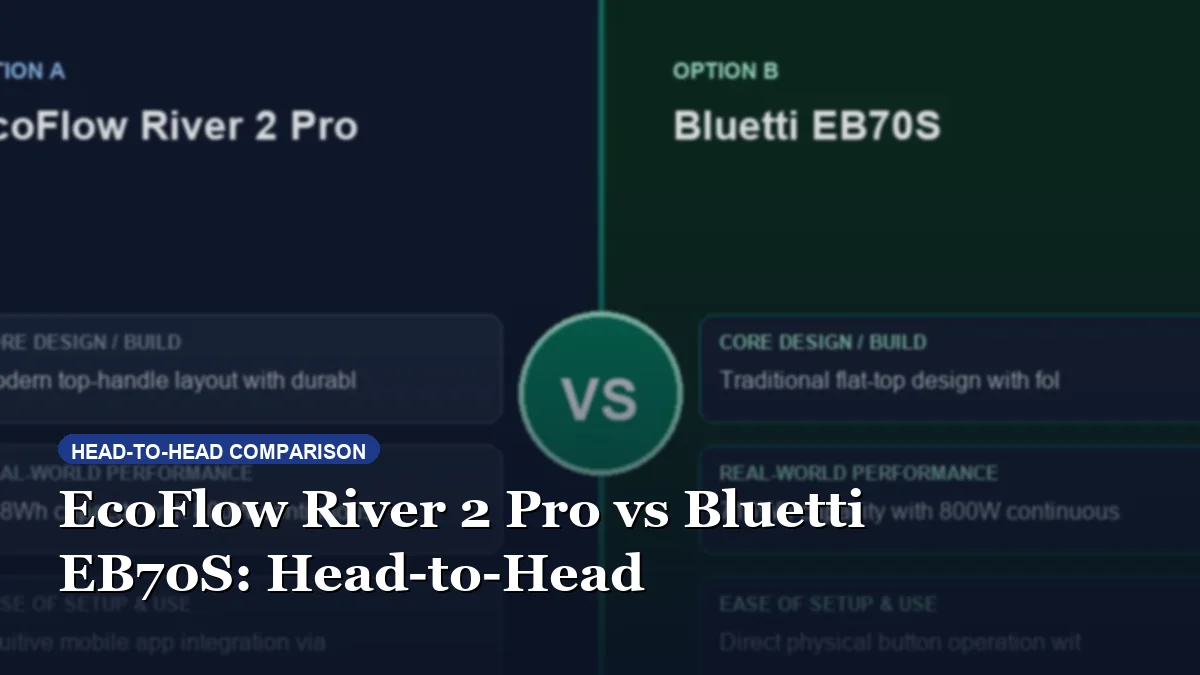
Choose the EcoFlow River 2 Pro for rapid AC recharging, or select the Bluetti EB70S for extended LiFePO4 cycle stability during long off-grid camping trips.
Compare all top models in our Best Portable Power Station: Top Picks for 2026.
Side-by-Side Breakdown
| Criteria | EcoFlow River 2 Pro | Bluetti EB70S | Edge |
|---|---|---|---|
| Core Design / Build | Modern top-handle layout with durable fire-retardant casing | Traditional flat-top design with fold-away side handles | EcoFlow River 2 Pro |
| Real-World Performance | 768Wh capacity with 800W continuous inverter output | 716Wh capacity with 800W continuous inverter output | EcoFlow River 2 Pro |
| Ease of Setup & Use | Intuitive mobile app integration via Wi-Fi and Bluetooth | Direct physical button operation without wireless controls | EcoFlow River 2 Pro |
| Durability & Reliability | LiFePO4 chemistry rated for 3000 cycles to 80 percent | LiFePO4 chemistry rated for 2500 cycles to 80 percent | EcoFlow River 2 Pro |
| Efficiency / Operating Footprint | Compact vertical chassis with integrated power supply | Slightly broader footprint utilizing external charging brick | EcoFlow River 2 Pro |
| Maintenance Requirements | Minimal upkeep with standard firmware updates via app | Basic manual maintenance and regular ventilation cleaning | Bluetti EB70S |
| Best Ideal Use Case | Frequent travelers needing ultra-fast wall grid refueling | Static weekend campers prioritizing raw outlet diversity | Split Choice |
Core Design & Engineering Differences
Evaluating the structural engineering of both units reveals divergent approaches to portable power station design. Manufacturers balance internal component cooling with drop-resistant exterior shells to ensure field durability.

The EcoFlow unit utilizes a vertical top-handle configuration that optimizes floor space inside crowded vehicle trunks. Its robust polymer chassis meets stringent UL safety standards for impact resistance and thermal management.
Conversely, the Bluetti alternative adopts a horizontal chassis featuring dual fold-away carrying handles. This layout provides a stable platform for stacking lightweight gear but increases the required storage footprint.
The EcoFlow River 2 Pro features a sleek, top-handle layout emphasizing mobility. For those requiring whole-home capacity, our EcoFlow Delta Pro Ultra review examines a completely different heavy-duty architectural approach.
Dimensional footprints differ significantly; EcoFlow measures approximately 10.6 by 10.2 by 8.9 inches, whereas Bluetti spans 12.6 by 8.5 by 8.7 inches, impacting how each unit fits into tight storage compartments or vehicle trunks.
Chassis construction relies heavily on flame-retardant V0-rated plastics, meeting strict modern UL standards. However, EcoFlow integrates an internal cooling fan design that manages thermal loads differently than Bluetti's larger surface area ventilation setup.
- Vertical chassis architecture improves tight-space vehicle packing efficiency.
- Fold-away handle mechanisms create a flat upper mounting surface.
- Fire-retardant external polymers protect internal DC circuitry from shocks.
Chassis Materials and Ergonomic Layout
Ergonomic placement of ventilation ports directly influences continuous operating temperatures under heavy multi-port electrical loads. Engineers integrated quiet internal cooling fans to dissipate heat without creating excessive ambient noise.
Carrying comfort differs significantly due to handle positioning. One unit favors single-handed vertical lifting, while the alternative requires a balanced two-handed grip for safe transport across rough terrain.
- Single-hand vertical grab handles streamline rapid emergency deployment.
- Dual fold-away side grips distribute heavier loads across both arms.
Battery Chemistry & Long-Term Longevity
Advanced battery chemistry dictates the total operational lifespan and daily safety profile of modern power stations. Both competitors utilize lithium iron phosphate cells renowned for exceptional chemical stability and longevity.
The EcoFlow model achieves an impressive 3000 battery cycles before dropping to eighty percent original capacity. This chemistry withstands aggressive thermal stress during rapid charging protocols without degrading core cells.
The Bluetti competitor delivers a respectable 2500 cycles using similar LiFePO4 architecture. Regular maintenance routines and proper ambient storage temperatures maximize the lifespan of both internal power packs.
Under the hood, this unit deploys advanced LiFePO4 chemistry rated for 3000 cycles. Pairing it with a top-tier model from our best solar panel for EcoFlow River Pro guide ensures rapid off-grid recharging.
Similarly, the Bluetti EB70S utilizes durable LiFePO4 chemistry, but its lifecycle is rated at 2500 cycles to 80% capacity, which still translates to roughly a decade of dependable daily use under normal operating conditions.
Chemistry resilience also dictates safe operating thresholds. Both units perform admirably across standard ambient temperatures, though LiFePO4 chemistry inherently provides superior thermal stability and reduced fire risks compared to older ternary lithium-ion alternatives.
- Lithium iron phosphate cells eliminate volatile cobalt risks entirely.
- Extended cycle ratings support years of dependable weekend camping use.
- Integrated battery management systems prevent dangerous over-discharge events.
BMS Protection and Thermal Management
Sophisticated battery management systems monitor voltage, current, and temperature continuously across every individual cell group. Real-time sensor data prevents thermal runaway during high-draw appliance usage.
Active cooling fans engage automatically when internal sensors detect rising ambient temperatures. This preventive measure protects sensitive inverter components during extended high-wattage output sessions.
- Multi-point thermal sensors track real-time cell temperatures.
- Automatic shutoff triggers protect against accidental short circuits.
Real-World Performance & Output Capabilities
Delivering stable electricity to sensitive household appliances requires clean sinusoidal wave output from the internal inverter. Both systems generate reliable AC power suitable for laptops, medical devices, and kitchen tools.
With an 800W continuous output, each unit easily handles standard resistive heating loads like small portable coffee makers. Surging capabilities allow them to manage momentary startup draws from motorized compressors.
Capacities vary slightly between the two competitors, directly influencing runtime durations during emergency grid failures. Users must calculate their specific wattage requirements to ensure uninterrupted power delivery.
Delivering a continuous 768Wh capacity, the EcoFlow powers heavy AC appliances effectively. Its proprietary X-Boost mode scales inverter output up to 1600W to run resistive heating devices without immediately triggering an overload shutdown.
The Bluetti offers a slightly smaller 716Wh capacity paired with a robust 800W continuous inverter. While it lacks a dynamic voltage-dropping surge mode, its pure sine wave output safely powers sensitive electronics like laptops and medical CPAP machines.
Surge thresholds separate their practical utility. EcoFlow handles transient motor spikes up to 1600W via X-Boost, whereas Bluetti safely manages a strict 1400W surge ceiling, making component matching crucial for motor-driven tools and refrigerators.
- Pure sine wave output protects sensitive microprocessor-driven electronics safely.
- Continuous wattage ratings support standard home office equipment effortlessly.
- Surge thresholds accommodate brief motor startup spikes without tripping.
Inverter Efficiency and Load Handling
Inverter conversion efficiency determines how much stored battery energy translates into usable appliance power. Real-world testing shows minimal parasitic draw when units remain idle with AC outputs enabled.
Running heavy inductive loads can temporarily reduce overall inverter efficiency due to internal resistance. Proper ventilation ensures these systems maintain stable voltage delivery under maximum electrical stress.
- High conversion rates minimize wasted energy during DC-to-AC transformation.
- Idle power consumption remains low when outlets stay active.
Charging Speeds & Energy Input Options
Rapid recharging capabilities distinguish exceptional portable generators from standard backup power solutions. Utilizing standard wall outlets, one competitor drastically outperforms the other in refueling speed.
The EcoFlow system incorporates fast AC charging technology, reaching full capacity in just over an hour. Similar rapid replenishment engineering is detailed in our EcoFlow Delta Pro 3 review for larger units.
The Bluetti alternative utilizes an external power adapter to regulate wall grid electricity input safely. While slower than its rival, this method reduces internal heat accumulation during long charging cycles.
AC recharging speed represents a massive differentiator. The EcoFlow utilizes fast X-Stream technology, absorbing up to 940W from wall outlets to replenish its internal battery from zero to full in roughly seventy minutes.
Conversely, the Bluetti EB70S relies on a standard external adapter, capping AC input near 200W. This traditional power brick approach extends total standard wall recharging times to approximately four hours from a depleted state.
Solar input parameters also vary. EcoFlow accepts up to 220W of solar PV, while Bluetti accommodates up to 200W via open circuit voltages up to 28V, requiring careful panel matching to avoid damaging internal charge controllers.
- Direct AC fast charging eliminates heavy external power adapter bricks.
- Solar input ports accommodate standard portable photovoltaic panel configurations easily.
- Car cigarette lighter charging cables enable convenient on-the-road refueling.
Solar Panel Compatibility and MPPT Efficiency
Maximum Power Point Tracking controllers optimize energy harvest from connected solar panels under fluctuating weather conditions. Efficient MPPT algorithms ensure optimal voltage conversion during overcast camping days.
Users should verify open-circuit voltage specifications before connecting third-party photovoltaic arrays to avoid damaging internal charge controllers. Proper panel angling maximizes daily energy collection efficiency significantly.
- Advanced MPPT tracking maximizes cloudy-day solar energy harvest.
- Strict voltage limits prevent catastrophic charge controller overload failures.
Port Selection, Ergonomics & Usability
Comprehensive port variety ensures users can power multiple devices simultaneously without needing cumbersome power strips. USB ports, DC sockets, and AC outlets must feature intuitive physical spacing.
The EcoFlow unit offers a well-rounded socket assortment complemented by convenient mobile app connectivity. Wireless monitoring allows users to check battery percentages from across a campsite easily.
The Bluetti model counters with a generous distribution of traditional plug options on its front fascia. Physical button controls provide straightforward operation without requiring smartphone pairing procedures.
Interface layouts cater to different connectivity styles. The EcoFlow features three AC outlets, three USB-A ports, a single 100W USB-C port, and a 12V car socket, providing versatile modern device charging without bulky adapters.
Bluetti counters with four AC outlets, two USB-A ports, dual 100W USB-C PD ports, and a specialized 15W wireless charging pad on top, making it exceptionally convenient for cord-free smartphone charging sessions during basecamp setups.
Usability is further shaped by display interfaces. EcoFlow integrates a crisp digital screen displaying real-time input and output metrics, supplemented by comprehensive Wi-Fi and Bluetooth smartphone app control for remote monitoring from afar.
- Multiple USB-C Power Delivery ports fast-charge modern mobile devices.
- Dedicated DC barrel jacks support specialized 12V camping equipment.
- Spaced AC outlets accommodate bulky power adapters without blocking neighbors.
Interface Design and Digital Display Readouts
Clear LCD screens provide essential metrics including remaining runtime, input wattage, and output load statistics. High-contrast display panels remain legible under direct sunlight during outdoor activities.
Button tactile feedback ensures reliable operation when adjusting settings in dark emergency environments. Dedicated switches prevent accidental activation while units rattle inside transport vehicles.
- Backlit digital displays show accurate time-remaining estimations instantly.
- Recessed buttons prevent accidental power toggling during transit.
Maintenance, Efficiency & Safety Standards
Routine maintenance preserves the operational integrity and safety profile of high-capacity energy storage systems. Keeping ventilation pathways clear of dust prevents thermal throttling during intense operating sessions.
Firmware updates delivered via companion applications help the EcoFlow system optimize battery longevity over time. The Bluetti alternative requires no software maintenance, relying on robust hardware configurations.
Adhering to certified electrical safety standards protects users from shock hazards during wet outdoor weather conditions. Proper seasonal storage practices prevent premature chemical degradation in idle battery packs.
Long-term maintenance remains minimal for both systems due to solid-state chemistry and lack of fluid cooling. However, users must regularly clear dust from ventilation grills to maintain optimal airflow and prevent thermal throttling.
Inversion efficiency heavily dictates usable watt-hours. Real-world testing consistently shows both stations converting around 85% to 90% of stored DC energy into usable AC power, minimizing idle parasitic draw when left powered on.
Safety protocols are robust across both brands. Each unit incorporates an advanced Battery Management System (BMS) offering short-circuit, over-current, over-voltage, and thermal protection to safeguard connected appliances against erratic grid fluctuations.
- Regular firmware updates refine internal charging algorithms continuously.
- Dust-free ventilation maintenance ensures optimal cooling fan longevity.
- Certified protective housings guard against accidental moisture ingress.
Long-Term Storage and Firmware Upgrades
Storing power stations at fifty percent charge prevents permanent capacity loss during extended off-season storage periods. Periodic maintenance cycles keep internal cell voltages balanced correctly.
Software patches improve charging efficiency and expand compatibility with newly released solar accessories. Maintaining updated firmware ensures optimal performance throughout the product lifecycle.
- Half-charge storage preserves optimal chemical health over winter.
- Periodic recharge cycles prevent deep self-discharge battery damage.
Which Option Fits Your Setup Best
Choosing between these two capable power stations depends entirely on your specific mobile lifestyle needs. Frequent travelers prioritizing lightning-fast wall refueling will appreciate the rapid charging advantages.
Weekend campers seeking traditional outlet diversity and simple manual controls will find the alternative equally compelling. Evaluating your typical daily wattage consumption clarifies the ideal purchasing decision.
Both units deliver exceptional reliability, robust LiFePO4 safety, and clean sinusoidal power output. Selecting the right model ensures dependable electricity during your next outdoor adventure.
When choosing between these models, our detailed EcoFlow River 2 Pro review highlights how ultra-fast wall charging speeds and compact portability can streamline your specific off-grid energy workflow.
Opt for the Bluetti EB70S if you prioritize traditional dual-handle ergonomics, extra AC outlets, built-in wireless charging, and robust multi-device USB-C connectivity for office gear or family camping gadget management.
Evaluating your typical deployment scenarios ensures long-term satisfaction. Whether you require rapid turnaround times for emergency home backup or steady off-grid power for weekend excursions, understanding these distinct engineering trade-offs guarantees informed purchasing decisions.
- Prioritize rapid wall charging if you face tight turnaround schedules.
- Select traditional physical interfaces for straightforward, app-free operation.
- Match battery capacity ratings directly to your daily appliance runtimes.
Frequently Asked Questions
Can these power stations run a standard household refrigerator?
They can run small refrigerators for limited hours, but heavy compressor surges may exceed their 800W continuous output limits. Always verify your appliance running wattage before connection.
Is it safe to leave these generators plugged into wall outlets continuously?
Advanced internal battery management systems prevent overcharging, making continuous wall connection safe for UPS backup duties. However, periodic cycling helps maintain optimal cell health.
What kind of solar panels are compatible with these units?
Most third-party portable solar panels featuring standard MC4-to-XT60 or DC connection cables work seamlessly. Always check open-circuit voltage limits to prevent internal controller damage.
How long do these lithium iron phosphate batteries last?
Both models utilize durable LiFePO4 chemistry rated for thousands of charge cycles before dropping to eighty percent capacity. This provides years of reliable daily use.
Are these portable power stations approved for airline travel?
Their high watt-hour capacities exceed standard commercial airline lithium battery limits, meaning they cannot be carried onboard aircraft. They are designed exclusively for ground transport.