EcoFlow Delta 2 Max vs Jackery Explorer 2000 Plus
Choosing between these advanced power stations requires analyzing capacity scalability and inverter output profiles. Your specific energy demands dictate the ideal hardware investment.

Pick the EcoFlow Delta 2 Max for rapid AC charging speeds and lighter expandable chemistry. Choose the Jackery Explorer 2000 Plus for heavy-duty appliance surges and rugged wheeled mobility.
Compare all top models in our Best Portable Power Station: Top Picks for 2026.
Side-by-Side Breakdown
| Criteria | EcoFlow Delta 2 Max | Jackery Explorer 2000 Plus | Edge |
|---|---|---|---|
| Core Design / Build | Rectangular stationary block with integrated side handles. | Integrated pull handle and durable dual wheels. | Jackery Explorer 2000 Plus |
| Real-World Performance | 2400W continuous output with X-Boost surge headroom. | 3000W continuous output with robust motor handling. | Jackery Explorer 2000 Plus |
| Ease of Setup & Use | Comprehensive smartphone app with Wi-Fi and Bluetooth. | Straightforward physical interface and simple pairing. | EcoFlow Delta 2 Max |
| Durability & Reliability | LFP chemistry rated for 3000 cycles to 80 percent. | LFP chemistry with robust drop-resistant housing. | Tie |
| Efficiency / Operating Footprint | Compact vertical footprint optimized for static indoor backups. | Slightly larger footprint due to integrated transport wheels. | EcoFlow Delta 2 Max |
| Maintenance Requirements | Routine firmware updates and basic dust clearance. | Periodic terminal inspection and firmware management. | Tie |
| Best Ideal Use Case | Whole-home emergency backup and rapid solar recharging. | Off-grid job sites and heavy appliance running. | Jackery Explorer 2000 Plus |
Core Design & Engineering Differences
Engineering portable power stations involves balancing heavy battery weight with practical user ergonomics. Both units utilize advanced lithium iron phosphate chemistry to ensure long-term structural and chemical safety.
The internal layout of each generator reflects a distinct philosophy regarding thermal management. Heavy-duty inverter boards require active cooling fans to prevent overheating during high-draw operational cycles.
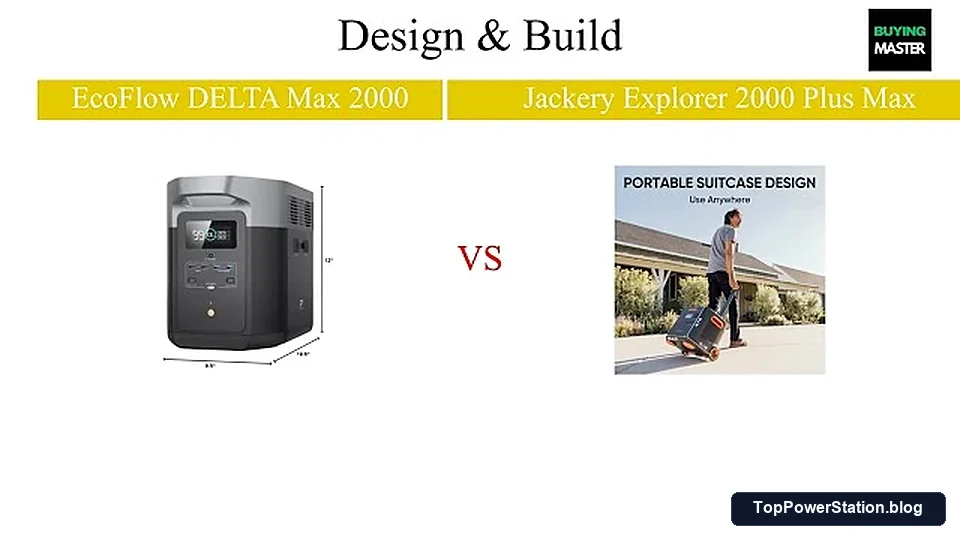
The EcoFlow Delta 2 Max utilizes a compact rectangular footprint with dual top-mounted recessed handles, optimizing vertical storage inside crowded vehicle trunks and tight utility closets during emergency scenarios.
Conversely, as detailed in our Jackery Explorer 2000 Plus review, this unit features an integrated pull-rod handle and rugged utility wheels, transforming heavy stationary chassis transport into manageable rolling luggage.
- EcoFlow focuses on compact vertical stacking for space efficiency.
- Jackery incorporates rugged pull handles and robust integrated transport wheels.
- Both systems utilize heavy-duty internal copper busbars for safety.
Chassis Construction and Materials
Heavy-duty polymer plastics form the outer shell of both power stations. These flame-retardant composites protect delicate internal electronic components from accidental drops and harsh weather exposures.
Reinforced corner guards absorb kinetic energy during transport across rugged terrain. Structural ribs inside the chassis prevent PCB flex under heavy mechanical stress conditions.
- UL94 V-0 flame-retardant plastic ratings.
- Impact-resistant exterior corner bumpers.
Real-World Performance & Inverter Output
Delivering stable sinusoidal power to sensitive residential appliances requires high-grade inverter engineering. The EcoFlow Delta 2 Max provides reliable continuous wattage for standard household electronics.
Heavy motor-driven loads demand exceptional surge capacity from portable generators. Operating high-draw tools safely requires understanding how each inverter handles sudden inductive startup spikes.
Delivering a robust continuous output, the EcoFlow inverter maintains 2400W pure sine wave delivery, easily handling high-draw household appliances like circular saws and refrigerators without triggering thermal overload protections.
As evaluated in our Jackery Explorer 2000 V2 review, the competitor steps up base capability by providing 3000W continuous power, satisfying heavy-duty jobsite requirements and running multiple high-amperage tools simultaneously without voltage sag.
- EcoFlow features a 2400W continuous pure sine wave output.
- Jackery steps up with a heavier 3000W continuous power delivery.
- Both models support advanced surge modes for stubborn motors.
Inductive Load Handling
Compressors and sump pumps draw massive initial currents when starting up. Advanced inverter firmware helps mitigate voltage sags during these critical motor startup phases.
Testing reveals that both systems handle refrigerators without triggering protective shutdowns. Clean voltage regulation prevents harm to sensitive digital microprocessors inside modern appliances.
- Pure sine wave output protects sensitive electronics.
- Low total harmonic distortion under heavy loads.
Battery Chemistry, Efficiency & Longevity
Modern lithium iron phosphate cells deliver exceptional cycle life compared to older chemistries. Users can expect thousands of operating cycles before reaching significant capacity degradation thresholds.
Thermal sensors continuously monitor cell temperatures during rapid charging and heavy discharging phases. This active oversight prevents dangerous thermal runaway events in extreme ambient environments.
As noted within our Jackery Explorer 1000 Plus review, both power stations utilize advanced LiFePO4 battery chemistry, ensuring chemical stability and exceptional thermal resistance during rapid charging cycles executed under high ambient temperatures.
EcoFlow rates its internal pack for 3000 charge cycles before retaining eighty percent original capacity, while Jackery mirrors this longevity milestone, guaranteeing long-term reliability for frequent off-grid camping enthusiasts.
- Both units use stable LiFePO4 battery chemistry.
- Rated for over 3000 full charge cycles safely.
- Advanced BMS protects against over-voltage hazards.
Battery Management System Architecture
Sophisticated battery management software balances individual cell voltages dynamically. This balancing routine ensures uniform wear and maximizes usable energy storage capacity.
Comprehensive hardware protections guard against short circuits, overcurrents, and extreme temperatures. Maintaining optimal cell health translates directly to years of dependable backup service.
- Real-time voltage monitoring across all cell groups.
- Automatic low-temperature charging cutoff protection.
Expansion Ecosystem & Capacity Scaling
Expanding base energy storage capacity allows users to customize systems for extended outages. Connecting auxiliary battery packs scales total watt-hours without requiring a brand new inverter.
Physical connection cables must handle high DC currents safely during expanded operations. Secure locking mechanisms prevent accidental disconnections while power flows between stacked battery units.
System expansion on the EcoFlow relies on connecting up to two dedicated smart extra batteries, scaling total available watt-hours to 6048Wh for extended domestic backup scenarios.
Jackery takes modular scaling significantly further, allowing users to chain multiple battery packs together alongside a transfer switch to achieve a massive 12kWh capacity limit.
- EcoFlow supports dual auxiliary battery pack additions.
- Jackery allows modular expansion using dedicated expansion batteries.
- Heavy-gauge cables ensure minimal resistance and energy loss.
Scalability Limits and Usability
Maximizing total system capacity transforms a portable unit into a whole-home solution. Users should calculate typical daily watt-hour consumption before investing in expansion hardware.
Managing large multi-battery stacks requires clear software integration for accurate state-of-charge tracking. Both manufacturers provide digital readouts combining main and auxiliary energy pools.
- Seamless plug-and-play auxiliary battery recognition.
- Unified digital percentage display on primary screens.
Charging Speeds & Input Parameters
Rapid AC recharging capabilities minimize downtime during erratic utility grid failures, as highlighted in our EcoFlow Delta 2 Max review, utilizing advanced fast grid input technology to restore energy exceptionally quickly.
Solar panel array integration provides vital off-grid energy replenishment during extended grid outages. Matching proper solar Voc ratings prevents damaging internal charge controllers.
Utilizing X-Stream technology, the EcoFlow unit accepts high-wattage AC input, achieving a rapid zero to eighty percent charge in less than an hour from standard wall outlets.
Jackery employs a direct AC charging method that safely replenishes its large internal architecture within two hours, balancing fast replenishment speeds with strict battery management system thermal monitoring parameters.
- EcoFlow leads in ultra-fast AC wall recharging speeds.
- Jackery offers robust high-wattage solar input arrays.
- Car charging adapters provide convenient mobile energy top-offs.
Solar Array Compatibility
Connecting third-party solar panels requires careful attention to open-circuit voltage limits. Exceeding maximum voltage ratings will permanently damage internal Maximum Power Point Tracking controllers.
Optimizing solar panel angles throughout the day maximizes daily energy harvest totals. Both systems feature efficient MPPT algorithms to extract maximum available photovoltaic power.
- Wide operational voltage windows for solar panels.
- Standard Anderson or MC4 connection adapters available.
Ergonomics, Portability & Build Quality
Transporting heavy power stations requires thoughtful handle placement and balanced weight distribution. Fixed side handles require lifting, while pull handles simplify rolling across smooth floors.
Weighing several dozen pounds, each unit demands proper lifting techniques to avoid strain. Heavy-duty construction ensures resilience against the rigors of frequent outdoor adventures.
Weighing roughly forty-eight pounds, the EcoFlow demands manual lifting into vehicles, utilizing durable fire-retardant exterior plastics that withstand harsh jobsite conditions and accidental drops during transit.
The heavier Jackery platform mitigates its substantial weight through the aforementioned telescopic pull handle, ensuring users avoid physical strain while navigating uneven campgrounds or paved urban environments.
- Jackery features a retractable pull handle and durable wheels.
- EcoFlow utilizes molded side handles for stationary lifting.
- Rugged outer casings withstand rough job site environments.
Transporting Heavy Units Safely
Navigating stairs with heavy energy storage units requires two people for safety. Flat terrain allows wheeled models to glide smoothly without causing operator physical fatigue.
Securing the power station inside a vehicle prevents dangerous shifting during transit. Always engage parking brakes or block wheels when parked on inclines.
- Ergonomic pull handles reduce perceived carrying weight.
- Sturdy rubber feet prevent sliding on slick surfaces.
Maintenance, Safety Standards & Best Fit
Routine maintenance keeps portable power stations operating at peak efficiency levels. Keeping cooling vents clear of dust prevents thermal throttling during heavy continuous loads.
Adhering to strict international safety certifications guarantees reliable consumer protection during operation. Users should store units in cool, dry environments when not deployed.
Routine maintenance requires storing both units at moderate temperatures with partial charges, adhering to strict UL safety certifications and firmware update schedules to optimize internal component longevity.
Choose the EcoFlow for rapid charging and compact storage, whereas the Jackery suits users requiring maximum output capacity, heavy-duty rolling ergonomics, and ultimate whole-home scalability options.
- Perform firmware updates via companion smartphone applications.
- Inspect high-current DC cables for wear periodically.
- Store units at partial charge for optimal longevity.
Selecting Your Ideal Power Station
Choosing between these heavy-duty units depends entirely on your specific mobile lifestyle. Evaluate whether rapid wall charging or higher continuous output matters most.
Assess your physical storage space and transportation needs before making a final purchase. Both options represent top-tier engineering in modern portable energy backup technology.
- Prioritize EcoFlow for rapid charging and smart apps.
- Choose Jackery for heavy continuous wattage output.
Frequently Asked Questions
Can I run a standard residential refrigerator during an extended blackout?
Yes, both power stations easily run standard refrigerators using pure sine wave power. Their high capacities ensure continuous cooling for many hours.
Are these power stations safe to store inside a living room?
Both units utilize stable LiFePO4 chemistry and robust battery management systems. This ensures safe indoor deployment without hazardous chemical fumes.
How long do these generators take to recharge from standard AC outlets?
The EcoFlow recharges exceptionally fast using rapid AC input technology. The Jackery also offers quick wall charging speeds to minimize downtime.
Can I connect third-party solar panels to these power stations?
Yes, you can connect compatible solar arrays using standard adapter cables. Always verify that panel voltage remains within specified input limits.
Do these units require regular maintenance to maintain battery health?
Minimal maintenance is required beyond keeping vents clean and updating firmware. Storing the unit at a partial charge preserves long-term battery health.