Bluetti AC200P vs Jackery 1500: Technical Showdown
Comparing two heavy-duty solar generators reveals stark differences in chemistry, capacity, and inverter output. Technical buyers must weigh these core engineering trade-offs carefully.

Choose the Bluetti AC200P for superior cycle life and high continuous wattage, or pick the Jackery 1500 if you prioritize lighter portability and straightforward appliance connections.
Compare all top models in our Best Portable Power Station: Top Picks for 2026.
Side-by-Side Breakdown
| Criteria | Bluetti AC200P | Jackery 1500 | Edge |
|---|---|---|---|
| Core Design / Build | Modular plastic housing with integrated handles | Compact ruggedized chassis with dual carrying bars | Bluetti AC200P |
| Real-World Performance | 2000W continuous output with heavy surge tolerance | 1800W continuous output with stable voltage regulation | Bluetti AC200P |
| Ease of Setup & Use | Comprehensive touchscreen interface with numerous ports | Simplified button layout with dedicated DC toggles | Jackery 1500 |
| Durability & Reliability | LiFePO4 chemistry rated for 3500-plus cycles | NMC lithium-ion core rated for 500 cycles | Bluetti AC200P |
| Efficiency / Operating Footprint | Slightly heavier unit with robust power conversion | Lighter weight profile with efficient passive cooling | Jackery 1500 |
| Maintenance Requirements | Minimal firmware oversight and standard dust cleaning | Routine ventilation checks and charge retention upkeep | Bluetti AC200P |
| Best Ideal Use Case | Extended off-grid living and heavy appliance operation | Weekend camping trips and moderate emergency backup | Bluetti AC200P |
Core Design and Engineering Differences
Examining the physical architecture of these power stations reveals distinct manufacturing philosophies. Engineers designed the Bluetti AC200P around a heavy-duty chassis prioritizing long-term structural resilience.
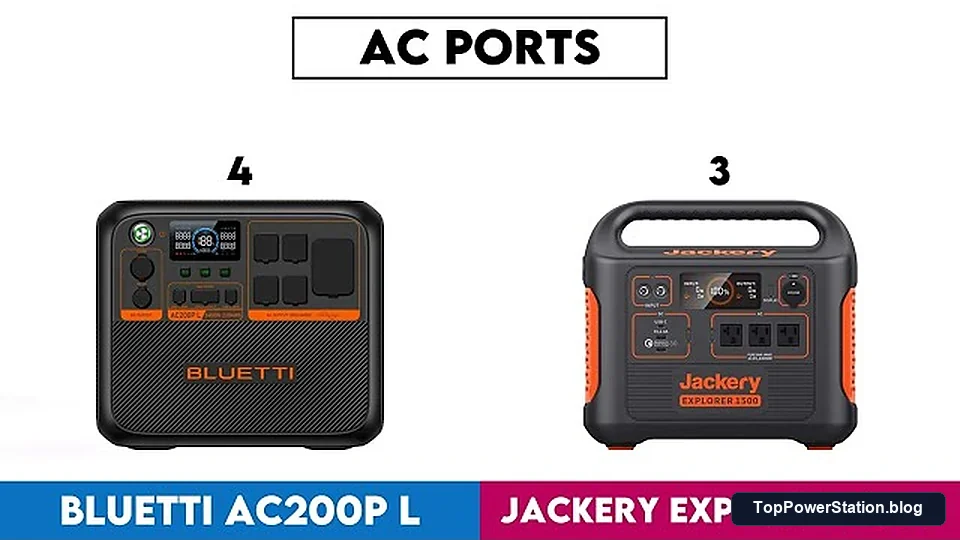
Conversely, the Jackery competitor opts for a more streamlined enclosure. This approach reduces overall system weight while maintaining rugged impact resistance for outdoor field deployments.
The Bluetti AC200P utilizes a robust modular inverter architecture, and you can pair it with units from our best solar panels for bluetti ac200p roundup for rapid off-grid recharging capabilities.
Internal thermal management differs significantly between these units, with Bluetti employing dual cooling fans to dissipate sustained high-wattage loads compared to Jackery's single variable-speed fan designed for quieter operation.
- Chassis material composition and impact resistance
- Internal thermal management layout and cooling fan placement
- Handler ergonomics and weight distribution profiles
Inverter Architecture and Output Topology
Pure sine wave inverters power sensitive electronics safely without signal degradation. The Bluetti system delivers 2000 watts of continuous power to handle demanding household appliances simultaneously.
Meanwhile, the Jackery alternative outputs 1800 watts continuously, which remains adequate for most standard camping gear, medical devices, and mobile computing workstations.
- Continuous and surge wattage thresholds
- Total harmonic distortion metrics for sensitive loads
Real-World Performance and Capacity Comparison
Field evaluations test actual watt-hour delivery under diverse environmental conditions and loads. Users experience varying runtime efficiencies due to internal conversion losses and ambient operating temperatures.
The 2000Wh capacity of the Bluetti unit sustains heavy tools longer. Meanwhile, the Jackery model provides an agile 1534Wh capacity tailored for mobile adventurers.
Delivering a massive 2000W continuous output with a 4800W surge, the Bluetti easily manages high-draw appliances like full-sized refrigerators, whereas the Jackery delivers 1800W continuous output suited for lighter recreational duty cycles.
Usable capacity favors the Bluetti's 1772Wh LiFePO4 chemistry over alternatives highlighted in our best jackery for camping guide, translating directly to extended runtime hours during prolonged grid outages or off-grid excursions.
- Usable watt-hour capacity under heavy loads
- Voltage sag behavior during peak compressor startup
- Inverter conversion efficiency percentages
Handling Inductive and Resistive Loads
Running motor-driven appliances requires robust surge handling capabilities from the internal inverter. Both units manage refrigerators successfully, but thermal throttling occurs differently under maximum stress.
Monitoring your connected device draws prevents unexpected shutdowns during critical off-grid tasks. Proper load balancing ensures steady operation across multiple active AC outlets.
- Compressor startup surge management
- Resistive heating element performance metrics
Battery Chemistry, Longevity, and Safety Standards
Internal battery chemistry dictates both total lifespan and daily safety margins. Bluetti utilizes LiFePO4 chemistry, offering thousands of charge cycles before degradation drops capacity significantly.
Jackery implements traditional lithium-ion nickel manganese cobalt cells. While lighter, this chemistry offers fewer total cycles, requiring more conscious management over the operational lifetime.
Bluetti integrates LiFePO4 battery cells rated for over 3500 cycles to 80 percent capacity, vastly outlasting the Jackery's lithium-ion NMC cells which typically achieve approximately 500 cycles before reaching similar degradation thresholds.
Safety certifications include comprehensive Battery Management System protections guarding against short circuits, over-voltage, and thermal runaway, complying with rigorous UL and FCC standards for safe residential and outdoor deployment.
- Nominal cycle life before capacity degradation
- Thermal runaway prevention mechanisms
- Battery management system protection thresholds
BMS Protections and Thermal Regulation
Advanced battery management systems protect against short circuits, overcharging, and extreme temperatures. These safeguards operate continuously to preserve cell health across varied operational scenarios.
Integrating multi-point thermal sensors prevents localized hotspots during rapid charging phases. Such engineering measures ensure safe deployment in demanding outdoor environments.
- Short circuit and overcurrent response times
- Active temperature regulation protocols
Charging Inputs and Solar Array Integration
Replenishment speed remains vital for extended off-grid expeditions and emergency preparedness scenarios. The Bluetti accepts high solar voltage inputs, accelerating total array recharging times significantly.
The Jackery competitor relies on regulated DC inputs requiring specific panel matching. Understanding these electrical boundaries protects internal charge controllers from accidental overvoltage damage.
Solar recharging capabilities highlight distinct hardware limitations, as the Bluetti accepts up to 700W of solar input via advanced MPPT controllers, significantly outpacing the Jackery's capped 800W input utilizing dual adapter cables.
Voltage thresholds also vary; Bluetti accommodates an open circuit voltage range up to 150V max, allowing complex serial-parallel array configurations, while Jackery restricts DC input to lower voltage thresholds using proprietary connectors.
- Maximum solar input wattage ratings
- MPPT charge controller voltage ranges
- AC wall charging adapter speeds
Wall Outlet and Car Charging Speeds
Standard AC wall charging provides convenient top-offs before heading out, similar to the setup detailed in our jackery explorer 1000 v2 review covering everyday power station performance metrics.
Vehicle auxiliary port charging offers slow but steady replenishment during long transit drives between remote campsites and urban supply hubs.
- AC brick temperature during rapid charging
- Car port fuse protection standards
Ergonomics, Physical Dimensions, and Portability
Transporting heavy power stations demands careful attention to handle placement and weight distribution. The Bluetti features dual flush handles, though its heavier footprint requires deliberate lifting posture.
Jackery utilizes folding top handles that save vertical storage space inside cramped vehicle trunks. This design choice enhances maneuverability during rapid campsite setups.
Physical dimensions present notable tradeoffs regarding site mobility, with the Bluetti weighing a heavy 60.6 pounds housed in a rugged plastic chassis featuring fixed dual-molded side lifting handles for two-person carries.
Conversely, the Jackery prioritizes transport efficiency, tipping the scales at a manageable 35.2 pounds with a single fold-down top handle, making it vastly superior for solo travelers and frequent weekend campers.
- Total unit weight and physical dimensions
- Handle durability and grip ergonomics
- Vehicle trunk storage footprint efficiency
Interface Layout and Display Usability
Clear user interfaces display essential voltage, wattage, and battery status metrics instantly. Bluetti incorporates a large touchscreen, whereas Jackery relies on a crisp LCD screen.
Dedicated button activation for specific port groups prevents accidental battery drain and simplifies troubleshooting during nighttime emergency operations.
- Screen readability in direct sunlight
- Port grouping and dust cover durability
Maintenance, Efficiency, and Longevity
Routine upkeep extends equipment operational lifespan and safeguards your financial investment. Keep ventilation ports free from dust accumulation to maintain optimal cooling fan performance.
Store the units in temperature-controlled environments when inactive for extended periods to preserve internal cell health and prevent parasitic battery discharge.
Long-term maintenance requires monitoring firmware updates and maintaining storage charges around 50 percent capacity when idle for months, preventing internal cell degradation and preserving inverter conversion efficiency over seasonal storage cycles.
Inverter idle draw is another critical factor; both systems consume minor standby power, but proper ventilation clearance and dust-free environments are mandatory to ensure optimal heat dissipation and prevent premature cooling fan failure.
- Ventilation cleaning and dust mitigation
- Long-term storage charge retention rules
- Firmware update procedures and support
Optimizing Operational Efficiency
Minimizing idle power draw prevents unnecessary energy loss during prolonged camping trips. Turning off unused DC and USB sections preserves vital watt-hours.
Utilizing eco-modes helps throttle inactive inverter circuits, maximizing overall system efficiency when powering very small continuous loads.
- Idle power consumption metrics
- Eco-mode threshold settings
Selecting the Ideal System for Your Setup
Choosing between these two generators depends strictly on your intended use cases. Off-grid homesteaders benefit from the robust Bluetti capacity and longevity.
Weekend campers and road trippers will appreciate the lighter Jackery footprint and straightforward operational controls for powering basic recreational electronics.
Choosing the correct station depends entirely on your power demands, as detailed in our best jackery power station breakdown, favoring Bluetti units for heavy emergency backup or stationary van builds.
Select the Jackery if your primary use case demands lightweight portability and straightforward setup for weekend camping trips where moderate appliance loads and easier solo transport outweigh extreme battery longevity metrics.
- Off-grid cabin and homestead suitability
- Recreational camping and road trip utility
- Emergency home backup preparedness value
Final Decision Framework for Buyers
Review your daily wattage requirements before purchasing any heavy-duty power station. Ensuring adequate inverter headroom prevents overloads during peak appliance usage.
Match your solar panel availability to the chosen unit input specifications for a seamless renewable energy experience.
- Wattage audit checklist for appliances
- Solar array compatibility verification
Frequently Asked Questions
Can both power stations run a full-size residential refrigerator?
Yes, both units successfully power standard refrigerators. The Bluetti AC200P offers greater surge headroom for heavy compressor motors.
How long do these batteries last over time?
The Bluetti uses LiFePO4 cells rated for over 3500 cycles. The Jackery relies on NMC chemistry with standard lifecycle ratings.
Are these generators safe to use inside an enclosed tent?
Neither unit emits toxic exhaust fumes like gas generators. However, adequate ventilation prevents heat buildup during heavy inverter usage.
Can I charge these stations using third-party solar panels?
Yes, provided you match the open-circuit voltage and amperage limits. Exceeding these input boundaries risks permanent internal damage.
Which model is easier to transport for weekend camping trips?
The Jackery 1500 is significantly lighter and more compact. This makes it easier to load into cramped vehicle trunks.