AC Coupling vs DC Coupling: Portable Power Architecture
Choosing between AC and DC coupling architectures defines how efficiently your portable power station manages solar input. Understanding internal power conversion stages ensures you maximize usable watt-hours.

Choose AC coupling for retrofitting existing microinverter arrays and straightforward household expansions. Select DC coupling for maximum round-trip efficiency when building dedicated off-grid solar generator kits.
Compare all top models in our Best Portable Power Station: Top Picks for 2026.
Side-by-Side Breakdown
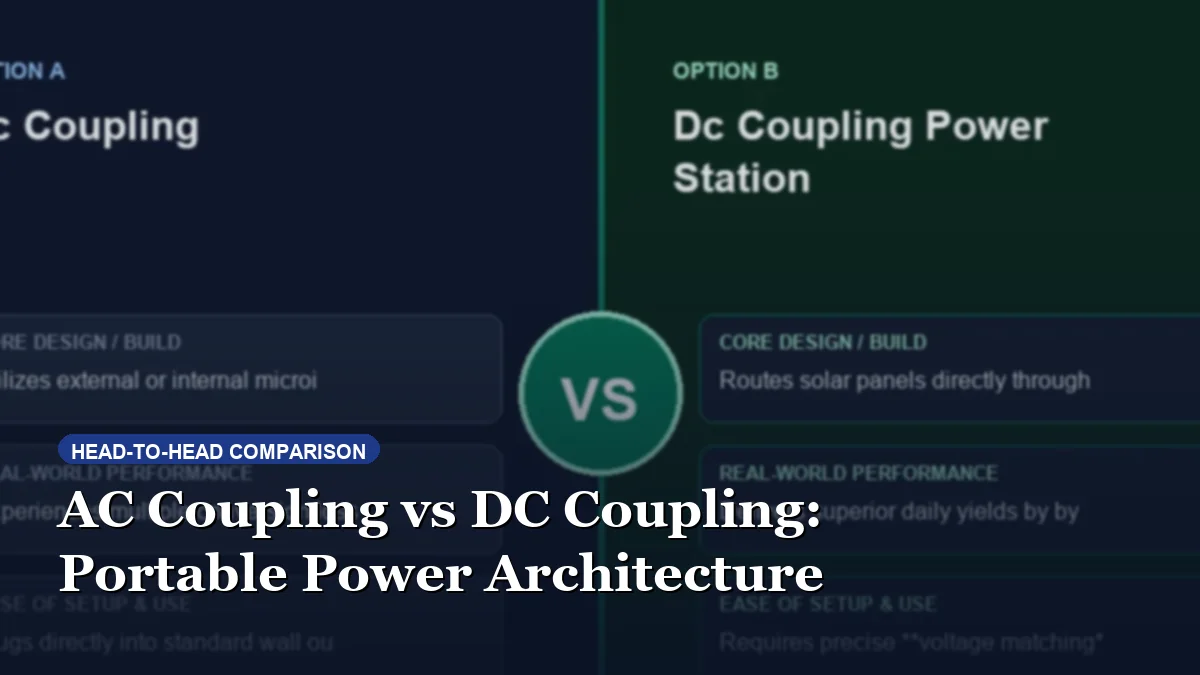
| Criteria | Ac Coupling | Dc Coupling Power Station | Edge |
|---|---|---|---|
| Core Design / Build | Utilizes external or internal microinverters converting DC to AC before storage ingestion. | Routes solar panels directly through a DC-to-DC charge controller straight to the battery pack. | Dc Coupling Power Station |
| Real-World Performance | Experiences multiple conversion losses due to dual inversion steps during generation. | Delivers superior daily yields by bypassing unnecessary alternating current conversion stages. | Dc Coupling Power Station |
| Ease of Setup & Use | Plugs directly into standard wall outlets or existing residential microinverter outputs. | Requires precise voltage matching and specialized wiring harnesses for safe operation. | Ac Coupling |
| Durability & Reliability | Complex inverter components introduce additional failure points under harsh thermal loads. | Simplified solid-state architecture improves long-term reliability and thermal management. | Dc Coupling Power Station |
| Efficiency / Operating Footprint | Typically achieves eighty to eighty-five percent round-trip efficiency under peak loads. | Frequently exceeds ninety percent efficiency by eliminating redundant conversion overhead. | Dc Coupling Power Station |
| Maintenance Requirements | Demands periodic firmware updates and monitoring of separate inverter hardware units. | Requires minimal upkeep centered primarily on terminal inspections and cable integrity checks. | Dc Coupling Power Station |
| Best Ideal Use Case | Grid-tied emergency backup integration and seamless whole-home expansion setups. | Dedicated mobile off-grid living, overlanding rigs, and remote cabin solar arrays. | Dc Coupling Power Station |
Core Design and Engineering Differences
Power architecture determines how renewable energy transitions from raw photon capture into chemical storage inside modern lithium chemistry cells. Engineers must balance conversion complexity against overall system reliability metrics.
AC coupling systems route photovoltaic current through grid-tied microinverters or string inverters first. This creates standard household alternating current before a secondary rectification step feeds the battery bank.
Conversely, DC coupling architectures bypass traditional inversion steps completely during the initial solar harvesting phase. Raw panel voltage enters an optimized MPPT charge controller regulating direct current flow.
When comparing models within the best portable power station category, AC coupling systems integrate standard string inverters to convert photovoltaic direct current before routing power safely into internal AC charging ports.
Conversely, DC coupling routes solar panel output straight through a maximum power point tracking charge controller, transforming voltage levels to match the internal battery pack architecture without unnecessary inversions.
Understanding these fundamental electrical blueprints helps technicians evaluate how power loss occurs during energy transfer, as bypassing secondary conversion stages inherently preserves more usable electricity for heavy field loads.
- AC systems require dual conversion stages for storage ingestion.
- DC systems utilize high-efficiency DC-to-DC step-down buck converters.
- Inverter placement dictates thermal dissipation footprints across the chassis.
Inverter Topology and Conversion Stages
Every conversion step introduces measurable thermal loss and parasitic power draw across the entire electronic circuit board. Minimizing these transformations preserves precious watt-hours during low-light conditions.
AC setups suffer from double-conversion penalties when storing solar energy for later night use.
- First conversion turns DC to AC at the panel level.
- Second conversion rectifies AC back to DC inside the power station.
Real-World Performance Comparison
Laboratory metrics often paint an overly optimistic picture of daily power station yields under erratic field conditions. Field performance depends heavily on ambient temperature swings and shading on panels.
AC coupled portable stations excel at integrating with existing household solar arrays without invasive rewiring. You simply plug the generation source into an AC input port.
DC coupled units deliver superior real-world watt-hour recovery because they avoid unnecessary inversion cycles. Users notice tangible runtime improvements when powering sensitive 12V DC loads directly.
During peak sunlight hours, DC-coupled power stations often deliver superior daily energy yields because they eliminate the double conversion penalty associated with traditional grid-tied microinverters.
Conversely, units featured in our best portable power station for camping guide often utilize AC-coupled setups to simplify retrofitting standard wall outlets and deliver reliable off-grid energy.
Voltage matching constraints can limit rapid expansion in DC configurations, whereas AC architectures accommodate distributed panel layouts across large camp properties without risking overvoltage faults.
- AC units handle complex multi-panel array configurations with varied orientations.
- DC units maximize solar yield during high-irradiance midday operating windows.
- Thermal throttling occurs faster when multiple internal inverters operate simultaneously.
Handling Variable Solar Input Loads
Passing clouds and intermittent shade challenge both architectural layouts differently during standard operational cycles. Quick response times protect internal lithium cells from damaging voltage spikes.
Advanced MPPT algorithms inside DC systems track maximum power points with minimal latency.
- Fast tracking prevents energy harvesting stagnation during passing weather.
- Stable voltage regulation protects sensitive downstream inverter components.
Maintenance, Efficiency, and Longevity
Long-term ownership costs are directly tied to thermal stress management and component count within the chassis. Fewer active conversion components generally translate to extended operational lifespans.
Efficiency ratings vary significantly between the two distinct system designs during heavy continuous loads. AC configurations lose valuable energy as waste heat during the secondary rectification process.
Maintaining optimal operating temperatures requires robust internal airflow management and strategic heatsink placement.
Thermal management differs significantly between these two architectures, with DC charge controllers typically generating localized heat that requires robust heatsink integration inside rugged portable enclosures.
Overall round-trip efficiency ratings typically favor DC configurations by three to seven percent, directly reducing cumulative component stress and extending the operating lifespan of sensitive lithium chemistry cells.
Maintenance routines for AC-coupled generators focus primarily on inverter firmware updates and connection terminal torque checks, whereas DC systems require careful monitoring of fuse block integrity.
- Lower component counts reduce long-term electronic failure rates significantly.
- Waste heat management dictates cooling fan duty cycles under load.
- Capacitor degradation accelerates when subjected to continuous high-temperature inversion.
Thermal Management and Component Lifespan
Thermal management remains crucial even when selecting an option from a typical best budget power station roundup, as efficient cooling protects sensitive semiconductor gates during heavy electrical loads.
Passive aluminum extrusions work alongside variable-speed fans to expel internal thermal buildup.
- Thermal sensors monitor critical junction temperatures across power boards.
- Automatic current derating prevents catastrophic thermal runaway events.
Which Option Fits Your Setup
Selecting the ideal model from any best portable power station for home backup lineup requires careful evaluation of your specific installation environment and continuous power grid demands.
Homeowners with existing rooftop solar arrays find AC coupling vastly simplifies installation procedures. You avoid modifying high-voltage DC string wiring runs across your roof structure.
Off-road enthusiasts and mobile remote workers benefit immensely from dedicated DC coupling efficiencies. Every harvested watt counts when operating away from traditional utility grid infrastructure.
Selecting the appropriate coupling methodology depends heavily on your existing hardware ecosystem and whether you plan to build a completely off-grid mobile solar trailer or an emergency backup system.
If you already own rigid residential panels with string inverters, an AC-coupled portable generator offers seamless plug-and-play integration without requiring specialized low-voltage DC cabling.
Mobile users prioritizing maximum energy harvest from portable panels should lean toward DC configurations to maximize efficiency under challenging, partially shaded field conditions.
- Assess your existing power generation equipment before making a final purchase.
- Consider portability requirements and total system weight constraints carefully.
- Evaluate whether your primary loads run on alternating or direct current.
Tailoring Architecture to Specific Use Cases
Matching your power station topology to your daily energy habits guarantees maximum satisfaction and utility. Overbuilding an AC system for a simple mobile kit introduces unnecessary weight.
Prioritize modularity if you plan on scaling your renewable energy capacity over time.
- Mobile kits demand lightweight, highly integrated DC solar inputs.
- Home backup solutions require robust AC pass-through capabilities.
Installation Complexity and Safety Standards
Working with electrical systems demands strict adherence to recognized safety codes and proper grounding protocols. Understanding the voltage thresholds of your chosen architecture prevents dangerous installation mistakes.
AC coupling leverages familiar household plug standards, reducing the risk of wiring errors for novices. However, managing high-voltage AC lines still requires caution and respect for electricity.
DC coupling involves managing variable amperage and open-circuit voltages from unshielded solar panels safely. Proper fuse placement and correct wire gauge selection are mandatory requirements.
Installing AC-coupled backup power solutions generally involves standard household wiring practices, requiring compliance with local electrical codes and proper ground fault protection protocols.
DC installations demand rigorous attention to wire gauge sizing to mitigate severe voltage drop over distance, alongside strict adherence to National Electrical Code regulations for photovoltaic circuits.
Safety disconnects must be strategically positioned within easy reach to isolate high-amperage direct current hazards before performing routine servicing on portable power station expansion ports.
- Always disconnect solar inputs before servicing internal battery terminals.
- Verify maximum open-circuit voltage ratings before connecting panels.
- Use appropriate circuit breakers to protect against unexpected electrical shorts.
Compliance and Wiring Best Practices
Adhering to local electrical codes ensures your portable power station setup remains safe and legal. Professional installation guidelines help prevent fire hazards in residential backup applications.
Proper cable management minimizes voltage drop across long outdoor panel runs.
- Choose weather-resistant connectors for all outdoor solar panel wiring.
- Ground all metallic frames to prevent hazardous stray voltage accumulation.
Cost Analysis and Value Proposition
Evaluating the financial investment of a power station involves looking beyond the initial purchase sticker price. Long-term efficiency gains and component durability dictate true ownership value over time.
AC coupled systems often utilize mass-produced inverter components, which can lower upfront hardware acquisition costs. Maintenance expenses might be higher if separate external microinverters fail.
DC coupling setups require specialized charge controllers and matching panels, potentially increasing initial component sourcing complexity. The ongoing savings in harvested solar energy offset initial expenses.
Initial hardware expenditures for DC-coupled mobile power kits often appear lower due to the omission of dedicated grid-syncing microinverters, lowering the barrier to entry for DIY enthusiasts.
However, specialized high-gauge DC wiring harnesses and external charge controllers can offset those savings, requiring a comprehensive evaluation of total system integration costs.
Evaluating the long-term value proposition requires weighing continuous efficiency gains against the flexibility of utilizing standard AC extension cords for distributed power distribution.
- Factor in potential wiring upgrades when calculating total project expenses.
- Weigh efficiency losses against daily power generation requirements.
- Consider warranty coverage lengths when assessing long-term reliability value.
Maximizing Return on Investment
Optimizing your energy harvesting chain ensures you recover your investment through reliable daily performance. Avoid bottlenecks that restrict your solar array output during peak sunlight hours.
Regular monitoring helps identify efficiency drops before they impact system longevity.
- Track daily watt-hour yields using companion mobile applications.
- Clean solar panels regularly to maintain peak conversion efficiency.
Future Trends in Portable Power Architecture
The portable power station industry continues evolving rapidly through advances in semiconductor materials and battery chemistry. Manufacturers are finding innovative ways to bridge the gap between AC and DC systems.
Hybrid architecture designs are emerging, offering bidirectional inverters that seamlessly handle both coupling methods simultaneously. These versatile units adapt automatically to changing field connectivity requirements.
Smart energy management software now optimizes charging schedules based on weather forecasts and local utility rates. This intelligent automation maximizes financial savings and emergency preparedness readiness.
Emerging semiconductor materials like gallium nitride are revolutionizing power conversion stages, promising significantly smaller footprint inverters for next-generation AC coupling systems.
Bi-directional charging protocols and advanced smart energy management software are simultaneously blurring the traditional performance boundaries that currently separate complex AC and DC coupling topologies.
Manufacturers are increasingly designing hybrid input ports that intelligently auto-detect voltage inputs, offering consumers unprecedented versatility across diverse renewable energy configurations.
- Gallide-on-silicon semiconductors reduce thermal losses inside modern inverter stages.
- Firmware updates continuously improve MPPT tracking algorithms for better yields.
- Modular battery expansion ports simplify future capacity upgrades considerably.
The Rise of Hybrid Coupling Solutions
Hybrid power stations eliminate the difficult choice between AC and DC configurations by supporting both natively. Users enjoy ultimate flexibility when connecting diverse solar arrays and emergency sources.
Advanced microcontrollers route power through the most efficient internal pathway automatically.
- Dual input ports accommodate legacy AC microinverters and direct DC panels.
- Smart switching reduces overall conversion wear across internal components.
Frequently Asked Questions
What is the primary difference between AC and DC coupling?
AC coupling converts solar generation to alternating current before storage ingestion, whereas DC coupling routes panels directly through a charge controller into the battery pack.
Which coupling method offers higher daily energy efficiency?
DC coupling consistently delivers superior round-trip efficiency by completely eliminating redundant conversion stages. This architectural advantage maximizes your daily solar yields significantly.
Can I connect my existing rooftop solar panels to a DC coupled station?
Connecting existing microinverter arrays usually requires an AC coupled portable power station setup. DC systems need unmanaged direct current strings matching precise voltage thresholds.
Which system type is better for mobile overlanding and remote camping?
DC coupling is vastly superior for mobile setups due to its lightweight design and reduced thermal footprint. It optimizes power delivery for standard direct current loads.
Do AC coupled power stations experience more component failures over time?
AC units incorporate complex internal and external inversion hardware that introduces additional thermal stress points. This increased complexity can elevate long-term maintenance requirements compared to simpler DC designs.